
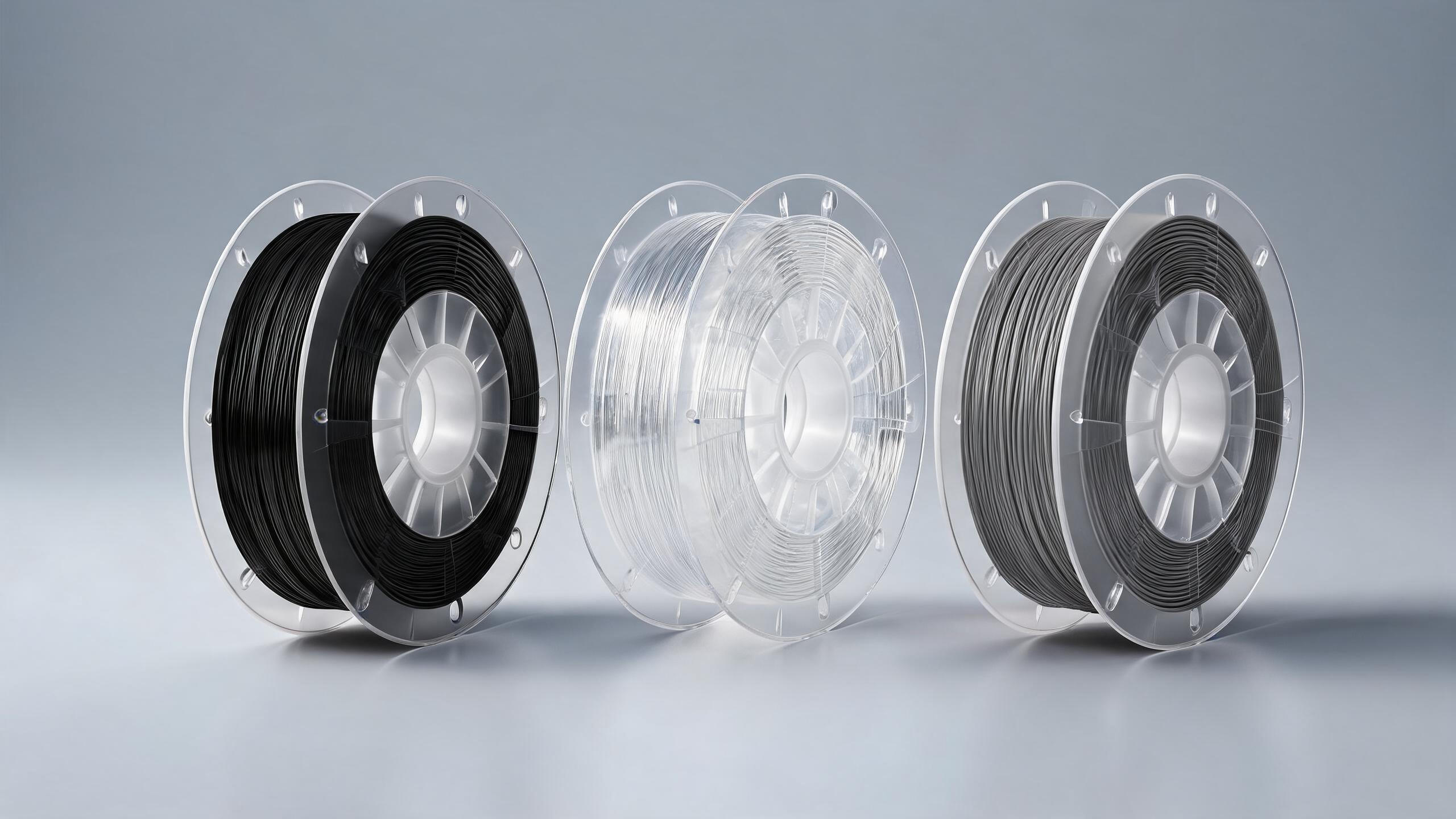
A practical B2B guide comparing PLA, PETG, ABS, and TPU 3D printing filament across mechanical properties, print difficulty, thermal resistance, and compliance - with a selection framework for matching materials to real applications.
BUYER GUIDE
Why Material Selection Is the First Decision That Matters
If you are sourcing 3D printing filament for resale, distribution, or in-house production, the first question your customers or engineers will ask is not "what brand?" or "what price?" - it is "what material?" A filament that prints beautifully on a demo bench but warps on the factory floor, or a spool that looks great but fails food-contact compliance, turns into returns, complaints, and eroded margins. Material choice drives print performance, end-use suitability, regulatory compliance, and ultimately how confident your buyers feel reordering.
This guide compares the four most commonly sourced FDM filament types - PLA, PETG, ABS, and TPU - across the criteria that B2B buyers actually evaluate: mechanical properties, print difficulty, thermal resistance, regulatory compliance, and cost-efficiency at scale. Whether you are building a product catalogue for European distributors or stocking a Southeast Asian retail chain, the framework below helps you match filament types to real applications - and avoid the costly mismatch between marketing claims and field performance.
Key takeaways from this guide:
- PLA wins on ease of printing and visual finish - ideal for prototypes, display models, and decorative parts.
- PETG bridges the gap between PLA's ease and ABS's toughness, with food-contact compliance for packaging applications.
- ABS remains the choice for functional, heat-resistant parts - but demands controlled print environments.
- TPU serves flexible, wear-resistant applications where rigid filaments simply cannot perform.
- Batch consistency and diameter tolerance matter as much as material chemistry - evaluate suppliers on QC data, not just spec sheets.
In this guide:
- 1. PLA: The Reliable Workhorse for Prototyping and Visual Prints
- 2. PETG: The Versatile Middle Ground
- 3. ABS: Heat Resistance for Functional Parts
- 4. TPU 95A: Flexibility Where Rigidity Fails
- 5. Side-by-Side Material Comparison
- 6. Selection Framework: Matching Material to Application
- 7. What to Evaluate in a Filament Supplier Beyond Material Type
- 8. Frequently Asked Questions
1. PLA: The Reliable Workhorse for Prototyping and Visual Prints
PLA (Polylactic Acid) is the most widely used FDM filament - and for good reason. It prints at low temperatures (190–220 °C), requires no heated enclosure, and adheres reliably to glass or PEI build surfaces. For B2B buyers stocking filament for schools, maker spaces, design studios, or retail consumers, PLA is the lowest-risk entry point: minimal printer requirements, minimal post-processing, and consistently good visual results.
From a sourcing perspective, PLA's strengths and limitations are well-defined:
- Printability: Excellent. Low warp, no enclosure needed, wide temperature tolerance. Suitable for entry-level and industrial printers alike.
- Mechanical properties: Rigid but brittle. Tensile strength is adequate for prototypes and display models, but PLA parts crack under impact and deform above 55–60 °C. Not suitable for functional parts exposed to heat or mechanical stress.
- Surface finish: Depends on formulation. Standard PLA prints matte; silk-blend formulations like PLA Silk Rainbow deliver a high-gloss surface that resembles injection-molded parts without post-processing.
- Compliance: CE and RoHS documentation is standard for export-grade PLA. Material declarations are available per shipment.
For buyers targeting decorative, educational, or display markets, PLA is the default choice. The PLA Matte Black 1.75mm with ±0.02 mm diameter tolerance is engineered for engineering prototyping where dimensional consistency matters; the PLA Silk Rainbow variant serves buyers who need multicolor visual appeal without dual-extrusion setups.
PLA's weakness is heat. If the printed part will sit in a car, near machinery, or in direct sunlight, PLA is the wrong material - regardless of how well it prints.
2. PETG: The Versatile Middle Ground
PETG (Glycol-modified PET) has become the fastest-growing filament category for B2B buyers who need more than PLA can offer but find ABS too demanding. It combines PLA's ease of printing with impact resistance that approaches ABS, plus a critical advantage for packaging and food-related applications: compliance with food-contact regulations.
What makes PETG attractive for sourcing decisions:
- Impact strength: Approximately three times tougher than standard PLA (Izod impact ~7.5 kJ/m²). Parts survive drops and handling without cracking.
- Thermal stability: Better than PLA, though not in ABS territory. Suitable for parts exposed to moderate ambient temperatures.
- Optical clarity: Transparent grades like PETG Clear Filament 1.75mm achieve 92% light transmission at 3 mm wall thickness - useful for packaging prototypes where internal geometry visibility matters.
- Food-contact compliance: Formulations complying with EU Regulation 10/2011 and FDA 21 CFR 177.1630 are available with per-batch documentation. This is a decisive factor for buyers supplying the food packaging or kitchenware sector.
- Print conditions: 230–250 °C nozzle, 70–80 °C bed. No heated enclosure required for most parts. Low shrinkage (below 0.3%) means dimensional stability on larger prints.
For European importers, PETG's food-contact documentation is often the deciding factor. For Southeast Asian manufacturers, its combination of toughness and printability makes it a strong candidate for functional prototypes that need to survive handling and shipping. The PETG Clear Filament in our catalogue is formulated with ±0.02 mm tolerance and ships with material compliance declarations referencing EU 10/2011 and FDA standards.
3. ABS: Heat Resistance for Functional Parts
ABS (Acrylonitrile Butadiene Styrene) remains the material of choice when the printed part must perform in real-world conditions - near heat sources, under mechanical load, or in environments where dimensional stability at elevated temperatures is non-negotiable. For buyers supplying industrial jigs, fixture templates, electronic enclosures, and automotive interior prototypes, no other common FDM filament matches ABS's combination of heat resistance and impact toughness.
Key characteristics for sourcing evaluation:
- Heat deflection temperature: Above 95 °C (at 0.45 MPa) for impact-grade formulations like ABS High-Impact Grey 1.75mm. Parts maintain geometry near motors, control panels, and sun-exposed surfaces.
- Tensile strength: ~42 MPa - suitable for load-bearing jigs and fixtures in production environments.
- Post-processing: Acetone vapor polishing produces smooth, sealed surfaces in minutes. This is a unique advantage for enclosures and customer-facing parts that need a finished appearance.
- Print requirements: 230–260 °C nozzle, 90–110 °C bed. An enclosure is recommended for parts over 200 mm to prevent draft-induced warping. This means ABS demands more capable printer hardware than PLA or PETG.
- Regulatory: CE compliant with material declaration. Suitable for European buyers who need documented material consistency.
The trade-off with ABS is print difficulty. Warping, corner lifting, and fume emission during printing require controlled environments - typically an enclosed printer with ventilation. For buyers whose end-users are hobbyists or schools, ABS may create support burden. For industrial buyers with enclosed production printers, ABS delivers functional parts that PLA and PETG cannot match.
4. TPU 95A: Flexibility Where Rigidity Fails
TPU (Thermoplastic Polyurethane) at Shore 95A hardness fills a gap that rigid filaments cannot address: parts that must bend, compress, absorb impact, and return to shape. For buyers supplying wearable device components, industrial gaskets, phone case prototypes, and protective covers, TPU is not an alternative to PLA or ABS - it is the only material that works.
Sourcing considerations for TPU:
- Hardness: Shore 95A - firm enough to hold shape, flexible enough to bend and compress. Think shoe sole firmness.
- Abrasion resistance: Superior to all rigid filaments. Parts withstand repeated rubbing and contact wear without surface degradation.
- Print conditions: 210–230 °C, low bed temperature (40–60 °C). Direct-drive extruders are preferred; Bowden setups require slower print speeds.
- Diameter tolerance: Critical for flexible materials. Variance causes under-extrusion and layer gaps. The TPU 95A Flexible Filament in our catalogue holds ±0.03 mm to minimize these issues.
- Compliance: REACH and RoHS compliant. Suitable for consumer goods sold in European markets.
TPU is typically a secondary SKU in a filament catalogue - not a volume driver like PLA, but essential for buyers who need to offer a complete material range. Distributors serving manufacturing clients should include at least one TPU grade to cover gasket, seal, and wearable applications.
5. Side-by-Side Material Comparison
The table below summarizes the four material types across the criteria most relevant to B2B sourcing decisions. All data reflects the filament grades in our production catalogue.
| Property | PLA | PETG | ABS | TPU 95A |
|---|---|---|---|---|
| Print Temperature | 190–220 °C | 230–250 °C | 230–260 °C | 210–230 °C |
| Bed Temperature | 50–65 °C | 70–80 °C | 90–110 °C | 40–60 °C |
| Heated Enclosure | Not required | Not required | Recommended (parts >200 mm) | Not required |
| Heat Deflection | ~55–60 °C | ~70–80 °C | > 95 °C | N/A (flexible) |
| Tensile Strength | ~37 MPa | ~50 MPa | ~42 MPa | ~26 MPa |
| Impact Resistance | Low (brittle) | High (~7.5 kJ/m²) | High | Very high (flexible) |
| Warping | Minimal | Low | Moderate to high | Minimal |
| Diameter Tolerance | ±0.02–0.03 mm | ±0.02 mm | ±0.05 mm | ±0.03 mm |
| Surface Finish | Matte or silk gloss | Glossy, transparent | Matte, acetone-smoothable | Matte, flexible |
| Key Compliance | CE, RoHS | EU 10/2011, FDA 177.1630 | CE, material declaration | REACH, RoHS |
| Best For | Prototypes, display, education | Functional prototypes, food-contact, packaging | Industrial jigs, enclosures, heat-exposed parts | Gaskets, wearables, protective covers |
6. Selection Framework: Matching Material to Application
Instead of choosing a material first and finding applications for it, work backwards from the end-use scenario. The decision framework below covers the most common B2B procurement paths:
Scenario A: Educational supplies and maker-space stocking
-> Choose PLA. Low printer requirements, minimal failure rates, broad color range. The PLA Silk Rainbow adds visual differentiation for retail display.
Scenario B: Packaging prototypes and food-contact components
-> Choose PETG. Food-contact compliance (EU 10/2011, FDA 177.1630), impact resistance for handling, optical clarity for internal geometry inspection. The PETG Clear Filament is purpose-built for this path.
Scenario C: Industrial jigs, fixtures, and electronic enclosures
-> Choose ABS. Heat deflection above 95 °C, acetone-smoothable surface, tensile strength for load-bearing use. The ABS High-Impact Grey is engineered for production environments.
Scenario D: Flexible components - gaskets, seals, wearable housings
-> Choose TPU 95A. No rigid filament can substitute. The TPU 95A Flexible Filament covers this application with Shore 95A hardness and abrasion resistance.
Scenario E: Multi-material distribution catalogue
-> Stock all four. Distributors and resellers serving diverse customer bases benefit from offering a complete material range. A typical starter assortment: PLA (matte + silk variants) as the volume driver, PETG for functional and food-contact applications, ABS for industrial clients, and TPU as a specialty SKU. This approach captures demand across education, prototyping, manufacturing, and consumer markets - and positions your catalogue as a one-stop source.
7. What to Evaluate in a Filament Supplier Beyond Material Type
Material chemistry is only half the equation. The other half - and often the more expensive half to get wrong - is batch-to-batch consistency. A filament that prints perfectly on the first spool and jams on the fiftieth destroys production schedules and customer trust. When evaluating suppliers, look beyond the material grade and ask for evidence on these points:
Diameter tolerance and measurement method. Tolerance claims mean nothing without a measurement protocol. Ask how diameter is measured (laser micrometer at regular intervals is the industry standard) and what the acceptable range is across a full spool, not just a single point. Our PLA Matte Black, for example, holds ±0.02 mm measured at 40 points per meter - a specification that directly translates to fewer extrusion failures on long print runs.
Batch consistency and QC documentation. Request a Certificate of Analysis (COA) showing diameter, roundness, moisture content, and colorimetric values for each production batch. A supplier that cannot provide per-batch QC data is a supplier that does not measure - and you will inherit their inconsistency.
Moisture control and packaging. Filament absorbs moisture from the air, and humid climates in Southeast Asia accelerate this process. Vacuum-sealed packaging with desiccant is the minimum standard for export. For buyers in tropical regions, proper drying and storage protocols are essential to maintain print quality after the spool leaves the factory.
Compliance documentation. For European buyers, REACH and RoHS compliance is not optional. Ensure your supplier provides material declarations and can supply test reports on request. For food-contact applications, verify that the specific formulation - not just the material family - carries the relevant regulatory documentation.
Color consistency for branded lines. If you are building a private-label filament brand, color matching is critical. Our custom color masterbatch program ensures that each production run matches your Pantone reference, with sample plaque approval before mass production.
Export logistics and lead time reliability. MOQ, packaging configuration, container loading plans, and documentation accuracy all affect whether your shipment clears customs and reaches your warehouse on schedule. For buyers new to sourcing from China, our Southeast Asia buying guide covers the practical steps from sample approval to container loading.
8. Frequently Asked Questions
Can I use one filament type for all my customers' applications?
No single material covers all use cases. PLA cannot handle heat exposure, ABS is too difficult for entry-level users, PETG lacks the flexibility of TPU, and TPU cannot produce rigid parts. If your customer base spans multiple application types, stocking at least two material grades (typically PLA + PETG, or PLA + ABS) is the practical minimum.
What MOQ should I expect for export orders?
Standard MOQ is typically 200 spools per SKU for first orders, with reduced minimums (100 spools) for repeat orders. Full container loads (approximately 600 spools per 20-foot container) qualify for tiered pricing. For color masterbatch, MOQ is typically 2 metric tons. These figures vary by supplier - always confirm MOQ and pricing for your specific requirements.
How do I verify diameter tolerance claims?
Request the supplier's measurement protocol and a sample COA. The key questions: How many measurement points per meter? What instrument is used? What is the pass/fail criteria? A supplier that measures diameter at 40 points per meter with a laser micrometer and rejects spools outside tolerance is fundamentally different from one that checks a single point with calipers.
Which certifications matter for my target market?
For Europe: CE declaration, RoHS test report, and REACH compliance documentation. For food-contact applications: EU Regulation 10/2011 or FDA 21 CFR compliance. For Southeast Asia: CE documentation plus certificate of origin and packing list for customs clearance. Always verify that certifications apply to the specific formulation you are ordering, not just the material family.
How should I handle filament storage in tropical climates?
Vacuum-sealed packaging with desiccant protects filament during shipping, but once opened, spools absorb moisture rapidly in high-humidity environments. Active drying (using a filament dryer or oven at 40–50 °C for 4–6 hours) before printing is essential. Store opened spools in airtight containers with desiccant packs. See our detailed guide on filament drying and moisture control for tropical climates.
Can I mix different filament types in a single container order?
Yes. Mixed-SKU container loading is common for distributors building a multi-material catalogue. A typical 20-foot container can hold approximately 600 spools across multiple material types. Confirm packaging configurations (12 spools per carton is standard) and request a container loading plan from your supplier to optimize space and prevent damage during transit.
Next Steps: Request Samples and Build Your Filament Programme
Choosing the right material is the first step; choosing the right supplier is what determines whether your filament programme succeeds at scale. The framework above helps you match materials to applications - but the final decision should be based on real samples, real QC data, and real compliance documentation.
We manufacture PLA, PETG, ABS, and TPU filament at 1.75 mm diameter with strict tolerance control across 12 extrusion lines, and supply color masterbatch for custom branding programmes. Every shipment includes per-batch QC records, compliance documentation, and export packaging configured for your destination port.
Request a Sample or Bulk Quote
Tell us your target material, quantity, and delivery port. We respond within 24 hours with FOB pricing, lead time, and compliance documentation.
Request a Quote