
A buyer's guide to PLA filament properties — mechanical and thermal performance, print parameters, typical applications, PLA vs ABS vs PETG trade-offs, quality standards, and a supplier evaluation checklist for B2B sourcing.
BUYER GUIDE · PLA FILAMENT
If you are sourcing PLA filament in bulk, you are not buying a spool of plastic — you are buying a set of material properties that decide whether your customer's parts hold up, print cleanly, and come off the bed without rework. This guide walks through the PLA filament properties that matter for B2B buying decisions: mechanical and thermal performance, print parameters, where PLA fits versus ABS and PETG, how to judge quality, and what to check before you commit to a supplier.
What PLA filament is, and why it is a common FDM material
PLA (polylactic acid) is a thermoplastic made from renewable feedstock such as corn starch or sugarcane. In 3D printing it is one of the most widely used filaments because it prints at low temperature, warps very little, and needs no heated enclosure. For a factory or distributor stocking filament for a broad customer base, that combination means fewer failed prints and less operator skill required than with ABS or PETG.
At Wanzhoutong we extrude PLA on a 12-line facility with closed-loop diameter control. The practical effect of that control is what buyers actually feel: consistent extrusion, uniform wall width, and fewer failed long prints. We supply PLA in matte and silk finishes, and we can match custom colors from a Pantone reference.
Mechanical properties of PLA filament
PLA is a stiff, strong material at room temperature, but it is not the toughest. It resists bending and holds shape well, which is why it suits prototypes, housings, and display parts. The trade-off is low impact resistance — PLA parts can crack or shatter under a sharp impact rather than flexing like PETG or ABS.
For buyers comparing materials, the practical rule is simple:
- PLA — stiff and easy to print, but brittle and low heat resistance.
- PETG — tougher and more impact-resistant than PLA, still prints without an enclosure.
- ABS — higher heat resistance and impact strength, but needs a heated bed and often an enclosure.
If your application needs to survive handling, drop testing, or repeated impact, PLA is usually the wrong choice — that is where our PETG clear filament or ABS high-impact filament comes in.
Thermal properties: where PLA's limits show up
PLA's biggest weakness is heat. It softens at roughly 55–60 °C, so parts left in a hot car, near a motor, or in direct sunlight can deform. That is the single most common reason a PLA part fails in service — not the print itself, but the environment it sits in afterward.
On the print side, PLA's low shrinkage is an advantage. It prints at 190–220 °C nozzle and 50–65 °C bed, and most parts hold flat on PEI or glass at room temperature. No heated enclosure, no brim, no raft for most geometries. That keeps equipment cost and setup time down for buyers running batch production.
If your parts will see sustained heat above about 60 °C, plan on ABS or PETG instead. Our PLA vs PETG vs ABS vs TPU selection guide lays out the heat-resistance trade-offs side by side.
Print parameters that matter for PLA
For a buyer evaluating PLA filament, the numbers that matter are the ones that decide whether a spool prints reliably across a whole production run:
| Parameter | Typical value (Wanzhoutong PLA) |
|---|---|
| Diameter | 1.75 mm ± 0.02–0.03 mm |
| Roundness | ≥ 95% |
| Nozzle temperature | 190–220 °C |
| Bed temperature | 50–65 °C |
| Heated enclosure | Not required |
| Spool weight | 1 kg net |
Diameter tolerance is the number to watch. A filament that drifts outside its tolerance band causes extrusion gaps, under-extrusion, and inconsistent wall width — failures that show up as rework on long unattended prints. We hold ±0.02 mm on our matte black PLA, checked by laser micrometer at 40 points per meter, and ±0.03 mm on our silk rainbow PLA.
Typical applications for PLA filament
PLA is the right material when appearance, printability, and cost matter more than heat or impact resistance. Common uses we see from buyers:
- Customer-facing prototypes — presentation models and concept parts that need a clean finish straight off the bed.
- Display and exhibition models — architectural models, product replicas, trade-show samples.
- Decorative and gift items — where a silk or multicolor finish adds value without post-processing.
- Housing and enclosure samples — prototype electronics housings where a molded-looking finish matters for stakeholder review.
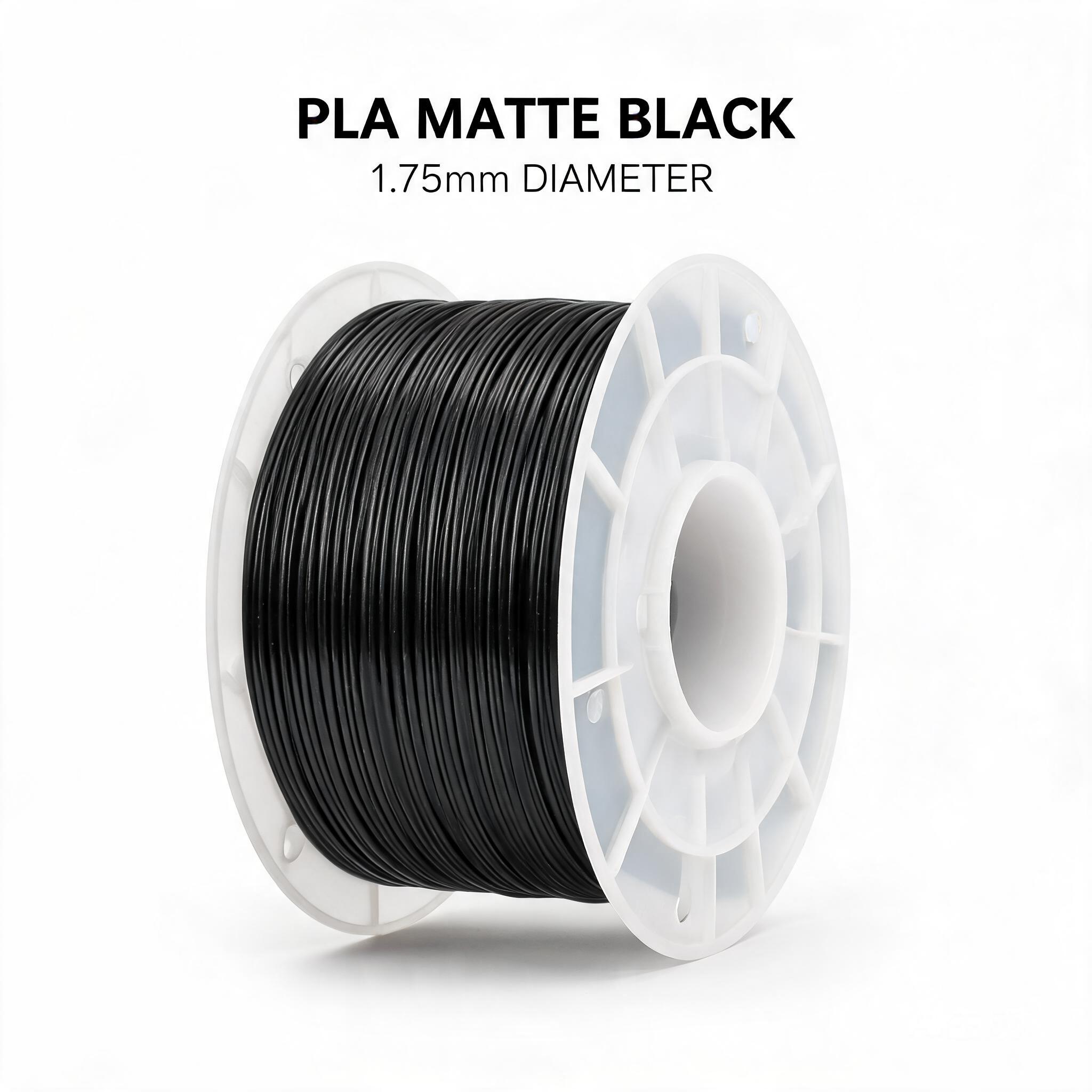
For decorative and display work, our PLA silk rainbow filament prints a multicolor gradient from a single spool. For prototypes and housings where glare and layer lines need to be minimized, PLA matte black filament scatters light instead of reflecting it.
PLA vs ABS vs PETG: a quick selection table
| Property | PLA | PETG | ABS |
|---|---|---|---|
| Print temperature | 190–220 °C | 230–250 °C | 230–260 °C |
| Bed temperature | 50–65 °C | 70–80 °C | 90–110 °C |
| Heated enclosure | Not required | Not required | Recommended for large parts |
| Heat resistance | Low (~55–60 °C) | Moderate | High (HDT > 95 °C) |
| Impact strength | Low (brittle) | High (7.5 kJ/m² Izod) | High (42 MPa tensile) |
| Ease of printing | Easiest | Easy | Harder |
There is no single "best" material — it depends on what the part has to survive. PLA is the easiest to print and the cheapest to run; PETG adds toughness; ABS adds heat resistance. The PETG and ABS figures above are from our published product specifications — see our PETG clear filament and ABS high-impact filament pages for the full spec sheets. For a full breakdown, see our material selection guide.
How to judge PLA filament quality before you buy
Not all PLA filament is the same, and the difference shows up in the print, not on the label. Here is what to check:
- Diameter tolerance — ask for the spec. We hold ±0.02 mm on our matte black PLA and ±0.03 mm on our silk rainbow PLA; wider bands cause extrusion problems.
- Roundness — an oval filament feeds unevenly. Look for ≥ 95% roundness.
- Winding — machine-wound spools with controlled tension avoid tangles that ruin overnight prints.
- Moisture — PLA absorbs moisture, and wet filament prints with stringing and bubbles. Spools should be vacuum-sealed with desiccant.
- Consistency across the spool — a good supplier checks diameter continuously, not just at the start and end.
Moisture is easy to overlook but costly. For storage and drying guidance in humid climates, our filament drying and moisture control guide covers the practical steps.
Supplier evaluation checklist for PLA filament
When you shortlist PLA filament suppliers, ask for evidence, not adjectives:
- Diameter control method — closed-loop laser micrometer on the line, or just a final check?
- Production capacity — how many extrusion lines, and can they hold your volume?
- Custom color matching — can they match a Pantone reference, and what is the minimum per color?
- Packaging for export — vacuum-sealed with desiccant, and carton/pallet loading for sea freight?
- Documentation — material declarations per shipment, and CE/RoHS/REACH reports on request.
- MOQ and lead time — what is the minimum order per SKU, and how long from payment to shipment?
At Wanzhoutong, PLA filament ships vacuum-sealed with desiccant, 12 spools per carton, with a material declaration per shipment. MOQ is 200 spools per SKU for first orders, dropping to 100 on repeat orders, with FOB Shenzhen or CIF terms. Custom color matching is available from a Pantone reference. CE, RoHS, and REACH documentation is available on request; send your destination market and we will confirm what we can provide before you order.
Frequently asked questions
What is the biggest limitation of PLA filament?
Heat resistance. PLA softens around 55–60 °C, so it is not suited to parts that sit near heat sources or in direct sun.
Does PLA need a heated enclosure?
No. PLA's low shrinkage means most parts hold flat on PEI or glass at room temperature, with a bed at 50–65 °C.
Is PLA or PETG better for functional parts?
PETG is tougher and more impact-resistant, so it suits parts that get handled or dropped. PLA is easier to print and cheaper to run for appearance-driven parts.
What diameter tolerance should I expect from a good PLA supplier?
We hold ±0.02 mm on our matte black PLA and ±0.03 mm on our silk rainbow PLA, checked continuously on the extrusion line.
Ready to source PLA filament for your market?
Send your target quantity, delivery port, and documentation requirements. We reply within 24 hours with FOB pricing and lead time.
By the Wanzhoutong materials engineering team.