
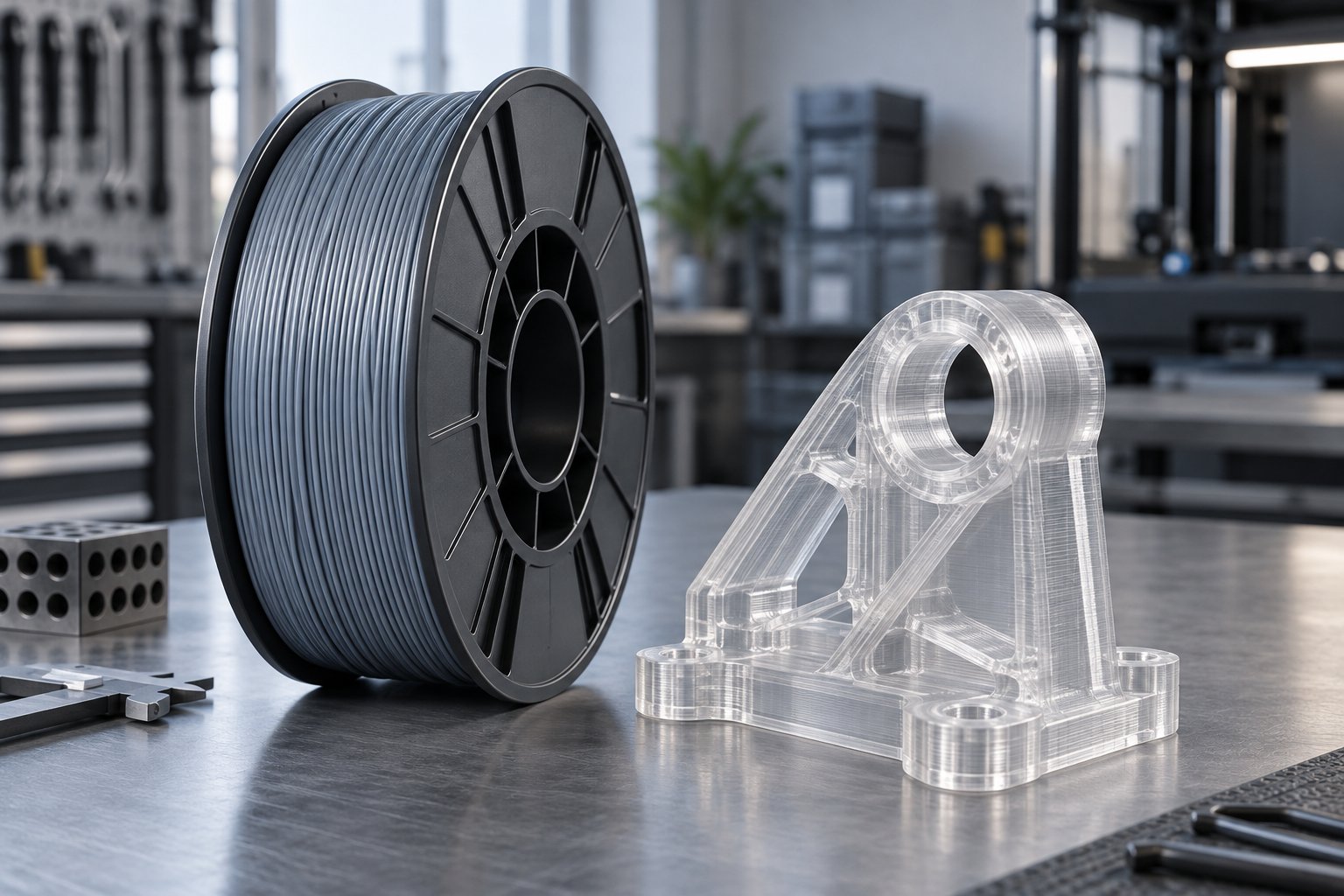
PC filament is an engineering-grade material known for toughness and clarity. This guide explains what polycarbonate filament is, where its properties genuinely pay off, and how to choose between PC, PC-ABS, and PC-CF grades for B2B parts. Includes processing checks, sourcing criteria, and a comparison table.
PC filament is a 3D printing material made from polycarbonate, a thermoplastic known for high impact strength and optical clarity. If you are evaluating engineering-grade filaments for parts that need to survive drops, loads, or repeated handling, polycarbonate filament sits near the top of the rigid-material range. But it is not the right answer for every application, and the differences between standard PC, PC-ABS, and PC-CF matter more than most buyers expect. This guide explains what PC filament is, where its properties genuinely pay off, and how to choose between the three grades for B2B parts.
Key takeaways
- PC filament offers high impact resistance and clarity, but demands careful processing.
- PC-ABS balances toughness with easier printing and better surface finish.
- PC-CF adds stiffness and dimensional stability at the cost of reduced elongation.
- Diameter tolerance and supplier consistency matter as much as the polymer itself.
- MOQ from 50 kg and custom color matching make factory-direct sourcing practical for B2B buyers.
What this guide covers
What is PC filament?
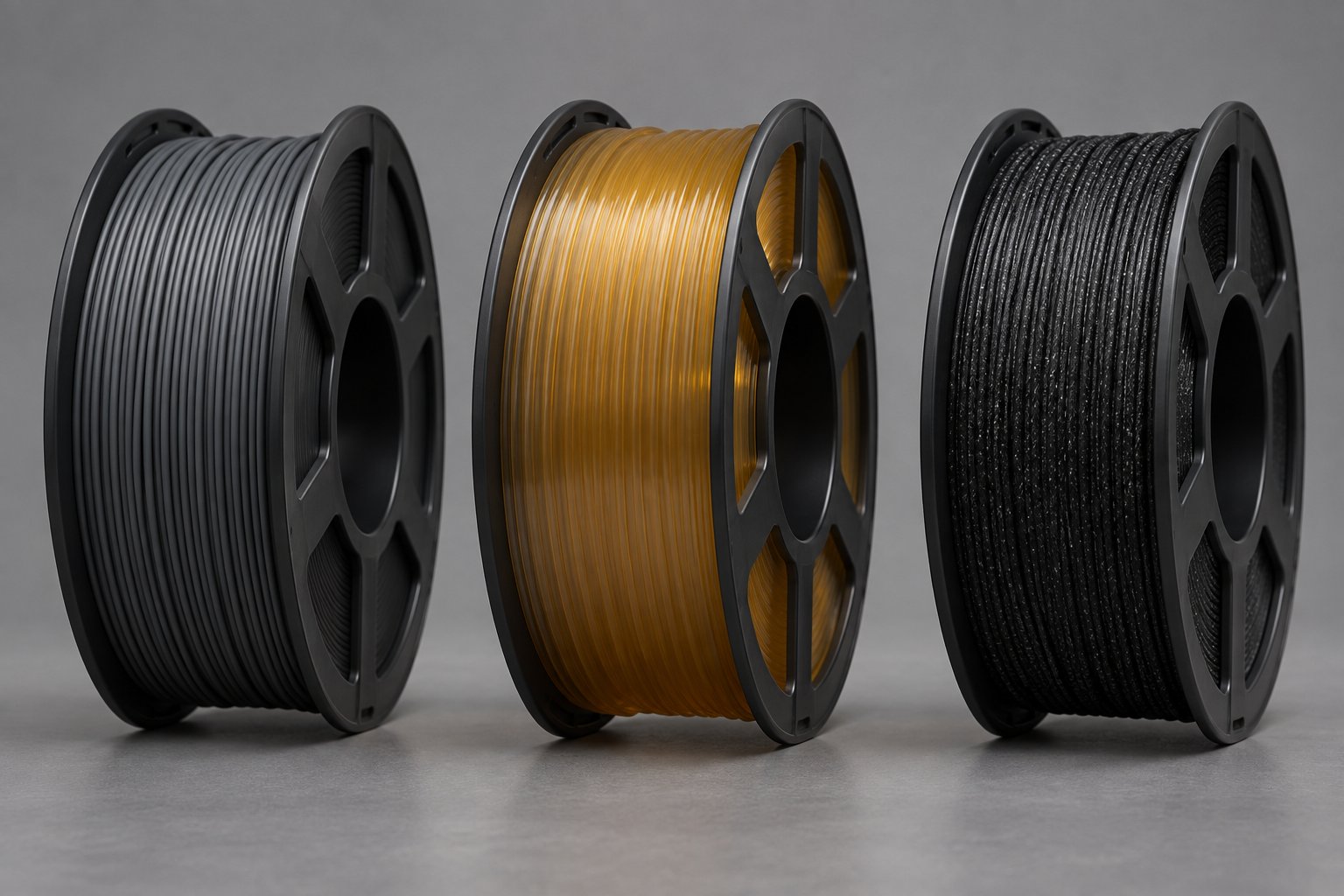
PC filament is polycarbonate in filament form, typically supplied in 1.75mm diameter for desktop and industrial FDM printers. Polycarbonate is an amorphous thermoplastic with a high glass transition temperature, which gives it two properties that stand out in 3D printing: toughness and transparency. A well-printed PC part can absorb impacts that would crack or shatter parts made from standard PLA or PETG.
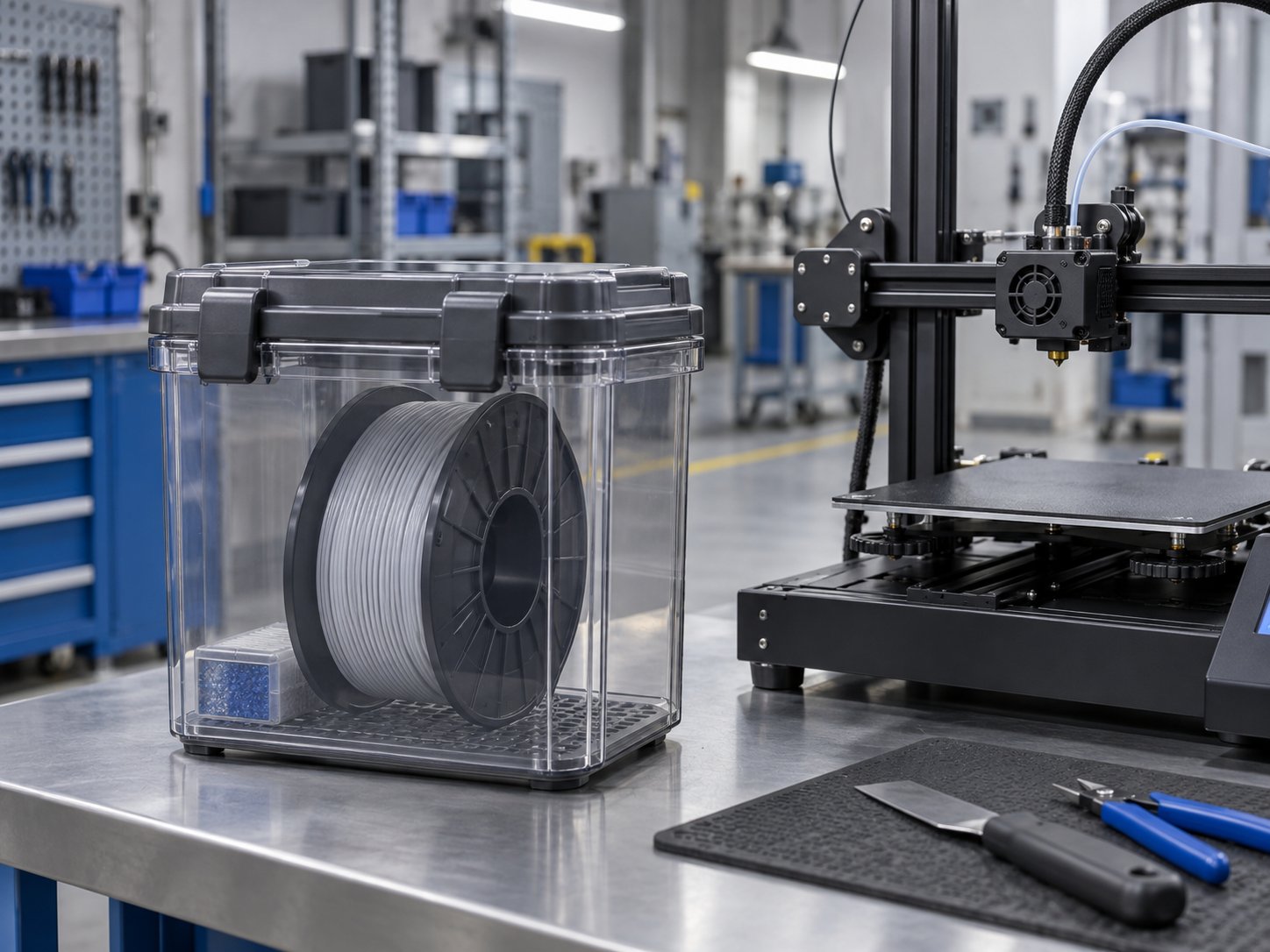
That toughness comes with trade-offs. Polycarbonate is hygroscopic, meaning it absorbs moisture from the air. Printing wet PC filament leads to bubbling, poor layer adhesion, and weak parts. It also requires higher nozzle and bed temperatures than common materials, and it benefits from an enclosed printer to control cooling and warping. These are not reasons to avoid PC filament, but they are reasons to treat it as an engineering material rather than a drop-in replacement for PLA.
For buyers comparing engineering filaments, it helps to see where PC sits relative to other options. Nylon, for example, offers excellent chemical resistance and flexural strength but is even more moisture-sensitive. If you are weighing those trade-offs, our guide on nylon filament PA6 vs PA12 covers the differences in detail. The point is that PC filament is one node in a family of engineering materials, each with a distinct balance of properties.
Where PC filament's strength and clarity pay off
PC filament is not a general-purpose material. It earns its place in applications where impact resistance or optical clarity is the primary requirement.
Impact-resistant industrial parts
Parts that get dropped, struck, or vibrated benefit from polycarbonate's high notched impact strength. Think machine guards, brackets, housings, and protective covers. For industrial applications where impact resistance is the deciding factor, our article on ABS 3D printing filament for industrial applications provides a useful comparison point, since ABS is often the lower-cost alternative when extreme toughness is not required.
Transparent or translucent components
Polycarbonate's natural clarity makes it suitable for light guides, lenses, covers, and fluid-level windows. Few FDM materials offer comparable transparency. Achieving good optical results requires careful tuning, but the material itself supports it in a way that opaque engineering plastics do not.
Functional parts under load
When a part must hold a load without deforming, PC filament's stiffness and strength are valuable. However, if the application is less demanding, a simpler material may be enough. Our guide on why PETG is the first choice for functional parts explains when PETG's easier processing and good-enough strength make it the more practical choice.
Rigid assemblies, not flexible ones
PC filament produces rigid parts. If your design requires bending, compression, or flex, you need a different material family entirely. For those cases, our article on TPU filament hardness explains how to select the right Shore hardness for flexible parts.
PC vs PC-ABS vs PC-CF: comparison table
PC-ABS and PC-CF are not simply "better" or "worse" versions of PC. They are different formulations that shift the balance of properties. The table below summarizes the typical strengths, trade-offs, and best-fit applications for each.
| Grade | Typical strengths | Trade-offs | Best-fit applications |
|---|---|---|---|
| PC | High impact resistance, optical clarity, good stiffness | Moisture-sensitive, requires high temperatures, prone to warping without enclosure | Transparent covers, impact-resistant housings, parts needing clarity plus toughness |
| PC-ABS | Good impact resistance, easier to print than PC, better surface finish, lower warping | Lower clarity than PC, slightly lower strength and heat resistance | Enclosures, automotive interior parts, consumer product housings where finish matters |
| PC-CF | High stiffness, excellent dimensional stability, reduced warping | Lower elongation and impact resistance than unfilled PC, abrasive to nozzles | Structural brackets, jigs and fixtures, parts needing rigidity over toughness |
For reinforced grades like PC-CF, the carbon fiber content and base polymer quality vary between suppliers. Our guide on carbon fiber filament covers what to look for when evaluating reinforced materials, including how fiber loading affects print behavior and part properties.
Processing checks before you commit
PC filament is less forgiving than PLA or PETG. Before you place a production order, confirm the following with your supplier and validate them on your own printer.
- Drying requirements: Polycarbonate absorbs moisture quickly. Ask your supplier for the recommended drying procedure for the specific grade, and confirm whether the filament ships vacuum-sealed with desiccant.
- Print temperature range: PC grades print at higher temperatures than common materials. The exact range depends on the formulation and your printer's hotend capability. Our 3D printing temperature chart provides a reference framework for planning print profiles across materials.
- Bed adhesion and enclosure: PC is prone to warping. Confirm whether your printer has an enclosed chamber and what bed surface the supplier recommends for the grade.
- Diameter tolerance: Inconsistent filament diameter causes inconsistent extrusion, which is especially visible in transparent PC parts. Our article on why filament diameter tolerance matters explains how tolerance affects print reliability and why it is a key supplier evaluation criterion.
These are selection criteria, not fixed specifications. The right values depend on the specific grade and your printer setup. A supplier who can provide clear guidance on each point is more likely to deliver consistent material.
Sourcing criteria for B2B buyers
When you source PC filament for production, the polymer is only part of the equation. Supplier consistency and commercial terms determine whether the material works in your process.
Diameter tolerance and extrusion consistency
PC filament is often used for functional parts where dimensional accuracy matters. A supplier with strict diameter tolerance control reduces the risk of under- or over-extrusion, which is particularly important for transparent parts where flow marks are visible. Wanzhoutong operates 12 extrusion lines and applies strict diameter tolerance control to 1.75mm filament, which supports consistent print results across batches.
Custom color matching and OEM support
If your product line requires a specific color, custom color matching keeps your parts visually consistent. For B2B buyers, OEM and private label support means the filament can ship under your brand with your labeling and packaging requirements. This is useful for distributors and brands that need to control the end-customer experience.
MOQ and order flexibility
MOQ from 50 kg makes it practical to trial a grade before committing to larger volumes. That matters with PC filament because processing behavior varies between formulations. A small trial order lets you validate drying, print temperature, and bed adhesion on your equipment before scaling up.
Factory-direct supply
Wanzhoutong is a Shenzhen-based factory-direct supplier of 3D printing filaments and color masterbatch, serving B2B buyers in Southeast Asia, Europe, and the Americas. Factory-direct sourcing typically means shorter communication lines on custom requirements and more direct control over production consistency.
FAQ
What is PC filament used for?
PC filament is used for parts that need high impact resistance or optical clarity: protective covers, machine guards, brackets, housings, light guides, and transparent components. It is also used for functional parts under load where stiffness and strength are required.
What is the difference between PC and PC-ABS filament?
PC filament offers higher impact resistance and clarity but is more difficult to print. PC-ABS blends polycarbonate with ABS, which improves printability, surface finish, and reduces warping, at the cost of some strength and clarity.
What is PC-CF filament?
PC-CF is polycarbonate reinforced with carbon fiber. The carbon fiber increases stiffness and dimensional stability and reduces warping, but it also lowers elongation and impact resistance compared to unfilled PC. It is abrasive to nozzles and requires a hardened nozzle.
Is polycarbonate filament good for outdoor use?
Polycarbonate has moderate UV resistance, but prolonged outdoor exposure can degrade it. For outdoor parts where UV resistance is critical, ASA or a UV-stabilized grade may be more suitable. Our article on ASA vs ABS filament for outdoor parts covers UV performance in detail.
What is the minimum order quantity for filament?
Wanzhoutong supplies 3D printing filament with MOQ from 50 kg, and custom color matching plus OEM/private label support are available. Contact the supplier to confirm the grade, lead time, and terms for your specific requirements.
Next step: If you are evaluating PC filament for a B2B application, start with a trial order to validate processing on your equipment. Wanzhoutong is a Shenzhen factory-direct supplier of 1.75mm 3D printing filament and color masterbatch, running 12 extrusion lines with strict diameter tolerance control, custom color matching, and OEM/private label support, with MOQ from 50 kg. Reach out with your grade, color, and volume requirements to discuss your project.