
A practical sourcing guide for B2B buyers: what carbon fiber filament is, the main grades (CF-PLA, CF-PETG, CF-nylon, CF-PC), what it's good for, the tradeoffs, and how to vet suppliers.
If you're a B2B buyer or distributor evaluating carbon fiber filament for the first time, you're probably asking the same questions as many others: What exactly is it? What is carbon fiber filament good for? And is the higher price justified? This guide answers those questions with the practical details you need to decide whether to stock it, and how to choose a reliable supplier.
In this guide
What is carbon fiber filament?
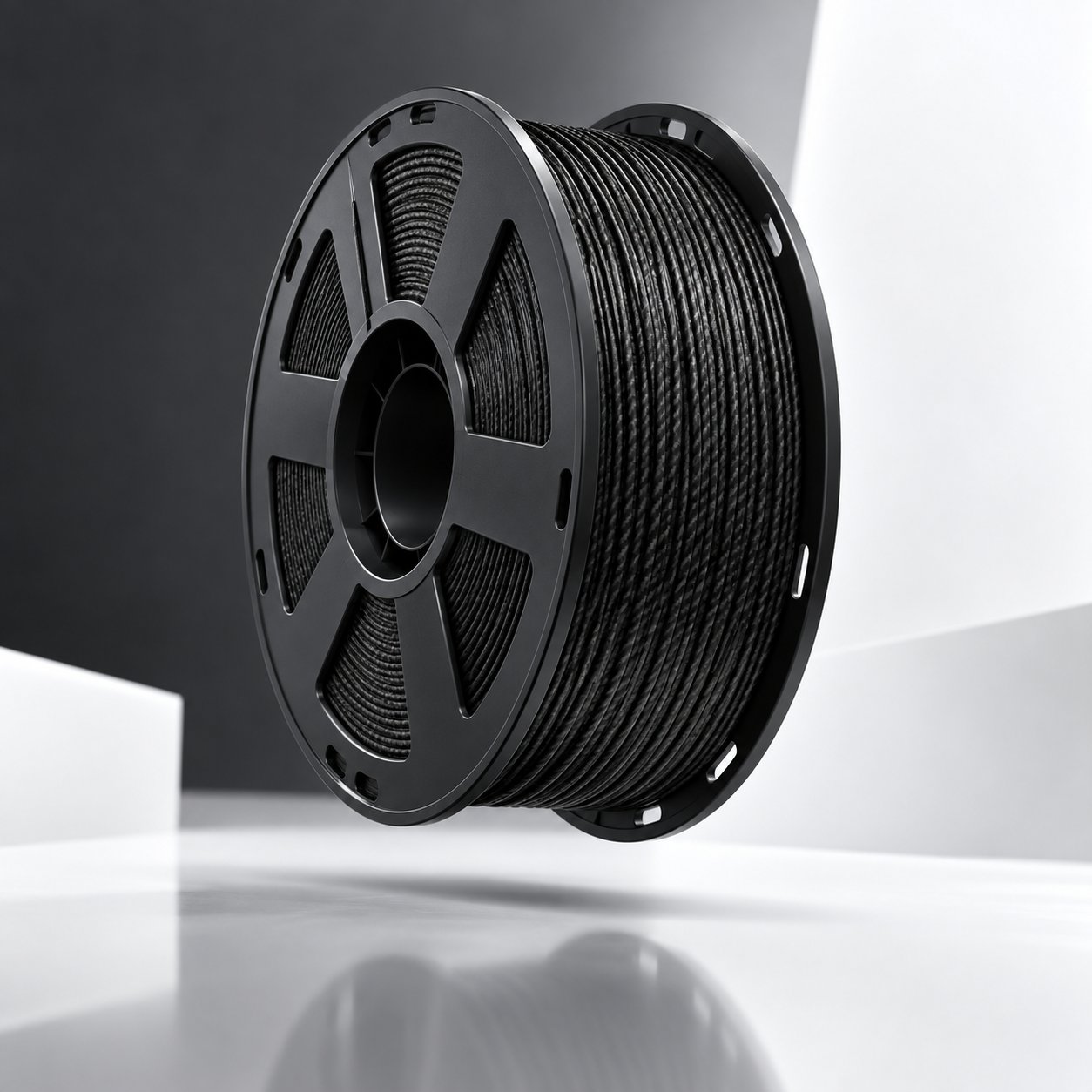
Carbon fiber filament is a composite material. Short carbon fibers are embedded in a base polymer—typically PLA, PETG, nylon (PA), or polycarbonate (PC)—to add stiffness and reduce weight compared to the unfilled base material. The result is a filament that prints parts with higher rigidity and better dimensional stability than standard thermoplastics.
The carbon fibers are short and randomly oriented within the polymer matrix. This is different from continuous carbon fiber reinforcement, which requires specialized printers. Standard FDM/FFF printers can handle filled filament as long as the nozzle is suitable.
Main grades: CF-PLA, CF-PETG, CF-nylon, CF-PC
The base polymer determines most of the filament's properties—temperature resistance, toughness, chemical resistance, and ease of printing. Carbon fiber modifies stiffness and weight. Here's a quick comparison:
| Grade | Base polymer | Typical strengths | Considerations |
|---|---|---|---|
| CF-PLA | PLA | Easy to print, low warping, good surface finish | Low heat resistance, brittle, not for functional parts above ~50°C |
| CF-PETG | PETG | Better toughness and chemical resistance than PLA, low warping | Still limited heat resistance; good for many functional parts |
| CF-nylon (PA) | Nylon | High strength, toughness, wear resistance, good heat resistance | Moisture-sensitive; must be dried before and during printing |
| CF-PC | Polycarbonate | High heat resistance and impact strength | Requires high print temperatures, prone to warping, needs enclosed printer |
Each grade serves a different purpose. For a distributor, stocking a range of base polymers makes sense because buyers will need different properties for different applications. The choice of base polymer also affects print settings—check our nozzle and bed temperature guide for typical ranges.
What is carbon fiber filament good for?
Carbon fiber filament is used for parts that need to be stiff, lightweight, and dimensionally stable. The added stiffness means parts resist bending under load, which is valuable for functional components. Common applications include:
- Jigs and fixtures for manufacturing—parts that hold, guide, or position workpieces.
- Drone and RC parts—frames, arms, mounts where weight matters.
- Automotive brackets and interior components that need rigidity.
- Robotics and mechanical parts—gears, levers, and structural links.
- Tooling and end-of-arm tooling for light-duty automation.
If you're sourcing for functional parts, CF-PETG is often a good balance—it's easier to print than nylon or PC but offers better toughness than PLA. For more demanding environments, CF-nylon is the go-to. Our guide on why PETG is a first choice for functional parts explains the base material's role.
Tradeoffs and handling requirements
Carbon fiber filament isn't just a drop-in replacement. Here are the key tradeoffs to understand:
- Abrasive to nozzles: Carbon fibers are abrasive. Standard brass nozzles wear out quickly, so a hardened steel nozzle is required. This is a non-negotiable for anyone printing CF filaments.
- Higher cost: Carbon fiber filament is more expensive than unfilled base polymers. The price difference reflects the material cost and more complex manufacturing. Buyers should evaluate whether the stiffness and weight benefits justify the premium for their specific part.
- Moisture sensitivity: Nylon-based CF filament is especially hygroscopic—it absorbs moisture from the air, which degrades print quality. Proper storage in dry boxes or vacuum-sealed bags is essential. Our moisture control guide covers best practices for warehousing.
- Printing difficulty: Higher printing temperatures and, for PC and nylon, the need for an enclosed printer. Warping can be an issue with larger parts.
These tradeoffs are not reasons to avoid CF filament, but they do mean buyers need to plan for the right equipment and handling. When sourcing for your customers, you'll need to provide clear guidance on nozzle selection and storage.
How to choose and vet suppliers
For B2B buyers, the supplier matters as much as the product. Here's what to look for:
- Diameter tolerance: Consistent filament diameter is critical for reliable printing. A reputable supplier will have strict tolerance control—ask for their spec sheet and any QC data.
- Consistency across batches: If you're stocking for resale, you need consistent color and mechanical properties from batch to batch. Ask about their production process and how they ensure uniformity.
- Custom color matching: Some buyers need specific brand colors. A supplier with in-house color matching capability offers more flexibility.
- Manufacturing capacity: If you're planning volume orders, check the supplier's production capacity. For example, a factory-direct supplier with multiple extrusion lines can handle larger orders more reliably.
- Export experience: If you're shipping internationally, the supplier should have experience with export documentation and packaging for transit.
When evaluating a potential supplier, ask for samples and test them on your own equipment. Verify that the filament prints consistently and meets your spec. Also, confirm the exact composition—the percentage of carbon fiber and the type of base polymer—because these affect performance and price. Don't rely on marketing claims; ask for technical data sheets.
If you're working with a supplier that offers multiple base polymers, it's easier to consolidate orders and get better pricing. For example, a manufacturer like Wanzhoutong produces PLA, PETG, ABS, and TPU filaments, which gives buyers flexibility in sourcing different materials from one partner. Their factory-direct setup with 12 extrusion lines supports volume orders, and they serve markets in Southeast Asia, Europe, and the Americas.
FAQs for B2B buyers
Is carbon fiber filament worth it?
It depends on the application. For parts that need stiffness and low weight, yes—the added cost is justified. For decorative parts or prototypes that don't bear loads, a standard filament like PLA or PETG is sufficient and more economical.
What is the difference between CF-PLA and CF-PETG?
The base polymer is different. CF-PLA is easier to print but has lower heat resistance and is more brittle. CF-PETG offers better toughness and chemical resistance, making it more suitable for functional parts. Choose based on the part's requirements.
Can I use carbon fiber filament on any 3D printer?
Most FDM printers can print CF filament if you upgrade to a hardened steel nozzle. However, some grades (like CF-PC) require higher temperatures and an enclosed chamber. Check your printer's specifications.
How should I store carbon fiber filament?
Store in a dry, cool environment, preferably in a sealed container with desiccant. Nylon-based CF filament is especially sensitive to moisture—drying before printing is recommended.
What should I ask a supplier before ordering?
Ask for the exact composition (base polymer and carbon fiber percentage), diameter tolerance, and batch-to-batch consistency. Request samples and test them. Also, confirm the supplier's production capacity and lead times.
Choosing the right carbon fiber filament comes down to matching the grade to the application and working with a supplier who can provide consistent quality and reliable supply. For more on selecting the right base polymer, see our PLA vs PETG vs ABS guide. If you have specific questions about your sourcing needs, contact us to discuss your requirements.