
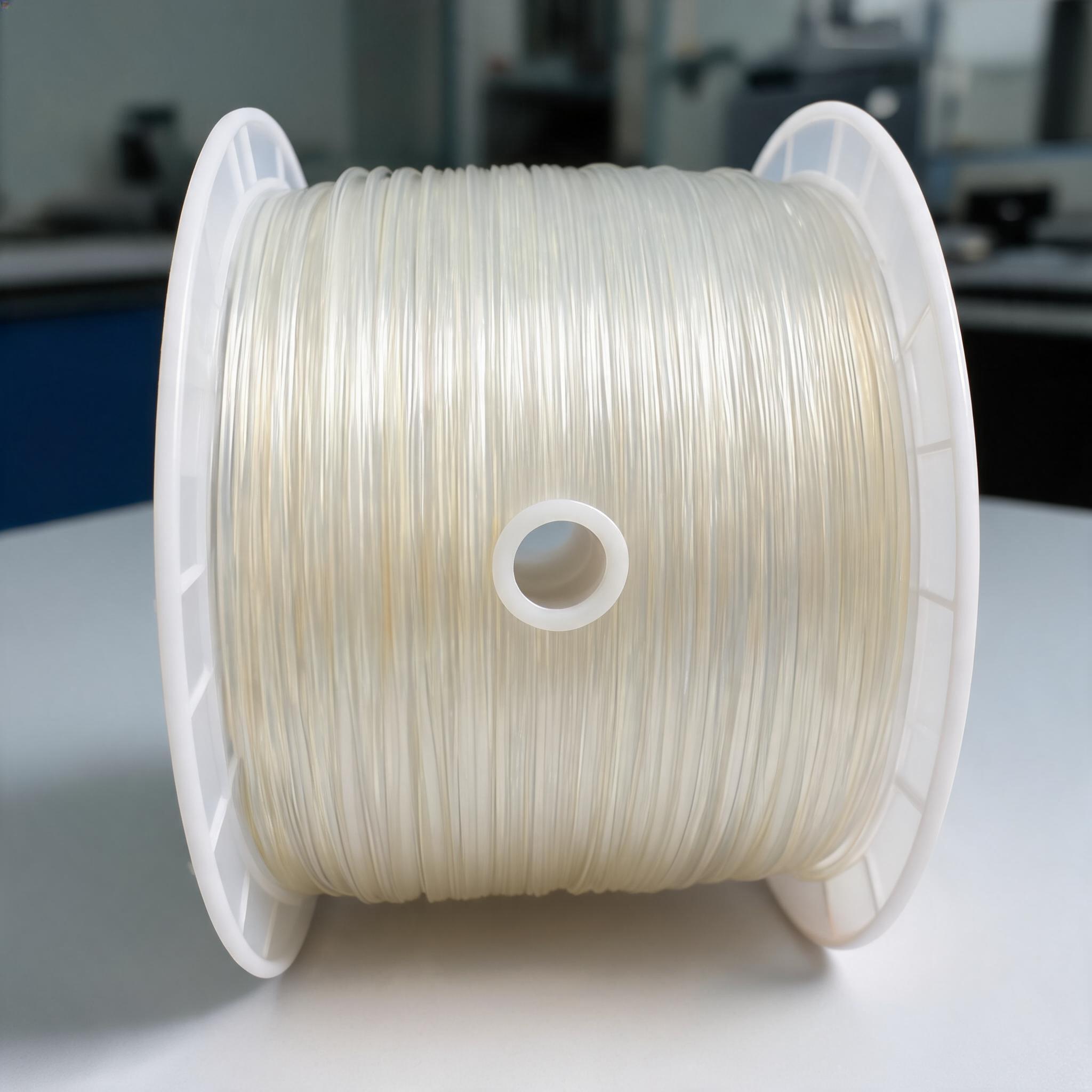
A practical B2B guide to TPU filament shore hardness. Learn what 95A means, how hardness affects flexibility, abrasion resistance, and printability, and what to verify with a supplier before placing a bulk order.
If you are sourcing TPU flexible filament for wearables, gaskets, phone cases, or industrial seals, the first specification you will be asked to confirm is Shore hardness. The most common grade you will encounter is TPU 95A. This number tells you how soft or stiff the material is, and it determines whether your part will flex as intended, resist abrasion, or print reliably on your machines. This guide explains what TPU filament hardness actually means, how to map hardness grades to real applications, and the specific details you should confirm with a supplier before committing to a bulk order.
What Does TPU Filament Shore Hardness Mean?
Shore hardness measures a material's resistance to indentation. For TPU filament, the scale you will see most often is Shore A. Softer materials have lower numbers, and harder materials have higher numbers. A Shore 95A TPU is on the firmer end of the flexible range—it bends and compresses, but it holds its shape far better than a softer grade like 85A.
To put it in physical terms: a 95A TPU part feels like a firm rubber band or a car tire. A softer 85A grade feels closer to a gel insole or a thick rubber band. The difference matters because hardness directly influences three properties you care about as a buyer: flexibility, abrasion resistance, and printability.
Key takeaways for sourcing: Shore 95A is the workhorse grade for functional flexible parts—firm enough to hold geometry, soft enough to absorb impact. Hardness is a trade-off: softer means more flexible but less abrasion-resistant; harder means stiffer but more durable against wear. Printability improves as hardness increases—95A is far easier to print reliably than ultra-soft grades. Always confirm diameter tolerance and packaging with your supplier—these affect print consistency more than most buyers expect.
How Hardness Maps to Applications
Your application dictates the hardness you need. Choosing the wrong grade leads to parts that fail in the field—either too stiff to function as a seal, or too soft to survive repeated contact.
Firm Flexible Parts: Shore 95A
Shore 95A TPU is the default choice for parts that need to flex without deforming permanently. This grade suits abrasion-resistant wearable parts—think watch straps, fitness tracker bands, and protective covers that rub against skin and clothing all day. It also works well for gaskets and seals that must compress to fill a gap but return to their original shape when pressure is released.
Phone case prototypes are another common use. A 95A case provides enough stiffness to hold its shape over the device, while still offering shock absorption when dropped. If you are prototyping a product that will eventually be mass-produced in injection-molded TPU, a 95A filament is a close match to many standard molding grades.
Very Soft Parts: Below 95A
Grades below 95A, such as 85A or softer, are used when you need extreme flexibility—parts that bend almost flat without cracking. Think of soft grips, vibration dampeners, or medical-like tubing. The trade-off is that these softer filaments are noticeably harder to print. They require slower speeds, more careful retraction settings, and they are more prone to jamming in a Bowden extruder. You will also see lower abrasion resistance, which means the surface wears faster in sliding contact.
Rigid Alternatives: When TPU Is Not the Answer
Not every flexible-looking part needs TPU. If your part requires rigidity with only slight give, a semi-rigid material like PETG is a better fit. PETG is stiff, impact-resistant, and much easier to print than any TPU grade. For structural housings or parts that must not flex under load, compare a clear PETG filament against a firm TPU before you commit. The decision comes down to whether the part must bend (choose TPU) or simply absorb impact without bending (choose PETG).
Why 95A Is the Industry Standard for Functional Prototypes
If you are new to sourcing TPU filament hardness, start with 95A. It is the most widely available grade, which means more suppliers stock it, and it offers the best balance of properties for a broad range of functional parts. The material is firm enough to print with relative ease—you can run it on a direct-drive extruder without fighting constant jams—yet it remains genuinely flexible in the finished part.
For buyers sourcing in volume, 95A also gives you the most consistent quality across production batches. Because it is the standard grade, reputable manufacturers have the most experience dialing in their extrusion lines for it. That translates to fewer diameter variations and less waste on your production floor.
What to Check With a Supplier Before Ordering
Hardness is only one variable. When you request a quote for TPU flexible filament, verify these four points with your supplier. They determine whether the filament will run smoothly in your printers and whether the finished parts meet your quality bar.
- Diameter tolerance: TPU is flexible, so it is more sensitive to diameter variation than rigid filaments. A wider-than-specified filament causes jams; a narrower one causes under-extrusion. Confirm the tolerance range. For a 1.75mm filament, a tolerance of ±0.03mm is a solid standard. Ask for the actual QC report.
- Spool weight and packaging: TPU absorbs moisture from the air, which degrades print quality. Poor packaging ruins the filament before it reaches your printer. Ask if the spool is vacuum-sealed with desiccant. This is a basic requirement for flexible filament, not a premium extra.
- Compliance documentation: If you export finished parts to Europe or other regulated markets, you need proof that the material meets chemical restrictions. Request REACH and RoHS compliance documentation. A reliable supplier will provide these on request without hesitation.
- Color matching and MOQ: If your product requires brand-specific colors, you need a supplier who can match them. And you need to know the minimum order quantity for custom colors. Ask about custom color matching capabilities. Confirm the MOQ for custom colors and for standard colors separately—they often differ.
Diameter Tolerance Is the Hidden Quality Differentiator
With TPU, diameter tolerance is the difference between a smooth production run and a printer that jams repeatedly. A 1.75mm filament with a tolerance of ±0.03mm is a good baseline. This means the filament diameter stays between 1.72mm and 1.78mm across the entire spool. For flexible material, this consistency is critical because the filament compresses in the extruder gear. If the diameter swells beyond spec, the gear grinds it flat and the feed stops.
When you evaluate suppliers, ask how they control this. A factory with dedicated extrusion lines and strict in-line measurement will give you a more consistent product than one that checks diameter only at the end of the run. Our own production uses dedicated extrusion lines with continuous diameter monitoring to hold the ±0.03mm tolerance on our TPU 95A Flexible Filament 1.75mm.
Packaging: The Moisture Problem
TPU is hygroscopic—it pulls moisture from the air. Even a small amount of absorbed water turns into steam in the hot nozzle, causing bubbles, weak layers, and rough surfaces. For a buyer sourcing in volume, this is a quality control issue that starts at the factory.
Vacuum-sealed packaging with a desiccant pouch is the minimum standard. If a supplier ships TPU in plain bags without desiccant, reject the quote. You will spend more time drying filament and scrapping failed parts than you saved on the unit price. Our TPU 95A spools are vacuum-sealed with desiccant to keep moisture out from the moment they leave the extrusion line.
Printing Considerations for TPU 95A
Even with the right hardness, TPU requires a different print setup than rigid materials. The key issue is that flexible filament bends and compresses in the extruder path. A direct-drive extruder—where the motor sits right above the hot end—is strongly recommended. A Bowden setup, where the filament travels through a long tube, gives the filament room to buckle and jam.
For the TPU 95A Flexible Filament 1.75mm, the recommended print temperature range is 210–230°C. Start at the lower end of the range and adjust based on layer adhesion. If you see gaps between layers, increase the temperature slightly. If you see stringing or oozing, decrease it. Each spool is 500g, which is a practical size for testing and prototyping before you commit to a larger production quantity.
Print speed is the other major factor. TPU needs slow speeds compared to rigid materials—at higher speeds, the extruder gear can't push the flexible filament fast enough, and you get under-extrusion. Ask your supplier for the recommended speed window for the specific grade, and plan for slower print times with TPU compared to rigid materials like PETG.
Ordering Checklist for B2B Buyers
Before you send your purchase order, run through this checklist. It will help you avoid the most common sourcing mistakes.
- Confirm the Shore hardness grade in writing. Do not assume—write "Shore 95A" on the PO.
- Verify diameter tolerance is ±0.03mm or better for 1.75mm filament.
- Ask for a sample spool before a large order. Print a test part that mimics your actual geometry.
- Request REACH and RoHS documentation if you export to regulated markets. Get it before you pay, not after.
- Confirm packaging: vacuum-sealed with desiccant.
- Clarify the MOQ for standard and custom colors. Confirm the MOQ with your supplier directly, as it may vary based on the color and order volume.
- Ask about custom color matching if your product needs a specific brand color.
FAQ: TPU Filament Hardness and Sourcing
What is the difference between Shore 95A and Shore 98A TPU?
Shore 98A is firmer than 95A. It behaves more like a stiff rubber or a very hard wheel, with less flex and higher abrasion resistance. However, 95A is more commonly stocked and offers a better balance between flexibility and durability for most parts. Unless your design specifically requires a stiffer feel, 95A is the safer starting point.
Can I print TPU 95A on a Bowden extruder?
It is possible, but challenging. 95A is firm enough that it sometimes works on a Bowden setup if you print very slowly and use a well-adjusted retraction setting. However, a direct-drive extruder is far more reliable. If you are sourcing for a production environment, we recommend testing your specific printer configuration with a sample spool first.
How does hardness affect the durability of a phone case?
A 95A phone case offers a good balance. It is firm enough to hold its shape and resist scratches, but soft enough to absorb impact energy when dropped. A softer grade would feel nicer in the hand but would show abrasion marks faster and might deform permanently under pressure.
Is TPU food-safe or medical-grade?
Standard TPU 95A is not automatically food-safe or medical-grade. If your application requires those certifications, you must specifically request a grade that is certified for that use. Do not assume that REACH and RoHS compliance implies food safety—they are different standards.
Make Your First Order Count
Sourcing TPU filament hardness is a straightforward decision once you understand the trade-offs. For most flexible parts—wearables, gaskets, phone cases, seals—Shore 95A is the right choice. It gives you genuine flexibility, solid abrasion resistance, and reasonable printability. The rest comes down to supplier quality: tight diameter tolerance, proper moisture-proof packaging, and compliance documentation you can actually use.
When you are ready to source, ask for a sample spool first. Test it on your own printers with your own parts. A reliable supplier will welcome this—it is how serious B2B relationships start. For a deeper look at our product range and sourcing topics, visit our knowledge hub.
Cover image is illustrative AI-generated and does not depict a specific product or factory.