A practical B2B guide to nylon (polyamide) 3D printing filament. Learn what nylon filament is, the real differences between PA6 and PA12 grades, which one suits your application, and how to evaluate a filament supplier before sourcing.
If you are sourcing 3D printing filament for functional parts, you have probably seen nylon filament listed as PA6 or PA12. The names look similar, but they behave differently in real parts. This guide explains what nylon filament is, how PA6 and PA12 differ, and which grade fits common applications. It also covers what to check when evaluating a filament supplier, so you can source with confidence.
Contents
What is nylon filament?
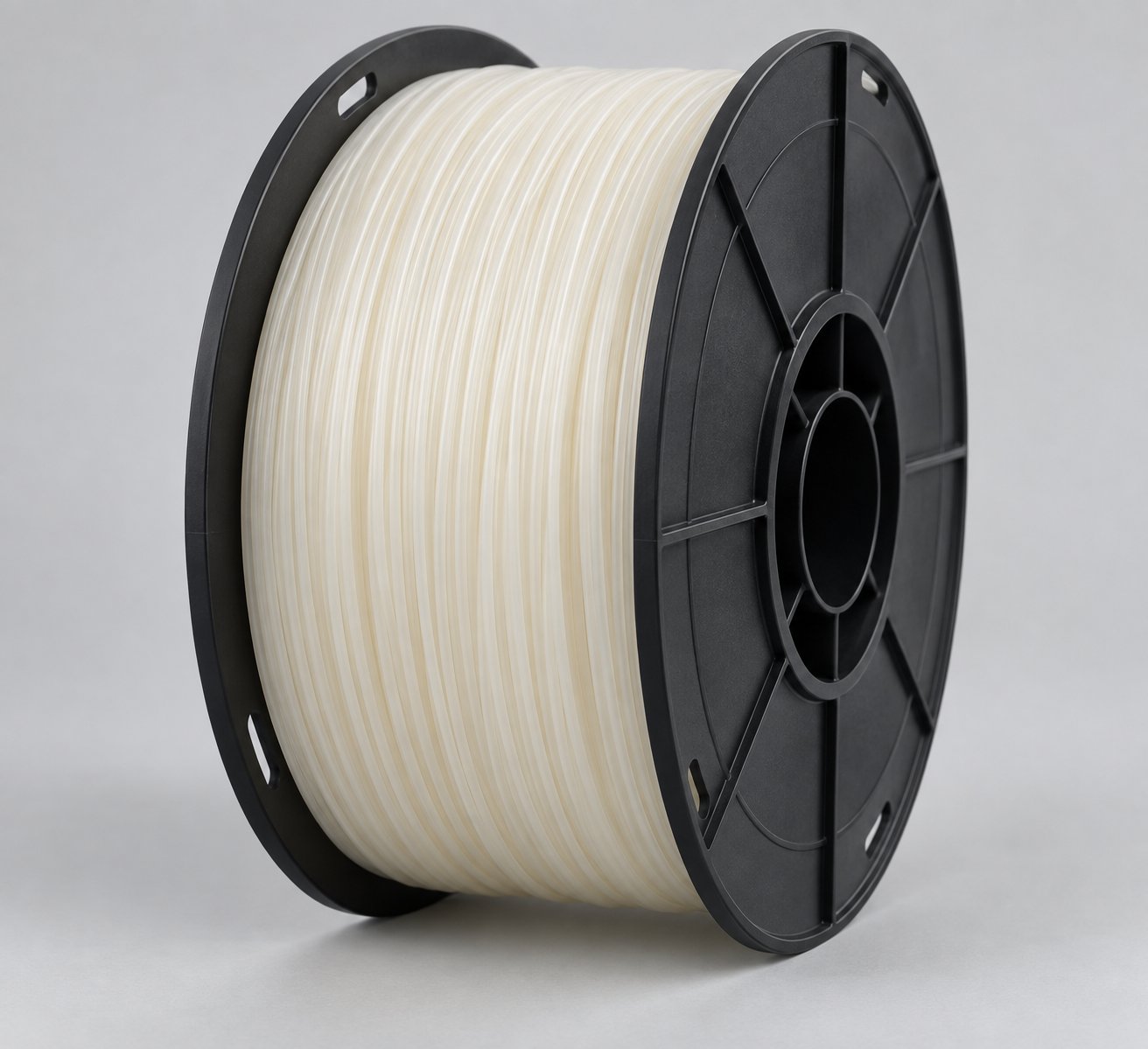
Nylon filament, also called polyamide (PA) filament, is a thermoplastic used in 3D printing when parts need more toughness and durability than standard plastics like PLA or PETG. It is known for high mechanical strength, good wear resistance, and the ability to handle repeated stress. That is why it is a common choice for gears, hinges, brackets, and other functional parts.
Nylon is a family of materials, and the two most common grades in 3D printing are PA6 and PA12. Both are polyamides, but they have different chemical structures that lead to different properties. Understanding these differences helps you pick the right filament for your application.
PA6 vs PA12: the key differences
PA6 and PA12 are both nylon, but they are not interchangeable. Here is a breakdown of the main differences.
Moisture absorption
Nylon is hygroscopic, meaning it absorbs moisture from the air. This affects printing quality and final part properties. PA6 absorbs more moisture than PA12. This means PA6 parts may change dimensions more in humid environments, and the filament itself needs more careful drying before printing. PA12 absorbs less moisture, so it is more dimensionally stable and easier to handle in humid conditions.
Flexibility and impact strength
PA12 is generally more flexible and has better impact resistance than PA6. If your part needs to bend or absorb shock without breaking, PA12 is often the better choice. PA6 is stiffer and stronger in terms of tensile strength, but it is more brittle under impact compared to PA12.
Printability
PA12 is often considered easier to print than PA6. It has a lower melting point and less warping tendency. PA6 prints at higher temperatures and is more prone to warping and stringing. For buyers who are new to nylon or do not have advanced print settings, PA12 may be a smoother start.
Cost
PA6 is generally less expensive than PA12. This is because PA6 is more widely produced and used in industrial applications. PA12 costs more but offers better flexibility and moisture resistance. The price difference can be significant for bulk orders, so it is a factor to consider if your application does not require PA12's specific benefits.
Chemical resistance
Both PA6 and PA12 have good resistance to oils, greases, and many solvents. However, PA12 has slightly better chemical resistance, especially to strong acids and bases. If your parts will be exposed to harsh chemicals, PA12 may be a safer choice.
Key takeaways
- PA6: Stiffer, stronger, cheaper, but absorbs more moisture and is harder to print.
- PA12: More flexible, better impact resistance, lower moisture absorption, easier to print, but more expensive.
- Choose based on your part's mechanical requirements and your printing environment.
Which grade should you choose?
The choice between PA6 and PA12 depends on your application. Here is a practical guide.
Choose PA6 if:
- You need maximum stiffness and high tensile strength.
- Your parts are not exposed to high humidity or water.
- You have a well-controlled printing environment and can dry the filament properly.
- Budget is a primary concern, and you can manage the printing challenges.
Choose PA12 if:
- Your parts need flexibility and impact resistance.
- They will be used in humid or wet environments.
- You want easier printing with less warping.
- You are willing to pay a bit more for better overall performance in demanding conditions.
Example applications
| Application | Recommended Grade | Why |
|---|---|---|
| Gears and mechanical parts | PA6 | Stiffness and wear resistance |
| Hinges and living hinges | PA12 | Flexibility and fatigue resistance |
| Protective casings | PA12 | Impact resistance |
| Automotive under-hood components | PA6 | Heat and chemical resistance |
| Outdoor equipment | PA12 | Low moisture absorption |
| Snap-fit connectors | PA12 | Flexibility for assembly |
These are general guidelines. Your specific part geometry and load conditions may require testing. Always request a sample and test with your own printer before committing to a large order.
How to evaluate a nylon filament supplier
When you source nylon filament for B2B use, the supplier's consistency matters as much as the material grade. Here is what to check.
Diameter tolerance
Filament diameter variations cause print defects. A reliable supplier should have strict diameter tolerance control. Ask for their tolerance specs. For example, a tolerance of ±0.02 mm is common for high-quality filament, but confirm with the supplier. Wanzhoutong, a factory-direct filament manufacturer, emphasizes strict diameter tolerance control across its product lines, which is a good sign of quality management.
Drying and packaging
Because nylon absorbs moisture, the way it is packaged matters. Vacuum-sealed bags with desiccant are standard for nylon filament. Ask if the supplier offers this. Also, ask about their recommended drying settings for their specific filament.
Consistency across batches
For production, you need consistent color and mechanical properties from batch to batch. Ask the supplier about their quality control processes. Do they test each batch? Can they provide a certificate of analysis? A factory-direct supplier with in-house extrusion lines is often better positioned to maintain consistency because they control the entire process.
Customization and support
If you need a specific color or a custom formulation, check if the supplier can do it. Wanzhoutong offers custom color matching for B2B buyers, which is useful if you need brand-colored parts. Also, ask about their technical support. A good supplier will help you troubleshoot printing issues.
Compliance and export experience
For overseas buyers, check if the supplier has experience exporting to your region. Wanzhoutong, for example, serves markets in Southeast Asia and Europe and offers bulk export with FOB and CIF terms. They are CE compliant, which is important for many industrial applications. Ask any supplier about their export experience and documentation.
Production capacity
If you plan to scale up, you need a supplier who can grow with you. Ask about their number of extrusion lines and production capacity. Wanzhoutong has 12 extrusion lines, which indicates they can handle larger orders. Confirm lead times and MOQs (minimum order quantities) before you commit.
Frequently asked questions
What is the difference between PA6 and PA12 filament?
PA6 is stiffer and stronger but absorbs more moisture and is harder to print. PA12 is more flexible, has better impact resistance, absorbs less moisture, and is easier to print. PA6 is generally cheaper.
What is nylon filament good for?
Nylon filament is used for functional parts that need toughness and durability, such as gears, hinges, brackets, and protective components. It is also used in automotive and industrial applications.
How strong is nylon filament?
Nylon is one of the strongest 3D printing materials, with high tensile strength and good impact resistance. The exact strength depends on the grade (PA6 vs PA12) and the print settings. For specific numbers, consult the supplier's data sheet.
What is nylon filament used for?
Common uses include end-use parts for automotive, machinery, and consumer products. It is also used for tools and fixtures in manufacturing. Because it is tough and durable, it is often chosen over PLA or PETG for functional applications.
What is PA12 material?
PA12 is a type of nylon (polyamide) with a longer carbon chain than PA6. This gives it lower moisture absorption, higher flexibility, and better impact resistance. It is often used for parts that need to withstand repeated stress or humid environments.
Next steps for sourcing
Now that you know the difference between PA6 and PA12, you can make a more informed decision for your application. Before you order, always request a sample and test it under your own conditions. Verify the supplier's quality control, drying recommendations, and export experience.
If you are also exploring other engineering materials, you may find our guides on carbon fiber filament, PETG for functional parts, and ABS for industrial applications useful. And when you are ready to source, talk to a factory-direct supplier like Wanzhoutong to discuss your requirements and see how they can support your project.