
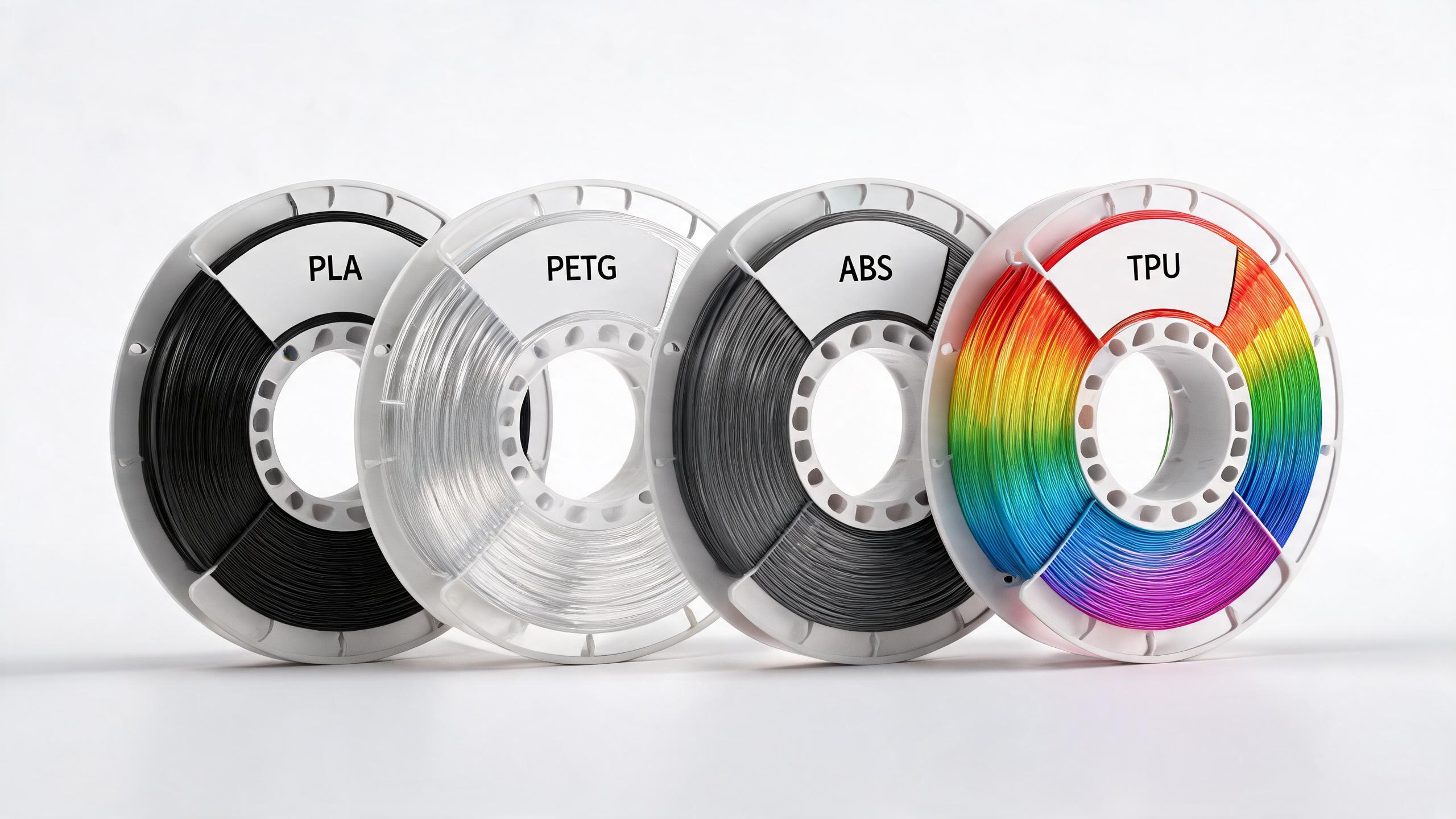
Discover the most popular 3D printer filament types in 2026 and how to plan a profitable SKU mix. A B2B guide to PLA, PETG, ABS, and TPU from a wholesale buyer's perspective.
Every wholesale buyer runs into the same question at ordering time: which filament types will actually move this year? Guess wrong and you are sitting on capital tied up in slow SKUs. The pattern we see across our export markets in Southeast Asia and Europe is fairly stable: PLA, PETG, ABS, and TPU account for the bulk of repeat orders, and each sells for a different reason. This article breaks down why these four dominate, what pushes each one off the shelf, and how to turn that into a SKU mix that earns its warehouse space.
Key Takeaways
- PLA remains the most common 3D printer filament, driven by ease of use and low cost.
- PETG keeps gaining ground for strength and durability, especially for functional parts.
- ABS is still essential for industrial work that needs heat resistance.
- TPU is a smaller segment but carries better margins and less competition.
- Plan your SKU mix around application, cost, and repeat demand — not popularity alone.
Why PLA Is the Most Common 3D Printer Filament
Ask any distributor which material moves first and the answer is PLA. Most users print their first spool of it, and many never leave. It prints without drama: low warping, little odor, and a wide temperature window. For a wholesaler, that means a high-volume product that rarely triggers complaints.
Consistency is what separates suppliers here. Check diameter tolerance before anything else. Our PLA Matte Black filament, for instance, holds ±0.02mm — smooth extrusion, fewer failed prints, fewer returns. That kind of consistency protects your reputation with end customers.
What Drives PLA Sales?
- Ease of use: beginners and rapid prototyping both start here.
- Price: a lower entry point encourages trial and repeat buys.
- Variety: wide color and finish range, including matte and silk.
- Renewable feedstock: a real selling point for eco-conscious buyers.
For margin, add a premium finish to the range. PLA Silk Rainbow filament sells steadily for decorative prints and typically prices above standard colors.
PETG: The Durable All-Rounder
PETG sits between PLA and ABS: nearly as easy to print as PLA, considerably tougher. That combination explains why it keeps taking share in functional parts, mechanical components, and anything that has to survive handling. For buyers, it is the segment with the strongest repeat-purchase growth right now.
When comparing PETG offers, check clarity and impact numbers. Our PETG Clear filament transmits up to 92% of light at 3mm wall thickness, so customers can inspect internal geometry without cutting the part. Izod impact strength is 7.5 kJ/m² — roughly three times standard PLA — and shrinkage stays below 0.3%, which matters for dimension-critical work.
Why PETG Is Becoming a Bestseller
- Strength: higher impact resistance than PLA.
- Durability: handles moisture and chemicals better than PLA.
- Versatility: works for both functional and appearance parts.
- Printability: far less warping than ABS, no enclosure needed for most models.
ABS: Still Essential for Industrial Use
ABS has lost some shelf space to PETG, but it has not lost its role. Where parts face heat or mechanical stress — automotive fittings, electronic housings, jigs — ABS remains the default. Its user base is smaller than PLA's but far more loyal, and industrial clients reorder on schedule.
Our ABS High-Impact Grey filament is formulated to limit warping and keep layer adhesion consistent, which is what large or functional parts demand.
TPU: The Flexible Niche
TPU covers everything that has to bend, stretch, or absorb shock: phone cases, gaskets, seals, wearables. The segment is smaller than PLA or PETG, and that is exactly the opportunity — fewer competitors, buyers who pay for the right hardness grade, and margins that hold up better.
Our TPU 95A Flexible filament runs at Shore 95A, prints at 210-230°C, and holds ±0.03mm diameter tolerance — consistent flow without clogging headaches.
How to Plan a Profitable SKU Mix
Knowing what is popular is not the same as knowing what to stock. Spread your capital across the four types instead of loading up on one.
Start with the Core
PLA is the foundation. It turns fastest, so depth matters more than breadth: matte black, white, and a silk option will cover most reorder demand.
Add Functional Options
PETG and ABS serve buyers who need tougher parts. They move slower than PLA but at higher price points, and the customers are stickier.
Differentiate with Specialties
TPU and specialty finishes like silk PLA are where margins widen. Buyers hunting a specific property will pay for it, and few local competitors stock the range.
Use Data to Refine
Watch what actually sells, not what you expected to sell. Trim the slow SKUs each quarter, and note seasonal swings — decorative filaments, for example, tend to spike before the holidays.
Supplier Evaluation: What to Look For
A good SKU mix still fails if the supply behind it is shaky. Before committing to a factory, check:
- Capacity: can they hold your volume through peak season? We run 12 extrusion lines specifically so repeat orders do not queue behind new customers.
- Tolerance control: ask how diameter is measured and at what interval. Vague answers here predict inconsistent spools.
- Custom color: a factory that can match colors lets you carry SKUs competitors cannot.
- Compliance: our PLA Matte Black, for example, ships with CE and REACH documentation for European import.
- Packaging: vacuum-sealed spools with desiccant — anything less risks moisture damage in transit to humid markets.
Wanzhoutong is a factory-direct supplier covering all five points above. We match custom colors for B2B buyers, export to Southeast Asia and Europe, and keep MOQ at 50kg or 200 spools with volume discounts from 500 spools — enough room to test a mix before scaling it.
FAQ
What is the most common 3D printer filament?
PLA. It is the easiest to print, the cheapest, and available everywhere — which is why it outsells every other type.
What is the most durable 3D printing filament?
PETG is the practical answer: high impact resistance and low shrinkage. ABS is also tough but warps more during printing.
What 3D printer filament is strongest?
Depends on the load. ABS and PETG lead on tensile strength; for parts that flex rather than break, TPU is the right call.
What is the best filament to use for 3D printing?
There is no single best — it depends on the part, the printer, and the operator. PLA suits beginners, PETG suits functional parts, ABS suits high-temperature environments.
Ready to Build Your Inventory?
A SKU mix built on the four dominant filament types, weighted by your own sales data, will beat chasing trends. If you want a supplier who can back that mix with consistent quality and export-ready documentation, send us your requirements and we will put together a product and volume proposal for your market.