
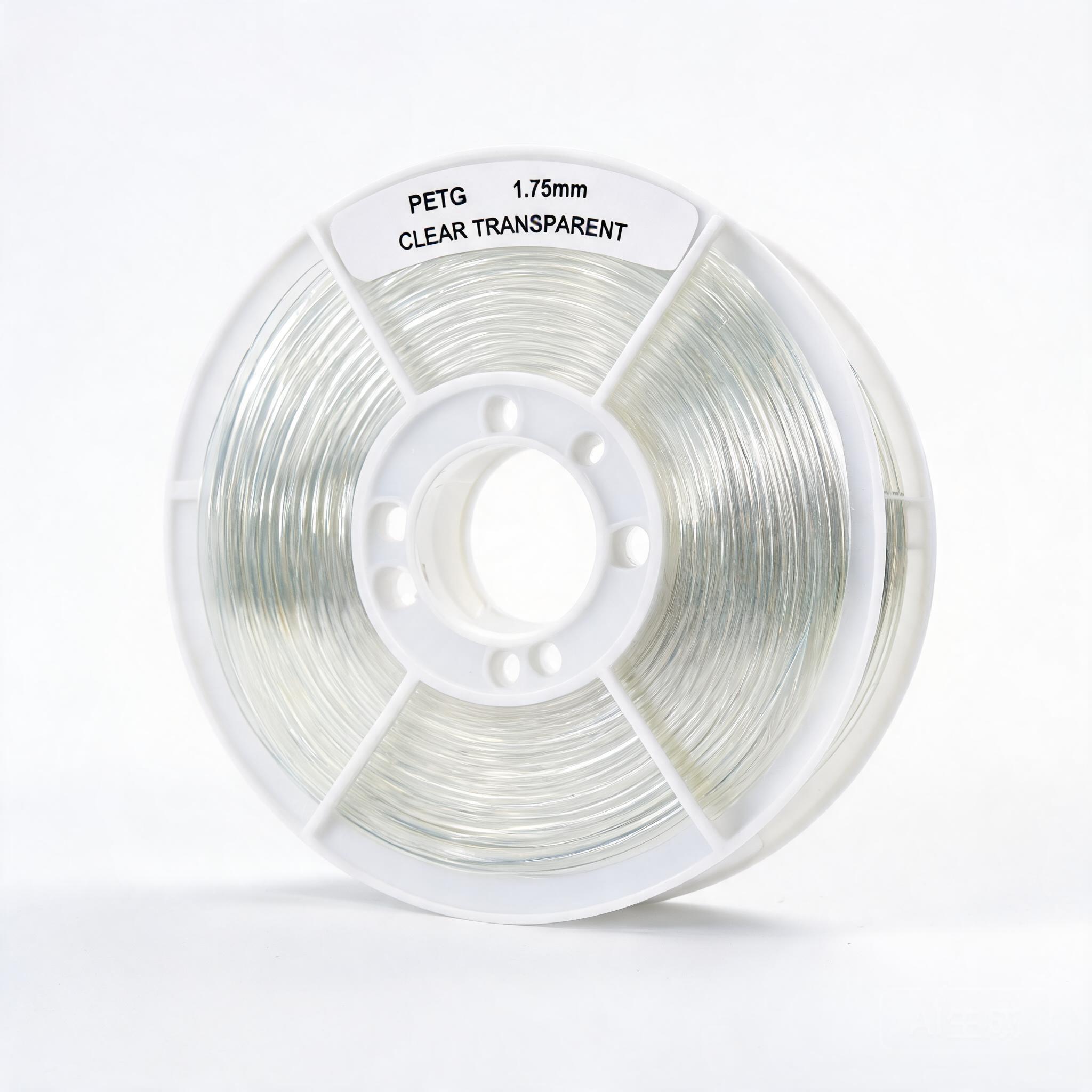
A practical guide to PETG filament properties for B2B buyers — impact strength, heat resistance, chemical and moisture behavior, print settings, PETG vs PLA vs ABS comparison, quality judging criteria, compliance, and factory-direct sourcing.
PETG FILAMENT · MATERIAL PROPERTIES · B2B BUYER GUIDE
If you are sourcing PETG filament for a product line, the first thing to settle is what the material actually gives you before you commit to a supplier and a price. PETG sits between PLA and ABS in most buyers' minds, but the real decision comes down to a handful of measurable properties: impact strength, heat deflection, chemical resistance, and how consistently the spool prints. This guide walks through the PETG filament properties that matter for B2B purchasing, what the numbers mean in practice, and how to judge a supplier's quality claims. The performance figures below are typical values for a clear PETG grade; confirm the exact numbers against the supplier's data sheet before you spec a part.
What PETG filament properties matter most for buyers
PETG (glycol-modified PET) is a copolyester. The glycol modification lowers the crystallinity of standard PET, which is what makes it printable on open-frame FDM machines. For a buyer, the properties that drive a sourcing decision are the ones that show up in the finished part, not the marketing sheet.
- Impact strength — PETG is noticeably tougher than PLA. A typical notched Izod value for a clear PETG grade is around 7.5 kJ/m², roughly three times what standard PLA delivers. That matters for parts that get handled, dropped, or assembled.
- Heat deflection — PETG handles more heat than PLA before it softens. PLA starts to deform around 55–60°C; PETG holds its shape at higher service temperatures, which is why it is chosen for housings and functional prototypes near warm components.
- Chemical and moisture resistance — PETG resists many common solvents and is less prone to moisture absorption than nylon, but it does absorb more moisture than PLA. Wet PETG strings and bubbles, so storage and drying matter.
- Optical clarity — a clear PETG grade can transmit around 92% of light at a 3 mm wall, which makes it the default choice for transparent prototypes and fluid channels.
Mechanical properties: strength and toughness
For functional parts, the number buyers should compare is impact strength, not just tensile strength. A clear PETG grade with an Izod notched impact of 7.5 kJ/m² (a typical value; confirm against the supplier's data sheet) will survive handling and drop testing far better than PLA. The trade-off is that PETG is softer and more flexible than PLA, so it is not the right choice for rigid, dimension-critical parts that must hold a precise shape under load.
Layer adhesion is another factor. PETG bonds well between layers, which reduces the risk of parts splitting along layer lines under stress. This is one reason PETG is a common choice for enclosures, brackets, and parts that see repeated assembly and disassembly.
Thermal properties: heat resistance and print settings
PETG's glass transition temperature sits higher than PLA's, which is why it holds up better near heat sources. In practice, a clear PETG filament prints at a nozzle temperature of 230–250°C with a bed at 70–80°C. Unlike ABS, PETG does not require a heated enclosure for most models because its shrinkage is low — below 0.3% for a well-formulated grade. That keeps large parts dimensionally stable and reduces corner lifting.
PETG vs PLA vs ABS: a quick comparison
| Property | PETG | PLA | ABS |
|---|---|---|---|
| Impact strength | High (≈7.5 kJ/m² notched) | Low | High |
| Heat resistance | Moderate | Low (softens 55–60°C) | High (HDT >95°C) |
| Print difficulty | Easy–moderate | Easy | Harder (needs enclosure) |
| Heated enclosure | Not required | Not required | Recommended |
| Optical clarity | High (clear grades) | Opaque | Opaque |
| Typical use | Transparent parts, housings, functional prototypes | Display models, decorative | Jigs, enclosures, heat-exposed parts |
For a deeper look at PLA, our PLA filament properties guide covers that material's strengths and limits in detail.
Where PETG falls short: limitations to plan around
PETG is not the right answer for every part, and knowing its limits prevents a failed batch. Three limitations matter most for B2B buyers:
- UV sensitivity — like most polyesters, PETG degrades under prolonged direct sunlight. For outdoor parts that face years of UV exposure, consider a UV-stabilized grade or a different material.
- Creep under sustained load — PETG is more flexible than PLA, and under a constant load over time it can deform (creep). It is not ideal for load-bearing parts that must hold a dimension indefinitely.
- Fatigue — repeated flexing can lead to fatigue failure. If a part is cycled continuously, test the specific geometry before committing to volume.
These are general material behaviors, not a judgment on any specific grade. Confirm how a given supplier's formulation behaves in your application with a sample before ordering volume.
How to judge PETG filament quality when sourcing
Two quality signals separate a production-grade PETG filament from a repackaged consumer spool: diameter tolerance and consistency.
- Diameter tolerance — a tight tolerance, such as ±0.02 mm, matters especially for transparent prints. Diameter variation shows up as visible banding in clear walls, and thin spots cause foggy streaks that ruin optical clarity. Ask the supplier for their tolerance spec and how it is measured (for example, laser micrometer readings per meter).
- Batch consistency — the same SKU should print the same across lots. A supplier with closed-loop extrusion control and per-batch QC is more likely to deliver repeatable results than one that repackages imported spools.
- Moisture control — PETG absorbs moisture more readily than PLA. Wet filament strings and bubbles. Confirm the spool is vacuum-sealed with desiccant for export, and see our filament drying and moisture control guide for storage best practices.
A supplier qualification checklist
Before you place a volume order, ask the supplier for evidence you can verify, not just claims:
- Diameter tolerance data — ask for the measurement method (e.g., laser micrometer) and the tolerance band held across a full spool.
- Per-batch certificate of analysis (COA) — confirm what each batch's COA covers, such as diameter, roundness, moisture, and color.
- Quality system — ask whether the facility runs to a documented quality system such as ISO 9001, and request the certificate.
- Compliance documentation — for EU or food-contact applications, request material declarations and any CE or REACH documentation per batch.
- Sample approval — run a sample spool through your own print and test process before committing to volume.
Compliance and documentation for importers
If you are importing PETG filament into the EU or selling parts made from it, compliance documentation matters. A clear PETG grade can be formulated to meet the material requirements of EU Regulation 10/2011 and FDA 21 CFR 177.1630 for repeated-use food contact surfaces — but you should verify compliance against your specific end-use and national regulations. Ask the supplier for material declarations and CE documentation per batch. For a broader view of EU requirements, see our EU REACH and RoHS compliance guide.
FAQ
Is PETG filament stronger than PLA?
PETG is tougher than PLA in impact resistance — a clear grade can reach around 7.5 kJ/m² notched Izod (typical value), about three times standard PLA. It is also more flexible, so for rigid dimension-critical parts PLA may still be preferred.
What temperature do you print PETG filament at?
A typical clear PETG prints at a nozzle temperature of 230–250°C with a bed at 70–80°C. No heated enclosure is required for most models because PETG shrinkage is low.
Does PETG need to be dried?
Yes. PETG absorbs moisture more readily than PLA. Wet filament causes stringing, popping, and bubbles in transparent prints. Store spools sealed with desiccant and dry before use if exposed to humidity.
Is PETG filament food safe?
A clear PETG grade can be formulated to meet the material requirements of EU Regulation 10/2011 and FDA 21 CFR 177.1630 for repeated-use food contact surfaces. Verify compliance against your specific end-use and national regulations.
What is the MOQ for PETG filament from a factory?
For factory-direct sourcing, a typical MOQ is 200 spools per SKU, with mixed-pallet options across PLA, PETG, ABS, and TPU lines. This is Wanzhoutong's standard policy; confirm MOQ and lead time with your supplier for your target quantity.
This guide was prepared by the Wanzhoutong technical team. Performance figures are typical values for a clear PETG grade and should be confirmed against the supplier's data sheet for your specific application.
Source PETG filament from a factory with tight tolerance control
Wanzhoutong states it extrudes PETG on a 12-line facility with closed-loop diameter control holding ±0.02 mm. Send your target quantity, delivery port, and documentation requirements for a quote, and request a sample spool to verify.
View PETG Clear Filament 1.75mm