
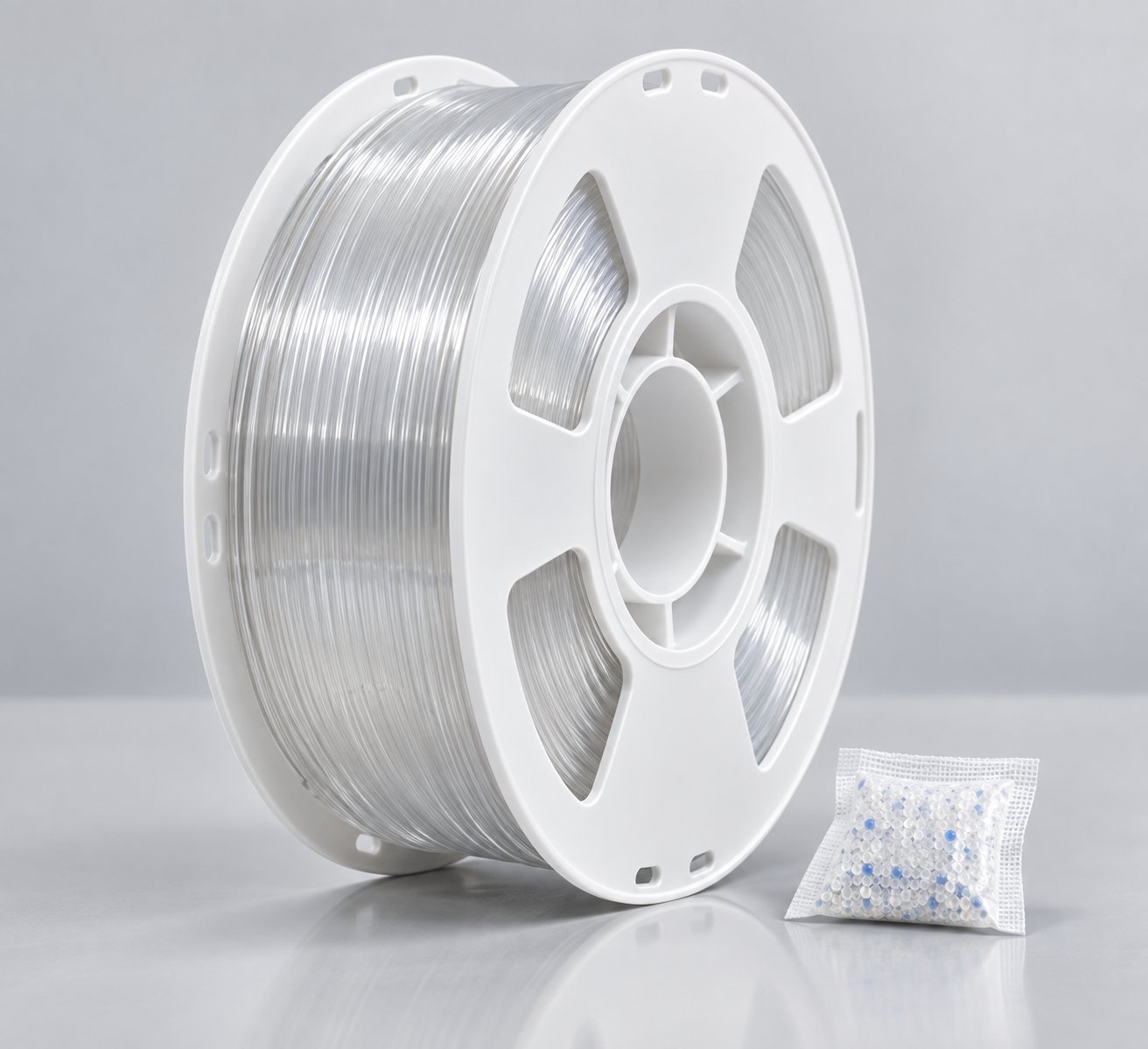
Learn why hygroscopic filaments like PLA, PETG, ABS, and TPU become brittle from absorbed moisture, how to recognize moisture damage, how to dry and store filament correctly, and what to check in a supplier's packaging to avoid moisture-damaged stock.
If your filament snaps before it even reaches the extruder, or prints come out stringy and weak, moisture is usually the cause. PLA, PETG, ABS, TPU, and nylon are all hygroscopic — they absorb moisture from the air. That absorbed water degrades the polymer and turns a perfectly good spool into a source of failed prints and wasted material.
This article explains why moisture makes filament brittle, how to recognize moisture damage, how to dry and store filament correctly, and what to check in a supplier's packaging so you don't receive moisture-damaged stock in the first place.
Key takeaway: Brittle filament is almost always a moisture problem, not a material defect. Correct drying and storage solve most cases. For wholesale buyers, packaging quality at the source matters just as much — vacuum-sealed spools with desiccant arrive dry and stay dry on the shelf.
Why Moisture Makes Filament Brittle
Hygroscopic polymers absorb water molecules from ambient air. The absorbed moisture acts as a plasticizer at the molecular level, disrupting the polymer chains. When the filament is heated in the nozzle, the water turns to steam, creating bubbles and weak spots. The result is a filament that snaps easily, especially after it has been exposed to humid air for days or weeks.
This is not a quality defect from the factory — it's an environmental condition. Even high-quality filament will become brittle if left unwrapped in a humid room. The rate of absorption depends on the material and the humidity level. Nylon absorbs moisture the fastest, followed by TPU, PETG, and ABS. PLA is less sensitive but still hygroscopic enough to cause problems in humid climates.
How to Recognize Moisture Damage
Moisture-damaged filament shows clear symptoms during printing and handling. If you notice any of the following, moisture is the likely culprit:
- Snapping: The filament breaks easily when bent, especially near the spool or in the Bowden tube. Dry filament should bend without breaking.
- Stringing and oozing: Excess moisture creates steam pressure, causing the melted plastic to ooze from the nozzle and leave stringy webs between parts.
- Poor layer adhesion: Water vapor disrupts the bond between layers, resulting in weak, delaminating prints.
- Surface defects: Bubbles, pitting, or a rough, matte surface on the printed part indicate trapped moisture.
- Popping or hissing sounds: You may hear steam escaping from the nozzle during printing.
If you see these signs, the fix is straightforward: dry the filament before printing.
How to Dry Filament
Drying removes absorbed moisture and restores the filament's mechanical properties. The process is simple, but the exact parameters depend on the material.
Follow the manufacturer's recommended drying temperature and time. Each material has a specific drying profile — too hot and the filament deforms; too short and the moisture remains. For example, PETG typically requires a lower temperature than nylon, but always check the spool label or the supplier's technical data sheet.
You can use a filament dryer, a food dehydrator, or an oven with accurate temperature control. Place the spool in the dryer for the recommended duration, then use it immediately or store it in a dry, sealed container.
If you don't have a dryer, you can still reduce moisture by keeping the filament in a sealed box with a large amount of desiccant for an extended period, but this is slower and less effective than active drying.
How to Store Filament
Prevention is better than cure. Proper storage keeps filament dry between print jobs and extends its usable life.
- Use airtight containers: Store filament in sealed boxes or bags with a gasket.
- Add desiccant: Silica gel packets or bulk desiccant absorb residual moisture inside the container. Replace or regenerate the desiccant regularly.
- Avoid humid environments: Keep filament away from basements, laundry rooms, and other high-humidity areas. A dry, climate-controlled room is ideal.
- Keep the original packaging: Vacuum-sealed bags with desiccant are the best storage until you open the spool.
For a quick reference, here's a comparison of common filament types and their moisture sensitivity:
| Material | Moisture Sensitivity | Common Issues When Wet |
|---|---|---|
| PLA | Moderate | Snapping, stringing, poor surface finish |
| PETG | High | Stringing, weak layers, bubbles |
| ABS | Moderate | Snapping, poor adhesion, steam pops |
| TPU | Very High | Flexibility loss, stringing, inconsistent extrusion |
| Nylon | Extreme | Brittleness, warping, poor layer bond |
What to Check in a Supplier's Packaging
For B2B buyers, moisture damage often starts before the spool reaches your warehouse. If a supplier ships filament in thin plastic bags without desiccant, or if the vacuum seal is broken, the filament may already be absorbing moisture during transit — especially on long ocean shipments to Southeast Asia or Europe, where humidity is high.
When evaluating a supplier, check for the following:
- Vacuum-sealed packaging: The spool should be in a vacuum-sealed bag with minimal air inside. This prevents moisture from reaching the filament during storage and transit.
- Desiccant included: A desiccant packet inside the bag absorbs any residual moisture. This is a sign that the supplier understands moisture control.
- Seal integrity: Inspect a sample of incoming shipments. If the seal is broken or the bag is punctured, reject the batch or dry the filament before use.
- Diameter tolerance: Consistent diameter is critical for reliable printing. Look for suppliers that state a tight tolerance, such as 1.75 mm ± 0.02 mm.
Wanzhoutong, a factory-direct supplier of 3D printing filaments and color masterbatch, uses vacuum-sealed packaging with desiccant for its PETG Clear Filament 1.75mm. This is specifically designed for moisture-sensitive export to Southeast Asia and Europe. The PETG has low warp and high impact resistance, with an Izod impact strength of 7.5 kJ/m², making it a reliable choice for functional parts. The company operates 12 extrusion lines with strict diameter tolerance control, ensuring consistent quality across batches.
For other materials, Wanzhoutong also offers PLA Matte Black Filament 1.75mm and ABS High Impact Grey Filament 1.75mm, both suitable for a range of applications.
FAQ
How long does it take for filament to absorb moisture?
It depends on the material and humidity. In a humid environment, some filaments like nylon can show signs of moisture absorption within hours. PLA and PETG may take days. The best practice is to assume that any filament left open in a humid room is absorbing moisture.
Can I dry filament in a regular oven?
Yes, but only if the oven has accurate temperature control and can maintain a low, consistent temperature. If the temperature fluctuates or exceeds the material's safe range, the filament can deform or melt. Always follow the manufacturer's recommended drying temperature and time.
How do I know if my filament is too wet to save?
If the filament snaps easily and does not improve after drying, it may be too degraded. In most cases, drying restores the filament, but if the material has been exposed to moisture for a very long time, the polymer chains may be permanently damaged. When in doubt, test a small print after drying.
What is a good humidity level for filament storage?
Lower is better. A dry, sealed container with desiccant is the standard. Avoid storing filament in areas with high humidity, such as basements or near windows. The exact humidity level depends on the material and your environment; the key is to keep the filament sealed and dry.
Why does my PLA filament snap even though it's new?
New filament can still be affected by moisture if the packaging was not sealed properly or if it was stored in a humid warehouse. Check the packaging for vacuum seal integrity and desiccant. If the filament snaps, dry it before use.
Brittle filament is a solvable problem. Dry your filament correctly, store it in a sealed container with desiccant, and choose a supplier that ships moisture-protected. For wholesale buyers, vacuum-sealed packaging with desiccant is a clear sign that the supplier understands the challenges of moisture-sensitive materials — and that your production line won't be the one dealing with snapped spools.