
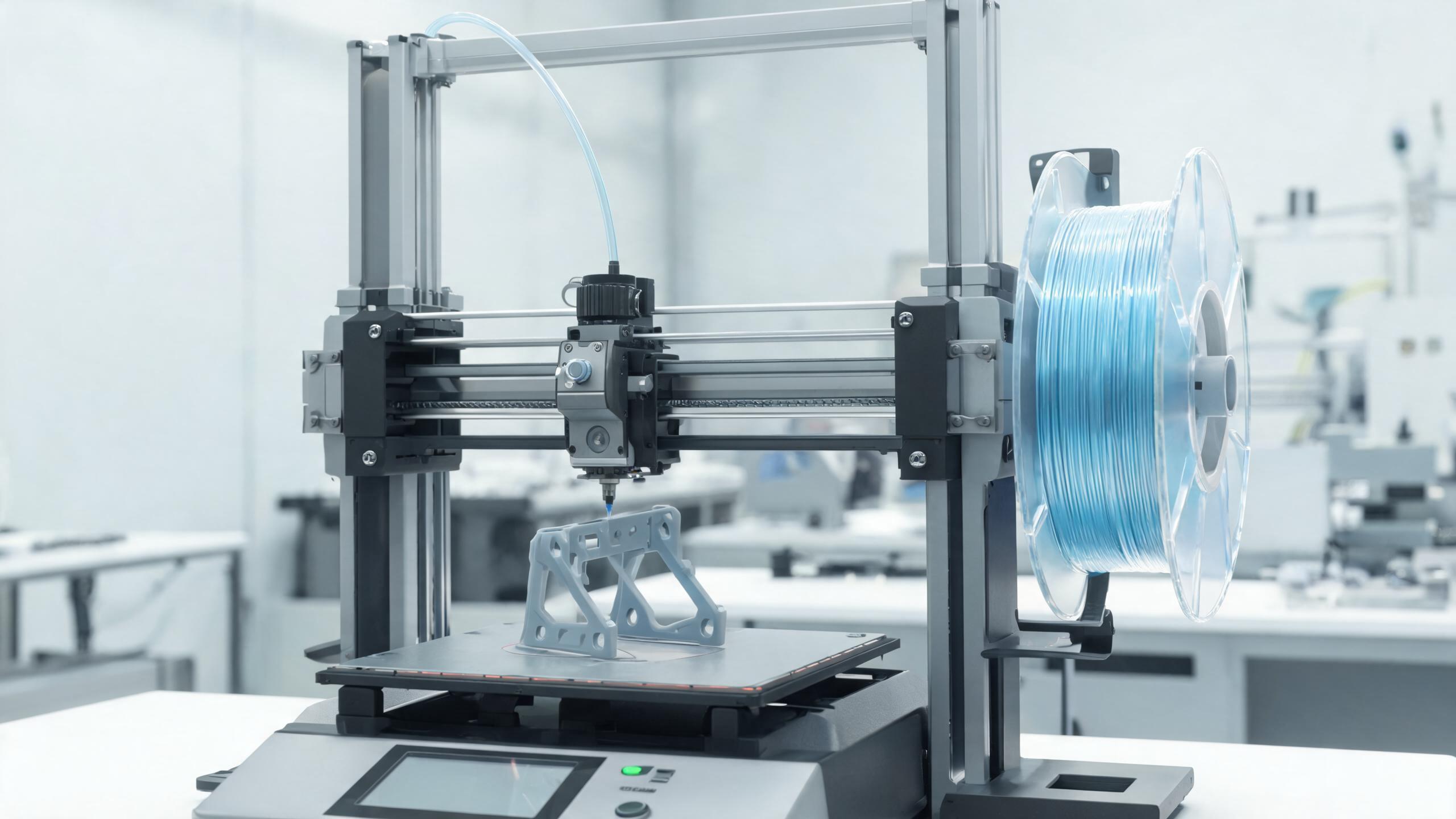
A B2B buyer's guide to PETG for functional parts: toughness, moisture resistance, heat behavior, layer adhesion, and where it still loses to ABS or nylon. Includes sourcing checks and compliance notes.
BUYER GUIDE
If you are sourcing filament for functional parts—brackets, enclosures, jigs, fixtures, or anything that will actually be handled, loaded, or exposed to the environment—you have probably noticed that PLA is not cutting it. It prints easily, but it is brittle and does not like heat or moisture. So what is PETG filament used for? In short: parts that need to survive real use. This guide explains why PETG has become the default choice for functional parts in many workshops, where it still loses to ABS or nylon, and what B2B buyers should check before committing to a supplier.
What Makes PETG Different from PLA for Functional Parts
PLA is a great material for prototypes and visual models. It is stiff, cheap, and easy to print. But when a part has to take a load, resist a drop, or sit near a warm motor, PLA's limitations show up fast. PETG sits between PLA and ABS. It is tougher, more durable, and more forgiving to print than ABS—no heated chamber needed for most models, which is a real advantage in a production environment.
The key property is impact strength. For example, the PETG Clear Filament 1.75mm from wanzhouto00 has an Izod impact strength of 7.5 kJ/m²—about three times tougher than standard PLA. That is not a marketing claim; it is a measured value you can compare across suppliers. For functional parts, that difference means the difference between a bracket that cracks on first assembly and one that survives years of service.
PETG also handles moisture better than PLA. PLA is hygroscopic and can degrade with humidity, which is a problem in Southeast Asia and other tropical markets. PETG is more resistant, so parts keep their dimensions and mechanical properties longer in humid conditions. This matters for anything shipped or stored in non-climate-controlled environments.
Heat behavior is another differentiator. PLA softens at relatively low temperatures. PETG has a higher heat deflection, so it can handle warmer environments—under a car hood, near a motor, or in a sunny enclosure. It will not match ABS (which has a heat deflection above 95°C), but it is good enough for many moderate-heat applications.
Layer adhesion is where PETG really shines. Because it bonds well between layers, printed parts are closer to isotropic—they do not split along layer lines as easily as PLA. For functional parts, this is critical. A part that fails at a layer line is a part that fails, period.
Where PETG Still Loses to ABS or Nylon
PETG is not a universal answer. For high-temperature environments, ABS is still the better choice. If a part will sit near a heat source exceeding 95°C, ABS—with its heat deflection above that point—is safer. PETG will soften and deform under sustained high heat.
For extreme mechanical loads, nylon has higher tensile strength and wear resistance. Nylon parts can handle repeated friction and heavy stress better than PETG. But nylon is harder to print: it warps, absorbs moisture from the air, and often requires a heated chamber and drying equipment. PETG is a middle ground—stronger than PLA, easier than ABS or nylon.
So the decision matrix looks like this:
| Material | Strength | Heat resistance | Ease of printing | Best for |
|---|---|---|---|---|
| PLA | Low | Low | Very easy | Prototypes, visual models |
| PETG | Medium-high (impact 7.5 kJ/m²) | Medium | Easy (no heated chamber needed) | Functional parts, end-use parts |
| ABS | Medium (tensile 42 MPa) | High (above 95°C) | Harder (heated chamber recommended) | High-heat applications |
| Nylon | High | Medium | Hardest | Heavy mechanical loads |
For most workshop and production parts, PETG is the sweet spot. It gives you the toughness and moisture resistance you need without the print headaches of ABS or nylon.
What to Check When Sourcing PETG for Functional Parts
Not all PETG is the same. When you evaluate a supplier, look beyond the price per kilo. Here are the checks that matter:
- Diameter tolerance: For consistent extrusion and strong parts, the filament diameter must be precise. Look for ±0.02 mm or better, which indicates closed-loop extrusion control. wanzhouto00's PETG, for example, is held to 1.75 mm ± 0.02 mm.
- Impact strength data: Ask for the Izod or Charpy impact value. If the supplier cannot provide it, be cautious. A number like 7.5 kJ/m² tells you the material is genuinely tough.
- Shrinkage: Low shrinkage (below 0.3% is typical for PETG) means parts will hold their dimensions and not warp. This is especially important for large flat parts.
- Moisture protection: PETG absorbs moisture from the air, which can cause bubbles and weak prints. A good supplier will vacuum-seal the filament with desiccant. This is a practical detail that affects your production quality.
- Compliance: If you are making food-contact parts, check whether the filament meets relevant regulations. wanzhouto00's PETG is formulated to meet EU 10/2011 and FDA 21 CFR 177.1630 material requirements, but you should verify compliance for your specific end-use.
- Consistency: Ask about the supplier's extrusion lines and quality control. A factory with multiple lines and strict tolerance control is more likely to deliver consistent material across batches.
For a deeper dive into sourcing criteria, see our PETG filament sourcing guide. It covers specifications and buying tips in more detail.
Practical Takeaways for B2B Buyers
Key takeaways:
- PETG is the first choice for functional parts when you need toughness, moisture resistance, and moderate heat resistance—without the print difficulty of ABS or nylon.
- Check impact strength (e.g., 7.5 kJ/m²), diameter tolerance (±0.02 mm), and shrinkage (<0.3%) on the datasheet.
- For high-heat environments above 95°C, choose ABS. For extreme mechanical loads, consider nylon.
- Moisture protection in packaging matters—vacuum-sealed with desiccant is a sign of a professional supplier.
- Compliance with food-contact regulations must be verified for your specific application, not assumed.
Frequently Asked Questions
What is PETG filament used for?
PETG filament is used for functional parts that need toughness and durability: brackets, enclosures, jigs, fixtures, and end-use components. It is also used for food-contact containers and medical device prototypes, provided the specific filament meets relevant regulations.
Is PETG stronger than PLA?
Yes, PETG is significantly tougher than PLA. For example, a typical PETG has an Izod impact strength around 7.5 kJ/m², about three times higher than standard PLA. It also has better layer adhesion, so printed parts are less likely to split.
Does PETG need a heated chamber?
For most models, no. PETG has low shrinkage (below 0.3%), so it does not require a heated chamber like ABS. This makes it easier to print in a standard open-frame printer.
Can PETG be used for food contact?
Some PETG filaments are formulated to meet food-contact regulations such as EU 10/2011 and FDA 21 CFR 177.1630. However, you must verify that the specific filament and your printing process meet the requirements for your intended use.
Conclusion: Make PETG Your Default for Functional Parts
When you are sourcing filament for functional parts, PETG is the material that balances performance and practicality. It gives you the toughness, moisture resistance, and layer adhesion that PLA lacks, while staying easier to print than ABS or nylon. That is why it has become the first choice for so many workshops and production environments.
But the material is only half the equation. The supplier's quality control matters just as much. Look for a factory that can show you measured impact strength, tight diameter tolerance, and proper moisture protection. wanzhouto00, a factory-direct supplier with 12 extrusion lines and strict tolerance control, offers PETG Clear Filament 1.75mm that meets these criteria. If you are also sourcing custom colors for your parts, check our colour masterbatch guide.
For your next functional part order, start with PETG. It is the safe, smart choice.