
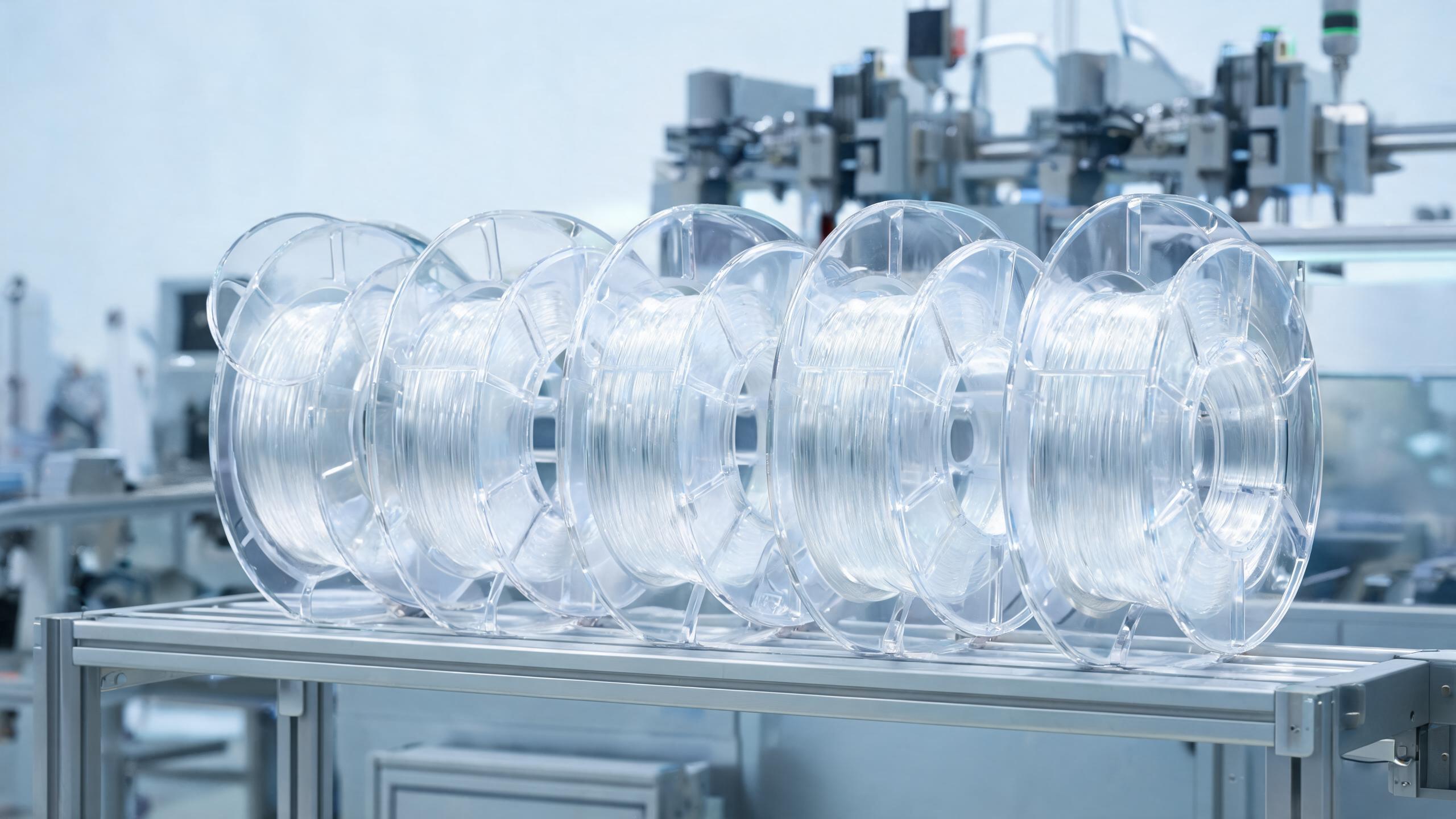
A comprehensive guide for B2B buyers of PETG 3D printing filament. Covers key properties, technical specifications, quality indicators, compliance requirements for the European market, and actionable tips for evaluating suppliers. Includes comparison tables, common pitfalls, and a supplier checklist.
BUYER GUIDE
- PETG filament is the preferred material for functional prototypes, jigs, and end-use parts requiring impact resistance and chemical resistance — better layer adhesion than PLA, easier to print than ABS.
- For European buyers, PETG filament CE compliant (CE marking under the Machinery Directive or REACH) is a minimum requirement; ask for a Declaration of Conformity (DoC).
- When sourcing PETG filament 1.75mm bulk, focus on dimensional tolerance (±0.02mm or better), moisture packaging, and batch-to-batch consistency.
- PETG CF (carbon-fiber-reinforced PETG) offers higher stiffness and dimensional stability, but requires hardened nozzles and careful drying.
- Always request a sample spool and a Certificate of Analysis (CoA) before committing to a large order.
Introduction: Why PETG for B2B 3D Printing?
PETG (polyethylene terephthalate glycol-modified) has become a workhorse material across industrial 3D printing applications. It bridges the gap between PLA's ease of printing and ABS's mechanical strength. For B2B buyers — whether you run a service bureau, a prototyping shop, or a production line making jigs and fixtures — PETG 3D printing filament offers a reliable, cost-effective option.
This guide covers the properties you need to verify, the specifications that matter for bulk purchasing, and the compliance requirements for selling or using PETG filament in Europe. It is written for procurement professionals and engineers who need to evaluate suppliers, not for hobbyists.
1. PETG Filament Properties: What Buyers Should Verify
Not all PETG filament is the same. The base resin, additives, and processing conditions affect print quality and final part performance. Here are the properties you should confirm with your supplier.
1.1 Mechanical & Thermal Properties
| Property | Typical Value (Standard PETG) | Why It Matters |
|---|---|---|
| Tensile Strength | 45–55 MPa | Determines load-bearing capacity for functional parts. |
| Elongation at Break | 15–30% | Indicates ductility; higher values mean parts bend before breaking. |
| Flexural Modulus | 2.0–2.3 GPa | Stiffness — important for jigs and fixtures. |
| Heat Deflection Temp (HDT, 0.45 MPa) | 65–70°C | Maximum service temperature without deformation. |
| Glass Transition Temp (Tg) | 78–82°C | Affects annealing and post-processing limits. |
| Impact Strength (Izod, notched) | 20–40 kJ/m² | Resistance to sudden shock; PETG outperforms PLA here. |
These values are typical for a good-quality PETG filament. Ask your supplier for their specific test data. If they cannot provide it, treat that as a red flag.
1.2 Chemical Resistance
PETG resists weak acids, alkalis, and many solvents. It is not suitable for continuous exposure to strong acids, ketones (like acetone), or aromatic hydrocarbons. For chemical storage or lab equipment, confirm the specific chemical environment with the supplier.
1.3 Printing Parameters (Typical Range)
- Nozzle temperature: 230–250°C
- Bed temperature: 70–80°C (glass or PEI sheet recommended)
- Print speed: 40–80 mm/s
- Cooling fan: 30–50% (too much fan can cause warping)
- Drying requirement: 65°C for 4–6 hours before printing (moisture causes stringing and bubbles)
2. PETG Filament Specifications: What to Look for in Bulk
When sourcing PETG filament 1.75mm bulk, the spec sheet is your first filter. Here are the critical parameters.
2.1 Diameter Tolerance
The most important quality metric. A loose tolerance causes inconsistent extrusion, under-extrusion, or clogging.
- Good: ±0.05 mm
- Better: ±0.03 mm
- Best: ±0.02 mm or tighter
Ask for a diameter report from the supplier's production line. A 10 kg spool of 1.75 mm filament should not vary by more than 0.03 mm along its length.
2.2 Roundness & Ovality
Oval filament (not perfectly round) causes variable extrusion. The spec should state roundness ≤ 0.02 mm.
2.3 Moisture Content
PETG is hygroscopic. Moisture causes bubbles, popping sounds, and weak parts. The supplier should vacuum-pack the filament with a desiccant bag. The moisture content at packaging should be below 0.02% (200 ppm).
2.4 Spooling & Winding
Poor winding leads to tangles and jams. Look for:
- Even, tension-controlled winding (no loose loops)
- Spool material: recycled cardboard or plastic (confirm with supplier)
- Spool dimensions: standard 200 mm diameter / 56 mm hub (common for 1 kg spools)
2.5 Batch-to-Batch Consistency
For bulk orders, you need consistent color, diameter, and mechanical properties across batches. Ask the supplier for a Certificate of Analysis (CoA) for each batch. A CoA should include:
- Melt flow index (MFI)
- Diameter measurement (average, min, max, standard deviation)
- Moisture content
- Color coordinates (L*a*b* values)
3. PETG CF: Carbon-Fiber-Reinforced PETG
PETG CF (carbon-fiber-reinforced PETG) contains short carbon fibers (typically 10–20% by weight). It offers higher stiffness, lower thermal expansion, and better dimensional stability than standard PETG. It is used for:
- Drone frames and RC parts
- Tooling and fixtures
- Automotive under-hood components
- Lightweight structural prototypes
Key Differences from Standard PETG
| Parameter | Standard PETG | PETG CF |
|---|---|---|
| Flexural Modulus | 2.0–2.3 GPa | 4.5–6.0 GPa |
| Tensile Strength | 45–55 MPa | 50–70 MPa |
| Density | 1.27 g/cm³ | 1.30–1.35 g/cm³ |
| Print Difficulty | Moderate | Higher (requires hardened nozzle, slower speed) |
| Surface Finish | Smooth, glossy | Matte, textured |
| Cost | Lower | Higher (typically 1.5–2x) |
Note: PETG CF is abrasive. You must use a hardened steel or ruby nozzle. Standard brass nozzles wear out quickly.
4. Compliance: PETG Filament CE Compliant for Europe
If you are importing PETG filament into the European Union, or if your customers use it in Europe, compliance is not optional. Here is what you need.
4.1 CE Marking
PETG filament sold as a product for 3D printing likely falls under the General Product Safety Directive (GPSD) or REACH (Registration, Evaluation, Authorisation and Restriction of Chemicals). The supplier must provide a Declaration of Conformity (DoC) stating that the product meets applicable EU standards.
For PETG filament CE compliant, the key documents are:
- Declaration of Conformity (DoC)
- Technical file (including test reports)
- Material Safety Data Sheet (MSDS) in the language of the destination country
4.2 REACH & RoHS
PETG filament must comply with REACH (no substances of very high concern above the threshold) and RoHS (restriction of hazardous substances like lead, mercury, cadmium). Ask for a REACH compliance statement and a RoHS test report.
4.3 Other Certifications (Optional but Useful)
- ISO 9001 — Quality management system certification for the factory.
- UL 94 — Flammability rating (e.g., HB or V-0). Useful for electronics enclosures.
- FDA — Food contact approval (only for specific PETG grades). Not standard for all PETG filament.
5. B2B Buying Tips: How to Evaluate a PETG Filament Supplier
Use this checklist when contacting potential suppliers for PETG filament 1.75mm bulk or other formats.
5.1 Supplier Evaluation Checklist
- Ask for a sample spool (1 kg). Print test parts using your own printers. Check for stringing, layer adhesion, and dimensional accuracy.
- Request a CoA for the sample batch. Compare the values to the supplier's claims.
- Verify the diameter tolerance. Use a micrometer to measure at 10 random points along the spool.
- Check the packaging. Is it vacuum-sealed? Does it include a desiccant bag? Is the spool damage-free?
- Ask about lead time and MOQ. For bulk orders, typical MOQ is 50–100 kg per SKU. Lead time is usually 7–15 days for standard colors, longer for custom colors.
- Confirm the shipping terms. FOB (port of origin) or CIF (destination port). Ask about incoterms.
- Check the MSDS and DoC. If you are exporting to Europe, the DoC must be in the language of the destination country.
- Ask about custom colors and custom spooling. Some suppliers offer color matching (Pantone) and custom spool labeling.
5.2 Common Pitfalls to Avoid
- Buying on price alone. Low-cost PETG often uses recycled or off-spec resin. It will have poor diameter tolerance, high moisture, and inconsistent mechanical properties.
- Ignoring moisture. Even "factory-sealed" spools can absorb moisture if stored improperly. Always dry PETG before printing, even if it is new.
- Assuming all PETG is the same. Different resin grades (e.g., Eastman, SK Chemicals, SABIC) have different properties. Ask the supplier which resin they use.
- Not testing batch consistency. A good first spool does not guarantee the next 100 spools are identical. Insist on batch testing.
6. PETG vs. Other Common Filaments: Quick Comparison
| Property | PETG | PLA | ABS | PETG CF |
|---|---|---|---|---|
| Ease of Printing | Moderate | Easy | Hard | Hard |
| Impact Resistance | High | Low | High | Medium |
| Heat Resistance | 65–70°C | 50–60°C | 80–100°C | 70–85°C |
| Chemical Resistance | Good | Poor | Good | Good |
| UV Resistance | Good (with additive) | Poor | Poor | Good |
| Odor During Printing | Low | Low (sweet) | Strong (styrene) | Low |
| Cost per kg (Bulk) | €8–€15 | €6–€12 | €10–€18 | €15–€25 |
7. PETG Filament Europe: Import & Distribution Considerations
For buyers sourcing PETG filament Europe, there are additional factors to consider:
- Customs & Tariffs: PETG filament falls under HS code 3916.90 (monofilament of plastics). Check the current EU tariff rate and any anti-dumping duties applicable to the country of origin.
- EU Authorized Representative: If the manufacturer is outside the EU, they may need an EU-based authorized representative for CE marking compliance.
- Logistics: PETG filament is lightweight but bulky. Shipping costs are often volumetric. Ask the supplier for the exact spool dimensions and weight to calculate shipping.
- Warehousing: If you plan to stock PETG filament in Europe, ensure the warehouse is climate-controlled (below 25°C, humidity below 50%).
Frequently Asked Questions (FAQ)
Q: What is the difference between PETG and PETG CF?
PETG CF contains short carbon fibers (typically 10–20% by weight). It is stiffer, has lower thermal expansion, and a matte finish. It requires a hardened nozzle and is more expensive.
Q: Is PETG filament food-safe?
Not all PETG is food-safe. Only specific grades (e.g., Eastman Amphora) are FDA-approved for food contact. Always ask the supplier for a food-contact certificate if that is your requirement.
Q: How do I store PETG filament?
Store in a sealed bag with desiccant, in a dry environment (humidity < 20%). Use a dry box or a filament dryer before printing if the spool has been exposed to air for more than 24 hours.
Q: What is the typical MOQ for PETG filament 1.75mm bulk?
For standard colors, MOQ is usually 50–100 kg per SKU. For custom colors, MOQ can be 200–500 kg. Confirm with the supplier.
Q: Can I get PETG filament with a CE declaration?
Yes. Many suppliers offer PETG filament CE compliant. Ask for a Declaration of Conformity and a REACH compliance statement. If the supplier cannot provide one, consider that a risk.
Q: How do I test PETG filament quality myself?
Print a standard test cube (20 mm) at recommended settings. Measure the dimensions with calipers. Check for stringing, layer adhesion, and surface finish. Then do a simple bend test — good PETG bends without breaking; poor PETG snaps.
Conclusion: Make an Informed Sourcing Decision
PETG 3D printing filament is a reliable material for B2B applications, but only if you source it from a supplier who can provide consistent quality, proper documentation, and compliance with your target market's regulations. Start with a sample, verify the specs, and always ask for a CoA and DoC.
If you are looking for a supplier of PETG filament 1.75mm bulk with CE compliance and batch-to-batch consistency, contact us. We can provide samples, technical data sheets, and a CoA for your evaluation.