
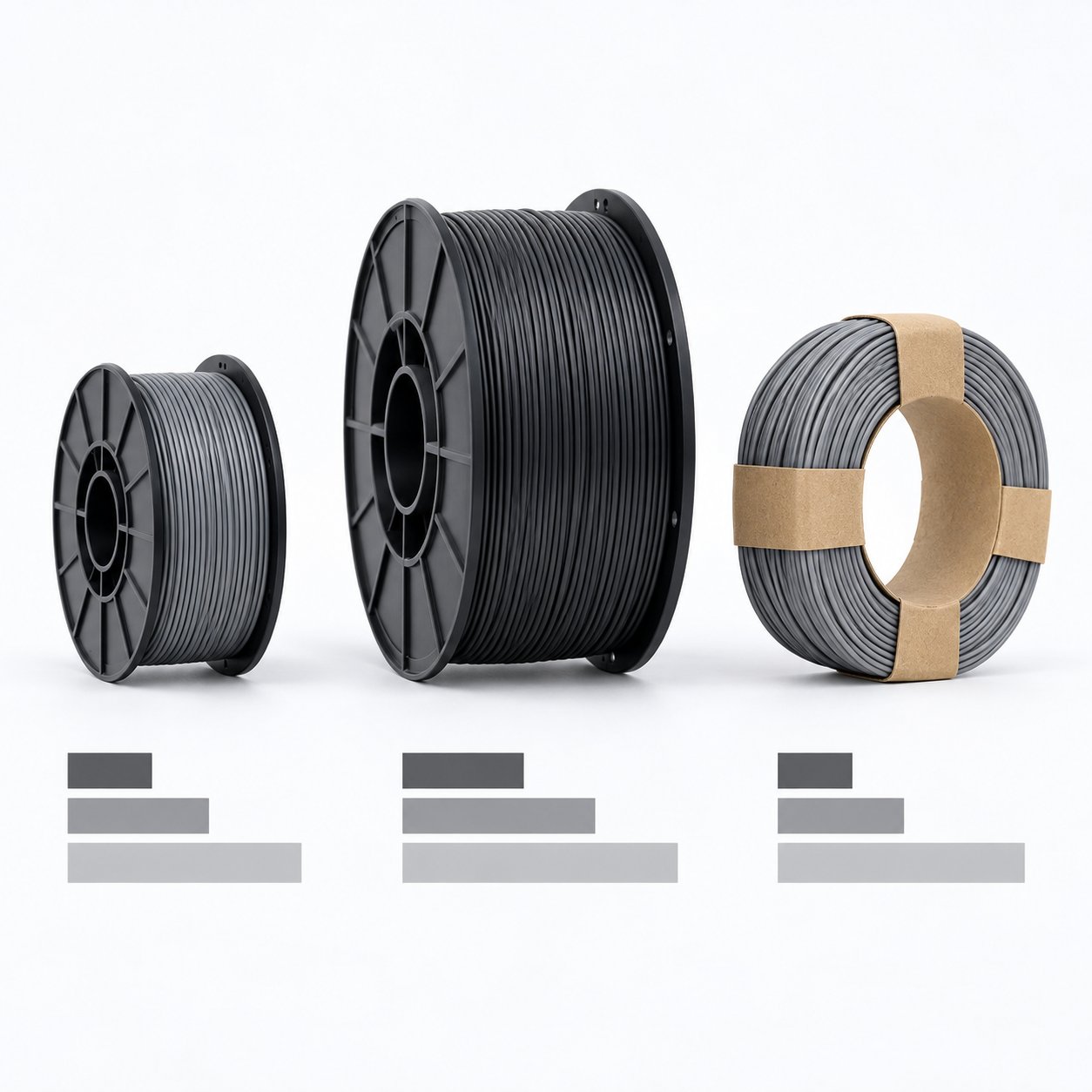
A procurement-focused comparison of 1 kg spools, 5 kg spools, and spool-free refills for importers and distributors, plus a breakdown of the real cost drivers behind filament cost per kg and how to evaluate a supplier quote.
If you are sourcing 3D printer filament for resale, the spool format you choose affects your landed cost, your warehouse space, and how many of your customers come back with complaints about tangles. The price per kilogram on a quote sheet rarely tells the full story. This article compares the common spool options and breaks down what actually drives filament cost per kg, so you can evaluate a supplier quote with specific questions rather than guesswork.
In this guide
Why the spool format is a procurement decision Spool options compared: 1 kg, 5 kg, and spool-free What drives cost per kg How to evaluate a per-kg quote Buyer questions answeredWhy the spool format is a procurement decision
The standard spool weight in the industry is 1.0 kg net. That is the format most of your customers know, and it is what most printers are set up to hold. But if you are importing container volumes, the spool itself becomes a cost and logistics factor. A 1 kg spool of filament is mostly plastic and cardboard around a smaller amount of product. Ship the same filament spool-free, and you reduce freight volume and eliminate the cost of the spool itself.
That trade-off is the core of the decision. It is not about which format is "better" in the abstract. It is about what your market expects, what your customers' machines accept, and whether the savings from bulk formats survive the logistics chain to your warehouse.
Spool options compared: 1 kg, 5 kg, and spool-free
Three formats dominate B2B filament sourcing. Each solves a different problem.
1 kg spools: the retail standard
This is the baseline. A 1 kg spool is what individual users buy, and it is what most retail shelves carry. For a distributor, the advantages are clear: it matches end-user expectations, it is easy to stock, and it moves without special handling. The disadvantages are equally clear: you pay for a spool on every kilogram, and you ship a lot of air and plastic.
When you source 1 kg spools, the quality of the winding matters more than the brand printed on the spool. Poorly wound filament tangles during long prints, and a tangled spool is a returned product. At Wanzhoutong, spools are machine-wound with even tension specifically to prevent this. That is a specification you should ask every supplier about, not assume.
5 kg spools: for volume users and print farms
For customers running multiple machines or long production jobs, a 5 kg spool means fewer spool changes and a lower per-kg price. The trade-off is handling. A 5 kg spool is heavy, and it requires a printer or a filament holder that can support the weight. Not all machines can. If your market is print farms and industrial users, this format has real demand. If your market is hobbyists and small studios, it will sit on your shelf.
Ask your supplier whether the 5 kg spool uses the same winding process and quality checks as the 1 kg format. The risk of tangling increases with spool size if the winding tension is not controlled.
Spool-free filament and refill coils
This is the format buyers search for when they ask "where to buy filament without spool." Spool-free filament is wound into a coil that the customer mounts on a reusable spool. It is the lowest-cost format per kilogram because there is no single-use spool to pay for, and it ships in a smaller box.
The catch is that not every customer wants to manage a refill. It requires a reusable spool, and the coil must be wound tightly enough to survive shipping without collapsing. For a distributor, spool-free filament is a strong option for repeat customers who have already bought their first spool. It is a harder sell for first-time buyers.
| Format | Best for | Key cost factor | Key risk |
|---|---|---|---|
| 1 kg spool | Retail, hobbyists, small studios | Spool cost per kg is highest | Poor winding causes tangles |
| 5 kg spool | Print farms, industrial users | Lower per-kg price, fewer changes | Machine must support weight |
| Spool-free / refill | Repeat customers, cost-sensitive buyers | Lowest cost per kg, smaller freight | Requires reusable spool |
Decision principle: Choose the format that matches your customers' equipment and buying habits first. Let the cost per kg savings from bulk formats be a secondary factor, not the primary one.
What actually drives cost per kg
When a supplier quotes you a price per kilogram, the number is built from several components. Understanding them lets you compare quotes fairly and spot where a low price might be hiding a real cost.
Material cost and polymer grade
The base resin is the largest single component of filament cost per kg. A standard PLA and a specialty composite are not in the same cost category. The grade of the polymer, the additives, and the colorants all move the price. When you compare quotes, confirm that you are comparing the same material specification, not just the same name.
Production consistency and tolerance
Consistent filament costs more to produce because it requires tighter process control. Diameter tolerance is the clearest measure. At Wanzhoutong, filament diameter tolerance is ±0.02 mm, verified by laser micrometer at 40 points per meter, with roundness at or above 95%. That level of checking adds cost to production, but it reduces your customers' failed prints and your return rate. A cheaper filament with loose tolerance will cost you more in customer complaints than you saved on the purchase.
Spool, winding, and packaging
The spool itself is a real cost. The plastic, the hub, the labeling. Machine winding with even tension is a process requirement, not a marketing phrase. Vacuum sealing with desiccant is another cost layer, and it is essential for filament that may sit in a warehouse for months before it reaches an end user. If you buy spool-free, you remove the spool cost but you still need packaging that protects the coil. Export-grade cartons with 12 spools per case are standard for protecting the product in ocean freight.
Logistics and shipping terms
Freight is a large and variable part of landed cost. A 1 kg spool of filament is mostly air and plastic, so shipping cost per kg of filament is higher than for spool-free coils. The shipping terms on your quote determine who carries that cost. FOB Shenzhen means you take ownership at the port of loading. CIF means the supplier covers freight and insurance to the destination port. The same product can look very different in price depending on which term is quoted. Always compare quotes on the same Incoterm.
MOQ and order size
A supplier's minimum order quantity affects your unit price. A lower MOQ, like 50 kg with trial orders accepted, lets you test a product before committing to volume. That flexibility is worth something, but it usually means a higher per-kg price than a large committed order. Factor the cost of capital and warehouse space into your calculation, not just the unit price.
Compliance and documentation
If you are importing into Europe, compliance is not optional. CE and REACH compliance are requirements for market access. A supplier who maintains these certifications and provides the documentation is carrying a real cost. A quote that skips compliance to lower the price will cost you more when your shipment is held at customs. For color masterbatch, a COA per batch with TiO2 content, MFI, moisture, and colorimetric data is the kind of documentation that protects your own quality claims to your customers.
How to evaluate a per-kg quote
When you receive a quote, do not compare only the bottom line. Walk through this checklist.
- Confirm the material spec. Same polymer, same grade, same color system. Ask for the datasheet.
- Ask about diameter tolerance and roundness. A supplier who quotes ±0.02 mm and verifies it with a laser micrometer is giving you a measurable quality claim. Ask how it is verified.
- Confirm the winding process. Is it machine-wound with even tension? What prevents tangling during long prints?
- Check the packaging. Is each spool vacuum-sealed with desiccant? What is the carton configuration? For export, 12 spools per case in export-grade cartons is a standard you can expect.
- Clarify the Incoterm. FOB Shenzhen and CIF are different cost structures. Compare like for like.
- Verify compliance documents. For the EU, CE and REACH compliance are required. Confirm the supplier can provide the certificates.
- Understand the MOQ. A lower MOQ with trial orders gives you flexibility to test. Confirm the lead time for both trial and volume orders.
This is not a list of nice-to-haves. Each item is a cost driver that will show up somewhere in your supply chain. If the supplier cannot answer these questions specifically, the low price per kg is not a bargain.
Buyer questions answered
What is the standard filament spool size?
The industry standard net weight is 1.0 kg per spool. This is the format most printers are designed around and the baseline for most retail sales. Larger formats like 5 kg spools exist for volume users, and spool-free coils are available for those who want to reduce cost and waste.
How much filament is in a 1kg spool?
A 1 kg spool contains 1.0 kg net of filament. The gross weight including the spool and packaging will be higher. When comparing quotes, confirm that the price is based on net filament weight, not gross weight.
How much can a spool of filament print?
The print volume depends entirely on the size and density of the parts you are printing. A 1 kg spool is a fixed amount of material by weight. The number of parts you get from it depends on your print settings and the specific objects. Larger spools reduce the frequency of spool changes but require compatible hardware.
Where can I buy filament without a spool?
Spool-free filament, also called refill coils, is available from manufacturers who offer it as a format option. It is wound into a coil that fits a reusable spool. It is the most cost-effective format per kilogram because you are not paying for a single-use spool, and it reduces shipping volume. Ask your supplier if they offer spool-free coils and what the MOQ is.
How much does 3D printer filament cost per kg?
There is no single answer because material, tolerance, spool format, packaging, and shipping terms all drive the price. A standard material on a 1 kg spool will cost more per kg than the same material in a spool-free coil, but the difference reflects real costs. To compare fairly, ask for a quote on a specific material and format, and confirm the Incoterm and compliance documents included.
Next step for buyers
Wanzhoutong is a factory-direct supplier of 3D printing filament and color masterbatch with 12 extrusion lines, serving markets in Southeast Asia and Europe. We supply filament with a diameter tolerance of ±0.02 mm, verified by laser micrometer at 40 points per meter, and roundness of 95% or higher. Spools are machine-wound with even tension, vacuum-sealed with desiccant, and inspected before packing into export-grade cartons of 12 spools per case. Our MOQ is 50 kg, and trial orders are accepted. We quote FOB Shenzhen or CIF, and our products are CE and REACH compliant for European import.
For related reading on what affects your product quality and cost, see our guides on why filament diameter tolerance matters for B2B buyers and filament shelf life and storage rules. To decide what to stock, review the most popular filament types for wholesale buyers. If you are also sourcing color masterbatch, our guide on masterbatch MOQ and lead time explains that process.
Send us your target material and annual volume, and we will quote you on the spool format that fits your market. Specify your Incoterm preference so the comparison is accurate.