
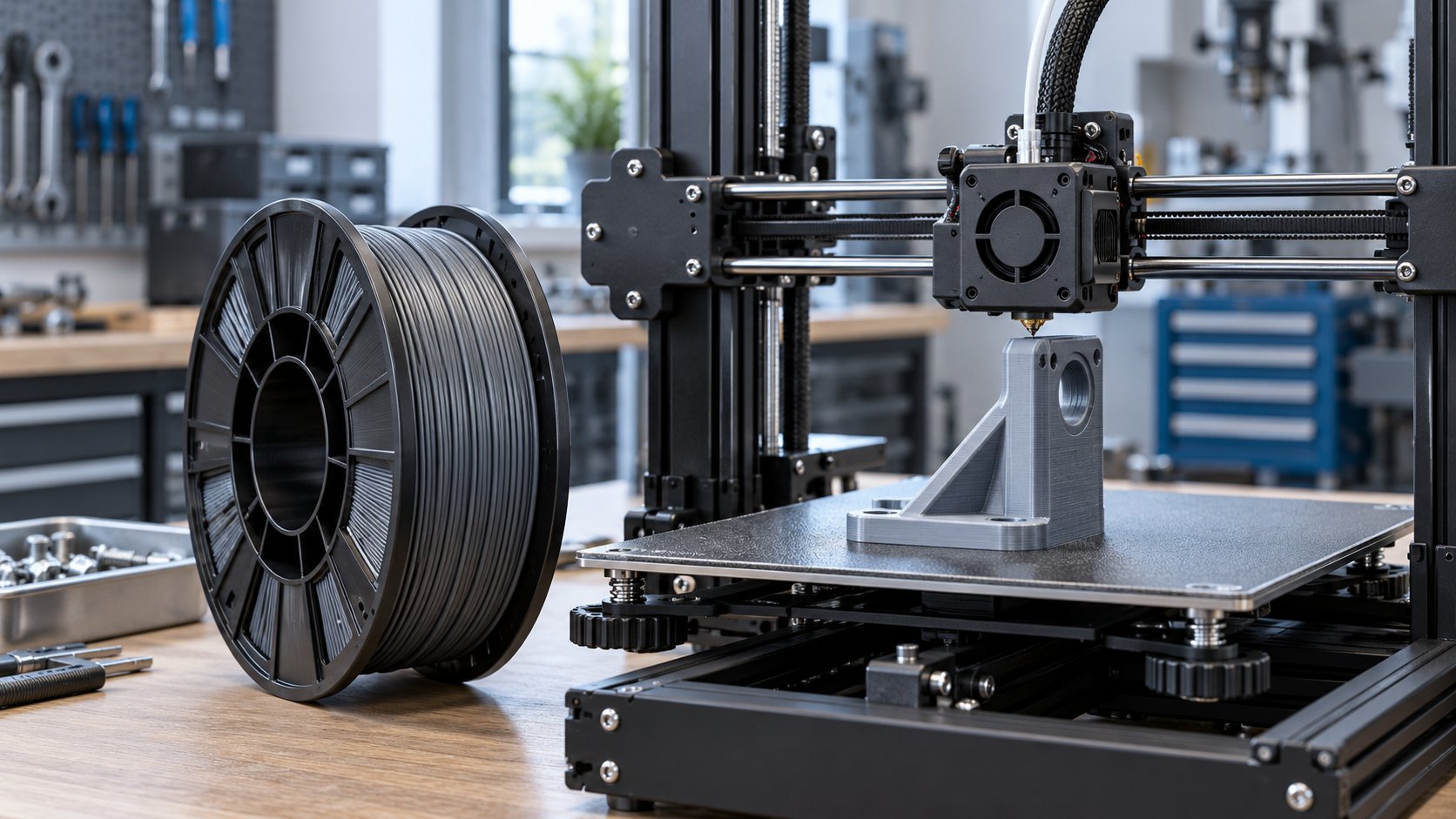
A decision guide for industrial buyers who prototype in FDM and need to know when a printed part can carry real load, heat, chemicals and duty cycles — covering what changes between a prototype and a functional 3D printed part, how to match PLA, PETG, ABS or TPU to operating conditions, and what to confirm with a supplier before switching.
FDM Decision Guide for Buyers
A 3D printing prototype proves an idea fits. A functional 3D printed part has to survive the actual job — load, heat, moisture, chemicals, vibration and time. The gap between those two states is not measured in print quality alone; it is measured by whether the material and the process hold up under the conditions the part will really meet.
What Actually Changes When a Part Must Function
A prototype is usually judged on geometry. Does the bracket sit flush, do the threads engage, does the housing close? Functional performance is a different question set. A printed part that must work in service gets evaluated against outside forces the prototype never saw.
The first shift is load. Static display parts can ignore creep and fatigue; a part under continuous stress cannot. FDM parts are anisotropic — the bond between layers is generally the weak plane. A bracket loaded perpendicular to the layer lines behaves differently from the same bracket loaded along them. If your functional 3D printed part will be bolted, compressed or bent, the print orientation and the load direction have to be planned together, not decided by which way fits the build plate.
The second shift is temperature. A prototype left on a desk sits at room temperature. A functional part inside an enclosure, near a motor, on a vehicle or outdoors in summer may sit well above it, and most polymer filaments lose stiffness as they warm. PLA softens first; ABS and PETG hold shape higher up the range. If the part will see sustained heat, general-purpose PLA is usually the wrong candidate regardless of how well the prototype looked. Nozzle and bed settings belong to this decision, not to it alone — the working temperature of the part matters more than the temperature of the printer.
The third shift is exposure: moisture, oils, solvents, UV and cleaning agents. PLA absorbs moisture and can degrade over time in humid or wet conditions. PETG resists moisture and many chemicals better. ABS is a common choice for automotive and industrial housings where some chemical and heat resistance is required. TPU responds to impacts and abrasion that would crack a rigid part, but it is not a chemical shield.
The fourth shift is duty cycle and repeatability. A one-off prototype can be a good print. A functional part is often a small batch, a replacement run or a production-support fixture, and it has to be the same every time — same fit, same strength, same behavior at part number fifty as at part number one. That is a process question as much as a material question, and it is where filament consistency enters.
Matching Material to Operating Condition, Not to Habit
Most FDM buyers start with PLA because it prints cleanly, then discover the limits the hard way. Material selection should follow the condition list, not the other way around. The table below is a starting point for general engineering comparison; the final call depends on the actual load, temperature and exposure of your part.
| Condition | PLA | PETG | ABS | TPU |
|---|---|---|---|---|
| Stiffness / dimensional stability | High | Moderate, tougher | Moderate | Low, flexes |
| Heat resistance | Low | Better than PLA | Higher, with warping risk | Moderate |
| Moisture / chemical exposure | Poor | Good | Good | Fair, not a barrier |
| Impact and abrasion | Brittle | Tougher than PLA | Moderate | High, absorbs impact |
| Typical functional role | Fit checks, light covers | Brackets, enclosures, jigs | Heat-exposed housings | Gaskets, grips, dampers |
Two practical notes. First, PETG is often the sensible default when a part has graduated from prototype status: it is tougher than PLA and more resistant to temperature and moisture, while printing with less warping than ABS. A closer look at why PETG suits functional parts is covered in the PETG functional-parts topic. Second, TPU needs its own decision layer — hardness determines whether a part flexes, cushions or supports. If your functional part is flexible, choose Shore hardness against the job, not against a sample on your desk; the Shore hardness guide walks through that choice.
Where the part sits close to a boundary — a bracket that warms up under load, a housing that sees both sun and vibration — the selection is a trade-off, not a match. That is the point at which a comparison of all four materials against real conditions, such as the PLA vs PETG vs ABS buyer's guide, is more useful than a single datasheet.
Tolerance and Repeatability: The Quiet Failure Point
Functional parts fail less often because the geometry was wrong and more often because the geometry was inconsistent. A bearing seat that is 0.05 mm loose passes the prototype stage and fails at assembly when thirty of them are loose in the same direction. A snap fit that works once can crack on the tenth cycle. Repeatability is the property that separates a printed prototype from a functional component.
Filament diameter sits at the center of that. Extrusion volume is calculated from the filament cross-section, so a spool that drifts between 1.70 mm and 1.80 mm changes the material laid down for the same slicer settings. The visible result is inconsistent walls and surfaces; the functional result is variable fit and variable strength. Wanzhoutong is a factory-direct supplier running 12 extrusion lines with closed-loop extrusion that holds 1.75 mm filament within ±0.02 mm. That tolerance does not make a bad design good, but it removes one source of batch-to-batch drift — which is exactly what a functional part cannot afford.
Beyond the filament, three process habits matter for functional 3D printed parts: keep print orientation consistent between prototype and production, dry the filament before use if the material is moisture-sensitive, and set slicer parameters for function (wall count, infill pattern, layer direction) rather than for appearance. Any of these can turn a good prototype into a bad functional part.
A Graduation Checklist Before the Switch
Use this to decide whether a part is ready to leave prototype status. It is a decision list, not a test protocol — some items you can answer internally, others need supplier input.
- Load path: Is the part carrying continuous stress, and is the layer direction aligned to resist it?
- Working temperature: What is the highest temperature the part will see in service, not the temperature of the room it prints in?
- Exposure: Will it meet water, humidity, oil, solvent, UV or cleaning agents? For how long?
- Duty cycle: One part, a small batch or a repeating replacement run? What variation is acceptable between parts?
- Critical tolerance: Which dimensions actually matter for function, and what happens if they drift?
- Material match: Does the chosen filament answer the four conditions above, or was it chosen for printability?
- Filament consistency: Can the supplier state the diameter tolerance and hold it across reorders?
- Process agreement: Are print orientation, drying and slicing settings fixed between prototype and functional run?
What to confirm with the supplier before switching: the stated filament tolerance and how it is controlled, the material grade behind the trade name (PLA, PETG, ABS and TPU come in formulations that behave differently), whether the same color and formulation can be repeated on a reorder, and the recommended nozzle and bed range for the specific grade. Temperature settings are supplier- and grade-specific; the PLA, PETG and ABS temperature chart is a useful reference to compare against before you lock a profile.
When Printing Is Not the Right Answer
Printing earns its place for complex geometry, low-to-medium volumes, custom fits, jigs, covers, housings and replacement parts where tooling cost would not be justified. It is a poor answer in several other cases, and honesty here saves money.
If the part sees sustained high temperature, structural load or long-term outdoor UV exposure, an FDM polymer part may not be the right choice at all — machined or molded alternatives should be on the table. If the required tolerance is tighter than FDM repeatability allows, printing will pass the prototype and fail the production run. If the part must be food-contact, medical or flame-rated, that is a compliance question that depends on the specific material grade and end-use approval, and neither the filament family nor a print sample answers it. And if the annual volume is high enough that tooling amortizes, molding is usually the more stable path.
The useful test is simple: if the part's failure would be a nuisance, printing is fine; if its failure would stop a line, verify the material and process against the real conditions before you commit.
FAQ
What is 3D prototyping, in a functional context?
It is using a printed part to validate form, fit and sometimes function before committing to tooling or production. In a functional context, the prototype is also used to test the material and process against the conditions the final part will meet — which is why the same filament and orientation should be used from the first functional prototype onward.
When is a printed prototype ready to become a functional part?
When it has been evaluated against load, working temperature, moisture and chemical exposure, duty cycle and critical tolerances — and when the material and print process are fixed and repeatable. Appearance is not the criterion. Repeatability across a batch is.
Can PLA be used for functional 3D printed parts?
For light-duty covers, fit checks and low-heat indoor applications, yes. For parts under sustained load, heat or moisture, PLA is usually the wrong choice because it softens at low temperatures and absorbs moisture over time. PETG is the more common graduation step from PLA for general functional use.
Why does filament diameter matter for functional parts?
Extrusion volume is calculated from filament diameter, so variation changes the material deposited for the same settings. Consistent diameter supports consistent walls, fit and strength across a batch. A stated tolerance such as 1.75 mm within ±0.02 mm is one of the few supplier claims you can compare directly before ordering.
What should I ask a supplier before switching filament for a functional part?
Ask for the diameter tolerance and how it is controlled, the grade behind the material name, color and formulation consistency on reorders, and recommended temperature ranges for that specific grade. If the part has compliance requirements, ask which approvals apply to that material and end use — and treat the answer as the starting point for verification, not the end of it.
Next Step
Take your shortest list of critical conditions — one load case, one temperature, one exposure — and test the candidate filament against them before switching a production run over. If the part is flexible, start with hardness; if it is rigid and warm, start with heat resistance; if it is bathed in moisture, start with PETG. When the material is chosen, confirm the diameter tolerance and grade with your supplier so the functional part you approve is the part you can order again.