
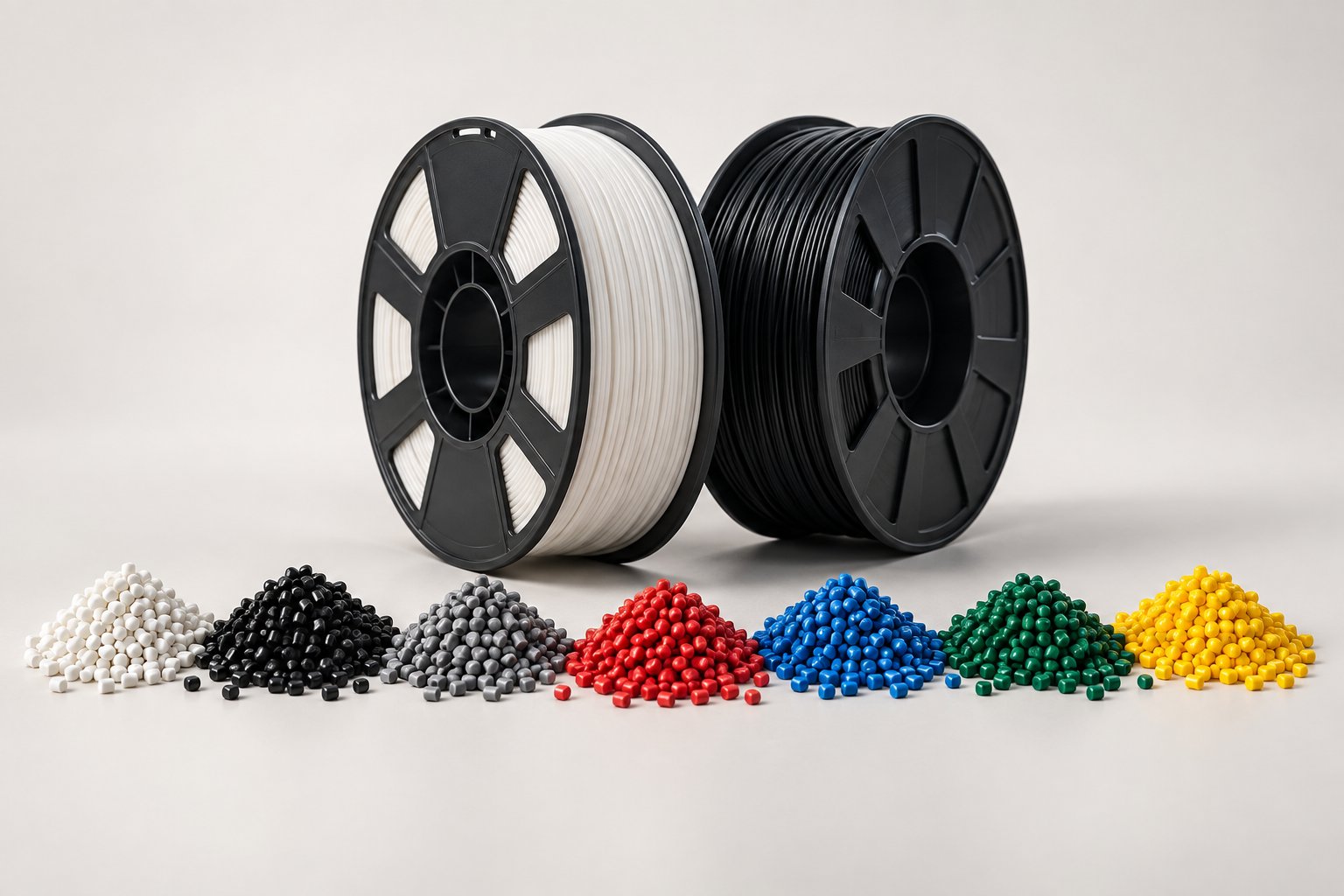
A buyer's color reference is not a production spec. This guide explains what Pantone, RAL and HEX actually give you, what data to send your supplier, how a factory converts that reference into a masterbatch formulation, and how to approve the color before mass production.
Color Reference Conversion
A buyer sends a Pantone number, a RAL code, or a HEX value and asks for a quote. The supplier replies with a price. Both sides assume they are talking about the same color. Then the first production batch arrives and it is visibly different from the reference. The dispute that follows is almost never about the supplier's ability to read a code. It is about the gap between a color reference and a production color specification.
This guide covers that gap: what each color system actually gives you, what data your supplier needs, how a factory converts a reference into a masterbatch formulation, and how to approve the color before mass production starts.
Key takeaways
- A Pantone, RAL or HEX reference defines a target, not a producible formulation.
- Substrate, let-down ratio, wall thickness, surface finish and lighting all shift the final appearance.
- Your supplier needs the reference code plus resin, process, part geometry and target quantity.
- Approval should be based on a physical sample plaque and colorimetric data, not on a screen preview.
- Batch-to-batch verification is a separate step from first-sample approval.
Why a Pantone or RAL reference is not yet a production spec
A color reference tells you what the color should look like under a defined viewing condition. It does not tell a compounder how much pigment to load into a specific resin, at what let-down ratio, for a specific part. Those variables change the result.
Four factors move the final color away from the reference:
- Substrate. The same pigment loading produces a different shade in PP than in PE. Resin base color, transparency and melt behavior all matter.
- Let-down ratio. A masterbatch dosed at 2% and the same masterbatch dosed at 4% will not match each other. The ratio is part of the color definition.
- Process and geometry. Injection molding, extrusion and 3D printing filament draw-down each orient pigment differently. Thin walls look lighter than thick sections of the same part.
- Surface finish. A textured mold surface scatters light and reads differently from a polished one, even with identical colorant.
This is why a reference code alone cannot be quoted accurately. It has to be converted into a formulation tied to your specific resin, process and part.
What each color system gives you and where it breaks down
Pantone, RAL and HEX are not interchangeable. Each was built for a different purpose, and each has a specific failure mode when applied to plastics.
| System | What it defines | Where it breaks down for masterbatch |
|---|---|---|
| Pantone / PMS | A printed ink reference on coated or uncoated paper stock | Paper and plastic reflect light differently. The same PMS number looks different on a molded part. |
| RAL | A European industrial coating and paint standard | Formulated for paint films, not for pigment dispersed in a polymer melt. Gloss level changes the read. |
| HEX / RGB | A screen color defined by emitted light | Screens emit light; plastic reflects it. A HEX value is a starting point, never a match target on its own. |
None of these systems is wrong to use. They are all useful as a starting reference. The mistake is treating any of them as the final acceptance criterion for a molded or extruded part. That criterion has to be a physical sample measured under controlled conditions.
What to send your supplier
The more of the following you provide up front, the fewer sample rounds you will need. A reference code with no context usually triggers a round of questions before work can start.
- Reference code and system. State whether it is Pantone, RAL or HEX, and give the exact code. If you have a physical chip or swatch, send it.
- Substrate and resin carrier. PP, PE or another polymer. If you already know the carrier you want, say so.
- Process. Injection molding, extrusion, blow molding or 3D printing filament. Each has a different pigment loading window.
- Part thickness. A nominal wall thickness in millimeters. Thin and thick sections of the same part will not read identically.
- Surface finish. Polished, matte, textured or a specific mold finish. This affects perceived color more than most buyers expect.
- Lighting condition. The light source under which the color will be judged, such as daylight or a specified indoor source.
- Target quantity. Your expected order volume and any MOQ constraints you are working within.
If you are still deciding between a masterbatch, a pigment or a liquid colorant for the job, that decision comes before color matching. The comparison of masterbatch vs pigment vs liquid colorant covers how each option affects color control and process fit.
What the factory does with your reference
Once your data is in hand, the conversion follows a defined sequence. Understanding it helps you judge whether a supplier is doing real color work or just quoting a code.
Resin carrier selection
The carrier resin must be compatible with your base polymer. A carrier that disperses well in PP may behave differently in PE. Carrier choice affects dispersion quality and, in turn, color uniformity.
Pigment loading and formulation
The colorant package is built to hit the reference at your stated let-down ratio. This is where the reference code becomes a formulation: pigment types, loading levels and any additives needed for process stability.
Color chip and dispersion check
A color chip is produced and the dispersion is assessed. Poor dispersion shows up as streaks, specks or uneven color, and it will not be fixed by adjusting the shade alone.
Test plaque and colorimetric reading
A test plaque is molded from your resin at your let-down ratio. Colorimetric data is read from that plaque, not from the masterbatch pellet. This is the number that matters for approval.
For a worked example of how these variables are specified on a real product, the Universal White Color Masterbatch for PE/PP lists its TiO2 content, let-down ratio, brightness and yellow index as measured on polypropylene test plaques.
How to approve a color before mass production
Approval is a two-stage process. Skipping either stage is the most common cause of rejected shipments.
Stage 1: Sample plaque approval
You receive a physical plaque molded from your resin at your let-down ratio. Judge it under the lighting condition you specified, against your reference. Approve or request a shade adjustment in writing. Do not approve from a photo or a screen preview.
Stage 2: Colorimetric data and COA
Alongside the plaque, review the colorimetric readings. A certificate of analysis per batch should carry the color data together with the relevant physical properties, so the approved color is tied to measurable values rather than to a visual memory.
Stage 3: Batch-to-batch verification
First-sample approval confirms the formulation. It does not guarantee that every subsequent batch matches. Batch verification compares incoming production lots against the approved reference. The method for doing this is covered in Masterbatch Color Consistency: Verify Between Batches.
Common mistakes that cause color rejection
- Approving from a screen. A HEX value on a monitor is emitted light. The molded part reflects light. They will not match.
- Omitting the let-down ratio. The same masterbatch at a different dose is a different color.
- Ignoring wall thickness. Thin sections read lighter than thick ones from the same pellet.
- Changing resin after approval. A new carrier or base resin invalidates the approved formulation.
- Judging under the wrong light. A part that matches in daylight may shift under indoor lighting.
- Skipping batch verification. First-sample approval is not a batch-to-batch guarantee.
If your concern is mainly about order size and scheduling rather than color, the Color Masterbatch MOQ and Lead Time guide covers those terms separately.
FAQ
Can you match a Pantone number exactly in plastic?
Pantone references are printed on paper. Plastic reflects light differently, so an exact match to the paper chip is not the right target. The practical goal is a close visual match on your resin, confirmed by a physical plaque and colorimetric data.
Is a HEX code enough to start a custom color masterbatch?
A HEX code is a useful starting reference but not sufficient on its own. You also need to specify the resin, process, part thickness, surface finish and let-down ratio, because each of these shifts the final appearance.
How do I know the color will be the same in every batch?
Approve a physical sample plaque first, then verify each production batch against that approved reference using colorimetric data. Batch verification is a separate step from first-sample approval.
What if my reference is a RAL code from a paint specification?
RAL codes are formulated for paint films. They can be used as a reference for masterbatch, but the result must be judged on a molded or extruded part, not on a paint sample.
Does the let-down ratio affect the color?
Yes. The same masterbatch dosed at 2% and at 4% will not produce the same shade. The let-down ratio is part of the color specification and must be stated before matching begins.
Wanzhoutong is a factory-direct supplier of 3D printing filaments and color masterbatch based in Shenzhen, China, with 12 extrusion lines and custom color matching for B2B buyers. To start a color match, send your reference code (Pantone, RAL or HEX), your resin and process, part thickness, surface finish and target quantity. Our team will confirm the formulation route and the sample approval steps before mass production.
Send your color reference and spec sheet for a quote.