
Pigment loading defines how much colorant is packed into a masterbatch pellet — and it directly affects your dosing cost, color strength, and batch consistency. This buyer's guide explains loading vs letdown ratio, typical industry ranges, and what to ask a white masterbatch manufacturer before you specify.
Sourcing Guide
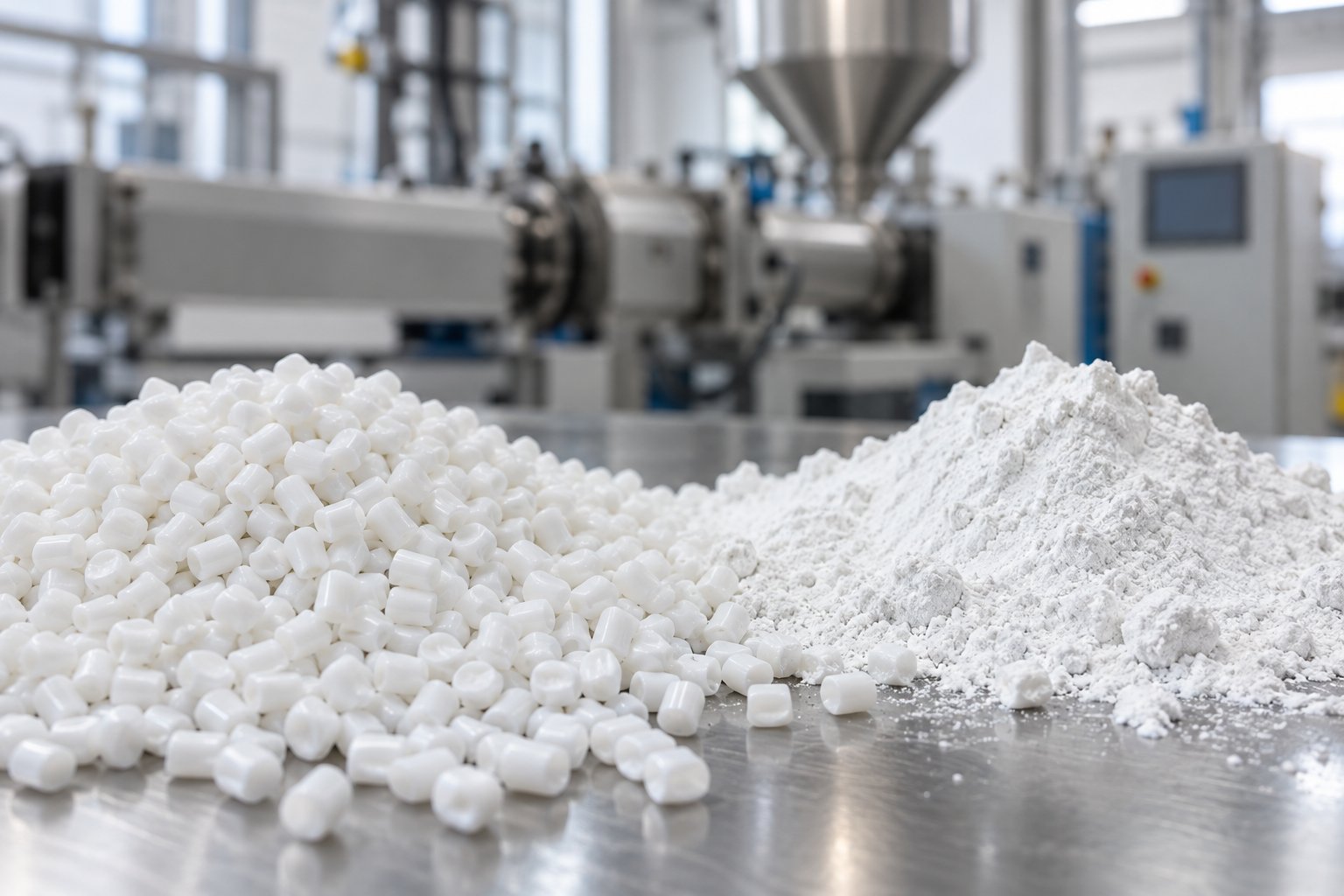
Masterbatch pigment loading is the percentage of pigment or colorant concentrated inside a masterbatch pellet. A 40% white masterbatch, for example, carries 40 kg of TiO₂ and 60 kg of carrier per 100 kg of product. It is the number that quietly sets your cost per colored part, your dosing accuracy, and how much variation you see between batches. Yet it is also one of the most confused specs in plastics procurement, because buyers often mix it up with letdown ratio — a different number that belongs to the processor, not the pellet.
This guide separates the two, explains what drives loading up or down, and gives you a short checklist to run past any supplier before you place an order.
Pigment Loading vs Letdown Ratio: Two Numbers, Two Jobs
Think of it this way. Pigment loading is what the masterbatch maker puts into the pellet. Letdown ratio is what you put into your hopper — the ratio of masterbatch to natural resin, usually expressed like 1:25, 1:50, or 4%.
A high-loading masterbatch might reach your target shade at 2% dosing. A low-loading one might need 8%. Both can produce the same color, but they behave very differently on your line. The loading tells you the concentration; the letdown tells you the recipe.
This is why two suppliers can quote the same "white masterbatch" at very different prices per kilogram — and neither is necessarily wrong. One is selling more pigment and less carrier. The other is selling more carrier and asking you to dose more. To compare quotes fairly, you have to convert both offers to a cost per kilogram of finished part, not cost per kilogram of pellet. If you want the full mechanics of that conversion, our related article on specifying custom colors with letdown ratios walks through the math.
Quick rule of thumb
Loading is a property of the masterbatch. Letdown is a choice on your production floor. A supplier who can explain both — and show how one drives the other — is usually the one who understands your process, not just the price sheet.
Typical Loading Ranges and What Moves Them
Industry references for color masterbatch often cite a pigment loading range of roughly 15% to 40%. Treat that as general context, not a fixed spec. The actual figure for any given product depends on three things:
- Pigment chemistry. Inorganic pigments such as TiO₂ are dense and can be loaded heavily — often at the top of the range — which is why white masterbatch tends to run pigment-rich. Organic pigments are lighter and more expensive per kilogram, so loading is often kept more moderate to protect dispersion and color stability.
- Carrier system. The carrier resin has to wet out and bind the pigment. A carrier that matches your base resin — PE for PE, PP for PP — generally tolerates higher loading without sacrificing dispersion. Mismatched carriers force suppliers to lower the loading to keep the pellet workable.
- Target color depth. Pale tints need less pigment in the pellet; deep, saturated or opaque colors need more. A light pastel and a jet-black compound are not built to the same loading logic.
There is a practical ceiling, too. Push loading too high and you risk poor dispersion, agglomerates, and color streaks in the finished part. Push it too low and you pay to ship carrier resin around the world. Most formulators land where the pellet still disperses cleanly at a reasonable letdown.
| Factor | Effect on loading | What the buyer notices |
|---|---|---|
| Inorganic pigment (e.g. TiO₂) | Pushes loading higher | Lower dosing rate, strong opacity |
| Organic pigment | Often lower, cost-driven | Higher dosing rate, brighter tones |
| Compatible carrier (PE/PP) | Allows higher loading | Smoother dispersion, fewer rejects |
| Deep or opaque target color | Requires higher loading | Fewer dosing headaches to hit shade |
| Pale or translucent target color | Lower loading is sufficient | Easier to fine-tune shade |
How Loading Affects Your Cost, Color Strength and Consistency
Loading is not an abstract spec. It shows up on your balance sheet and in your reject bin.
Color strength per kilogram
Higher loading means more color delivered per kilogram of masterbatch. That usually translates to a lower letdown ratio and less material consumed per part. But "stronger" is not automatically "better" — a very high-loading pellet can be harder to disperse evenly if your extruder's mixing section is short or your screw geometry is modest.
Dosing cost
Two quotes at $3.00/kg and $4.50/kg can land at the same cost per finished part once you account for loading and letdown. Always ask for the supplier's recommended letdown and calculate the effective cost. This is the single most common mistake we see from buyers comparing masterbatch offers on price per bag alone.
Dispersion quality
Dispersion is where loading meets processing. A well-formulated high-loading masterbatch disperses evenly when the carrier matches the base resin and the pellet is built for the application. A poorly built high-loading product can leave unmelted specks, which show up as surface defects or weak points in thin-wall parts.
Batch-to-batch consistency
A documented loading figure — and the pigment chemistry behind it — is what makes repeat orders repeatable. If a supplier changes pigment grade or carrier without telling you, the color will drift even though the label still says the same thing. Ask whether the formula is recorded and held stable across orders.
Transparency and opacity
For white and light colors, loading and pigment grade determine whether you get a bright opaque cover or a translucent tint. If your part needs to hide what's underneath, say so up front — it changes both the pigment grade and the loading the supplier should recommend. Our related piece on choosing TiO₂ content and grade in white masterbatch covers that trade-off in more depth.
Sourcing Checklist: What to Ask Before You Specify
Before you confirm a masterbatch order, get clear answers on these six points. A supplier who can answer them in writing is a supplier you can build a repeat program with.
- Pigment loading percentage. Ask for the figure as supplied, and whether it is a nominal target or a tested value with a tolerance.
- Pigment chemistry. Inorganic or organic? Grade? This tells you how the product will behave in UV, heat, and food-contact contexts, and it explains the price.
- Carrier resin compatibility. Match the carrier to your base polymer — PE, PP, ABS, and so on. An incompatible carrier can hurt mechanical properties or dispersion.
- Recommended letdown ratio. Get the supplier's starting point and a suggested adjustment range for your target shade.
- Documented formula for repeat orders. Confirm the formula is recorded and that any change will be flagged to you in advance.
- Sample and trial support. Ask for a sample at the recommended letdown so you can validate color and dispersion on your own equipment before committing to volume.
If you are still deciding between masterbatch and other colorant formats, our comparison of masterbatch vs pigment vs liquid colorant is a useful companion read. And for a broader view of sourcing criteria, see our B2B buyer's guide to sourcing color masterbatch.
Where the Supplier Fits In
Masterbatch formulation is a balance: enough pigment to make the pellet economical, enough carrier to make it process cleanly, and a carrier chemistry that matches your resin. Getting that balance right is a formulation job, not a catalog pick. A supplier with in-house compounding can adjust loading, carrier, and pigment grade to your actual base resin and target shade — rather than asking you to make a stock product work.
Wanzhoutong produces color masterbatch at factory level, with 12 extrusion lines and custom color matching for B2B buyers. Our white masterbatch range is built for PE and PP processing, and we work with customers on loading, carrier compatibility, and letdown recommendations based on their specific resin and shade requirements. If you are specifying a masterbatch for a new part or re-sourcing an existing one, send us your base resin, target color, and letdown constraints, and we can recommend a loading starting point and provide a sample for your line trial.
FAQ
Is a higher pigment loading always better?
Not automatically. Higher loading usually means lower dosing cost and stronger color per kilogram, but it only helps if the pellet disperses cleanly in your process. A high-loading product that streaks or leaves specks creates more waste than it saves. The right loading is the one that disperses well and hits your shade at a practical dosing rate.
Does a 40% loading mean the masterbatch is 40% cheaper to use?
No. Loading and price per kilogram move together, but the real comparison is cost per finished part. You have to factor in both the loading and the recommended letdown ratio. Two masterbatches at very different prices can end up costing the same per colored part.
Can I change the loading for my existing color?
Often yes, within limits set by the pigment chemistry and carrier. Increasing loading can reduce your dosing rate, but it may affect dispersion and shade slightly. Discuss any change with your supplier and validate with a sample before running production.
Why does white masterbatch often have higher loading than colored masterbatch?
TiO₂ is a dense inorganic pigment that can be loaded heavily while still dispersing well in PE and PP carriers. That is one reason white masterbatch tends to sit at the higher end of typical loading ranges, while organic-colored masterbatch is often formulated more moderately for color stability and dispersion.