
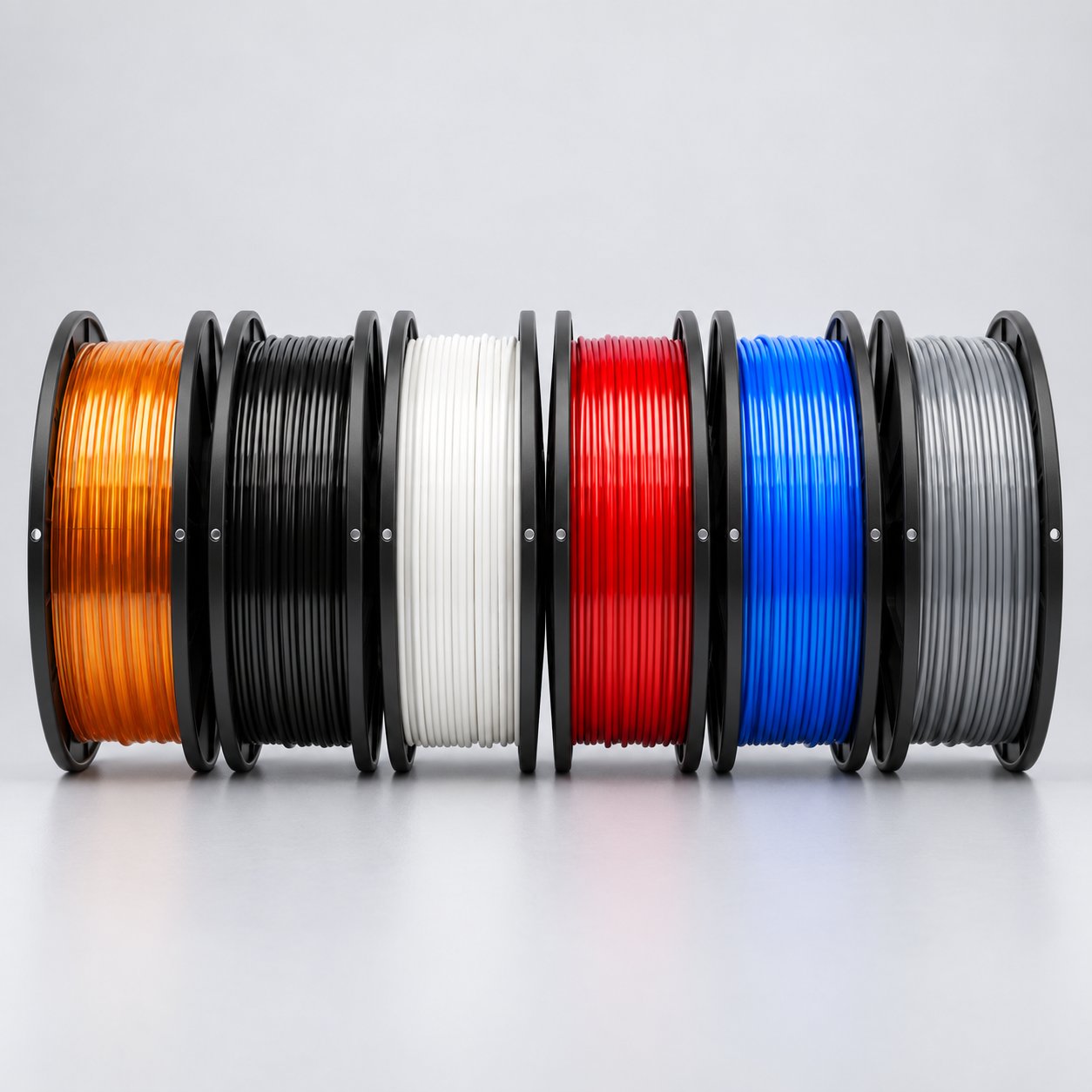
A 2026 wholesale buyer's guide to 3D printing filament colors: which color families move in volume, how to plan a stock lineup for PLA, PETG, ABS and TPU, and how custom color matching works through masterbatch — with practical notes on shelf appeal, minimums and inventory risk.
Competition on standard colors is fierce, and a slow-moving shade ties up warehouse space and cash. This rundown looks at the color families that actually turn over for PLA, PETG, ABS and TPU buyers, how shelf appeal interacts with inventory risk, and how custom color matching works when you want a shade nobody else stocks.
Key takeaways for 2026 planning
- Black, white and gray remain the volume core — they are the least risky opening order for any filament line.
- Transparent, matte, silk and rainbow shades drive shelf interest but need narrower depth and closer reorder management.
- Signal colors (red, yellow, safety orange) sell steadily into industrial and functional-print buyers rather than hobby shelves.
- Custom color matching via masterbatch is the practical route to a differentiated shade, but it usually comes with a minimum order quantity and a lead time for color development.
The volume core: black, white and gray carry the lineup
Ask any distributor which spools leave the warehouse fastest and the answer rarely changes. Black and white account for the bulk of repeat orders because they work on printers that do not get cleaned between jobs, and because buyers use them for brackets, jigs, prototypes and enclosures where color is irrelevant. Gray sits just behind them as the default "technical" shade for parts that will be photographed or shown to a client.
For 2026, the practical question is not whether to stock black and white — it is how deep. A filament supplier's standard range typically covers black, white, and one or two grays in each material, and these are the SKUs where you can safely hold deeper stock because the reorder cycle is predictable. Everything else is a calculated bet.
Two details affect turnover more than buyers expect. First, finish consistency matters as much as the color itself: a matte black and a glossy black are different products to a customer, and mixing them under one listing causes returns. Second, spool size and packaging affect which color a customer picks when two are otherwise equal — a well-labeled 1 kg spool with a visible color window moves faster than a plain carton.
Aesthetic families: transparent, matte, silk and rainbow
These are the colors that make a catalog look current. They also carry the highest inventory risk, because demand is trend-sensitive and often tied to specific print projects rather than routine replacement.
Transparent and natural
Natural PLA — undyed, translucent, sometimes called "clear" or "natural" — is the clarifying example here. Because it is not pigmented, its appearance shifts with wall thickness, infill and lighting, which is why buyers searching for its color often find conflicting photos. For wholesale purposes, natural filament functions as a niche SKU: it appeals to hobbyists who want to see internal structures and to buyers printing light-diffusing covers. Stock it shallow, in one or two spool sizes, and treat it as a complement rather than a volume line.
Transparent tints in PETG follow a similar pattern. A transparent blue or red sells in small but steady quantities to buyers making decorative and lighting parts. Keep the range narrow — three or four tints — and let special requests go through custom matching rather than sitting in your warehouse.
Matte
Matte finishes have moved from novelty to expectation in the hobby and consumer-product segments. A matte surface hides layer lines better than a glossy one, so matte black, matte white and matte earth tones sell well to buyers whose customers display printed objects. The catch is that matte additives can change flow behavior, so a matte PLA is not simply a pigmented version of the same base — ask your supplier how the formulation is stabilized before you commit to a full container.
Silk and rainbow
Silk and rainbow filaments are the most visible trend colors and the most dangerous to hold. They photograph beautifully, which drives initial orders, but repeat purchases depend on a steady stream of new buyers. A workable approach is to treat them as a rotating assortment: order in smaller quantities, refresh shades seasonally, and avoid deep commitments on any single variant. If your supplier can produce silk or rainbow on short notice, you can carry the look without carrying the risk.
Signal colors: red, yellow, safety orange
Signal colors behave differently from fashion colors. They are bought for function — marking, safety, color-coding, machine parts — and the buyer is usually more concerned with consistency between batches than with whether the shade is on trend. Red, yellow, orange and blue in this category sell steadily into industrial and engineering customers, and they justify a permanent place in the range because they are reordered rather than discovered.
For a distributor, the important commitment is batch-to-batch color consistency. A safety-yellow spool that arrives a shade lighter than the previous order breaks a color-coding system and generates complaints. This is a reason to favor suppliers who control their own compounding rather than buying finished filament on the spot market.
Color behavior by material
The same color name does not behave identically across materials. A few practical differences matter when you plan a lineup across PLA, PETG, ABS and TPU.
| Material | Typical color demand | Planning note |
|---|---|---|
| PLA | Broadest range — black, white, gray, plus matte, silk, rainbow and pastel shades | Where fashion colors belong; the fastest-turning material for aesthetic SKUs |
| PETG | Black, white, transparent tints, signal colors | Transparent tints are more convincing in PETG than in PLA; keep the range focused |
| ABS | Black, white, gray, signal colors | Industrial buyers dominate; consistency matters more than trend variety |
| TPU | Black, white, and a limited set of bright colors | Flexible applications are functional; keep the color count low |
In short: put your color variety into PLA and PETG, and keep ABS and TPU closer to a functional palette. That split reduces the number of slow-moving SKUs without making the catalog look thin.
Planning a 2026 color lineup
Building the lineup is a question of matching depth to demand. A simple structure works for most wholesale and distribution buyers:
- Core (deep stock): black, white, one or two grays per material. These should never run out.
- Functional (medium stock): red, yellow, orange, blue in ABS and PETG. Steady reorder, moderate depth.
- Trend (shallow stock): matte, silk, rainbow, pastel and transparent shades in PLA. Buy smaller, rotate more often.
- Custom (made to order): your own brand color or a shade requested by a key account, produced through masterbatch matching.
Two buyer considerations deserve attention before you place the order. First, shelf appeal is not the same as sell-through: a color that photographs well can still sit for months if no repeat buyer exists. Second, packaging and labeling do real work — a clear color indicator on the spool and carton reduces the chance that a customer orders the wrong shade and returns it.
How custom color matching works through masterbatch
When a shade is not in any catalog, the practical route is masterbatch color matching. Masterbatch is a concentrated color carrier that is let down into the base polymer during extrusion, so the color is built into the filament rather than applied afterward. A factory that compounds its own material can match a target shade — a Pantone reference, a physical sample, or a competitor's spool — and produce a run to that specification. For how a color reference travels from your side to the factory, see our breakdown of Pantone, RAL and HEX color matching.
What a buyer should expect from the process:
- A physical target. Color references travel better as a sample chip or spool than as a screen image, because monitors and lighting shift perception.
- A trial run. The first extrusion is used to confirm the match under the intended lighting before the full batch is committed.
- A minimum order quantity. Custom colors are not economical in single-spool quantities; the MOQ depends on the material and the shade.
- Consistency records. For a color that will be reordered, ask how the factory controls batch-to-batch variation.
One limitation worth stating plainly: white masterbatch for PE and PP is a different product from the color concentrates used in 3D printing filament. If your business also supplies polyolefin compounds, those are separate lines, and color work for filament should be discussed with the supplier as its own project.
FAQ
What are 3D prints made of?
Fused filament printing uses a thermoplastic filament — commonly PLA, PETG, ABS or TPU — that is heated and deposited layer by layer. The filament itself is the base polymer plus colorants and additives; the color comes from pigment or masterbatch compounded into the plastic, not from a coating on the surface.
What color is natural PLA filament?
Natural PLA is unpigmented, so it appears translucent and slightly off-white, with a warm or milky cast rather than a pure white. Because it is not dyed, its appearance changes with wall thickness, infill and the light behind it, which is why photos of natural PLA can look quite different from one another.
Can I order custom filament colors for my own brand?
Yes, through masterbatch color matching. You provide a target shade — a sample chip, a physical spool or a color reference — and the factory develops the match and confirms it with a trial run before production; the full workflow is covered in our OEM color matching guide. Custom colors carry a minimum order quantity and a development lead time, so they are best planned around your key accounts rather than as an opening order.
When you are ready to plan a 2026 range, share your target materials, color list and approximate volumes with your supplier. For standard colors, ask for the current spool sizes and packing options; for custom shades, send a physical sample and ask what MOQ and lead time apply to your chosen material.