
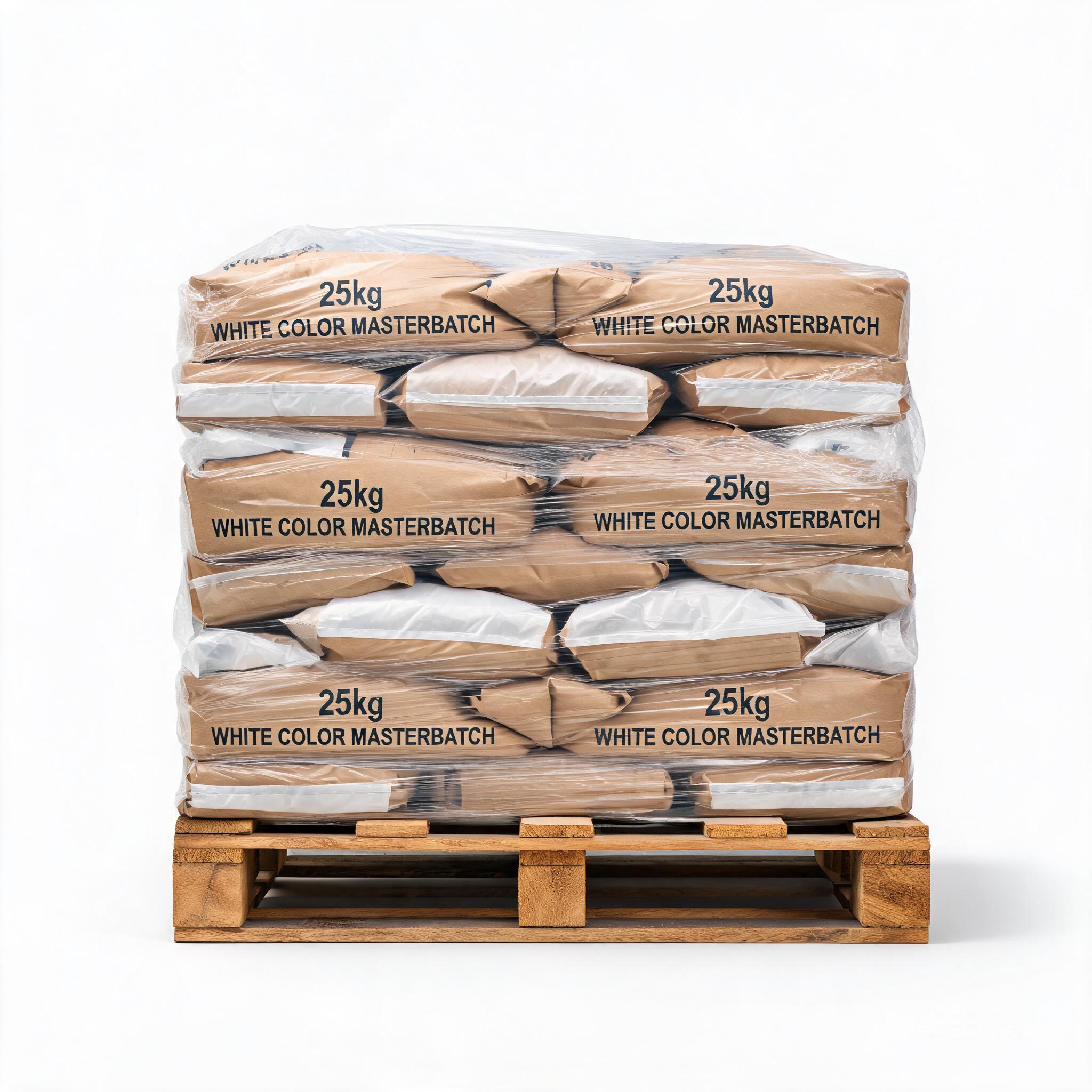
A practical buyer's guide to specifying white masterbatch: TiO2 grade, content, carrier resin compatibility, dispersion quality, and supplier checks.
BUYER GUIDE
If you are sourcing white masterbatch for film, injection molding, blow molding, or extrusion, the specification sheet alone will not tell you whether the product will work in your process. You need to understand four things: the TiO2 grade, the TiO2 content, the carrier resin, and the dispersion quality. This guide explains what each means, how they affect cost and performance, and what to ask your supplier before you place an order.
Key takeaways
- Rutile TiO2 is the standard choice for most applications; anatase is used only where specific optical or processing conditions require it.
- Higher TiO2 content means stronger hiding power but also higher cost and potentially more dispersion challenges.
- The carrier resin in the masterbatch must be compatible with your base polymer, or you risk surface defects and poor mechanical properties.
- Dispersion quality determines surface finish—poor dispersion shows up as specks, streaks, or dullness.
- Ask your supplier to declare TiO2 grade, content, and dispersion test results in writing.
What Does "TiO2 Grade" Mean in White Masterbatch?
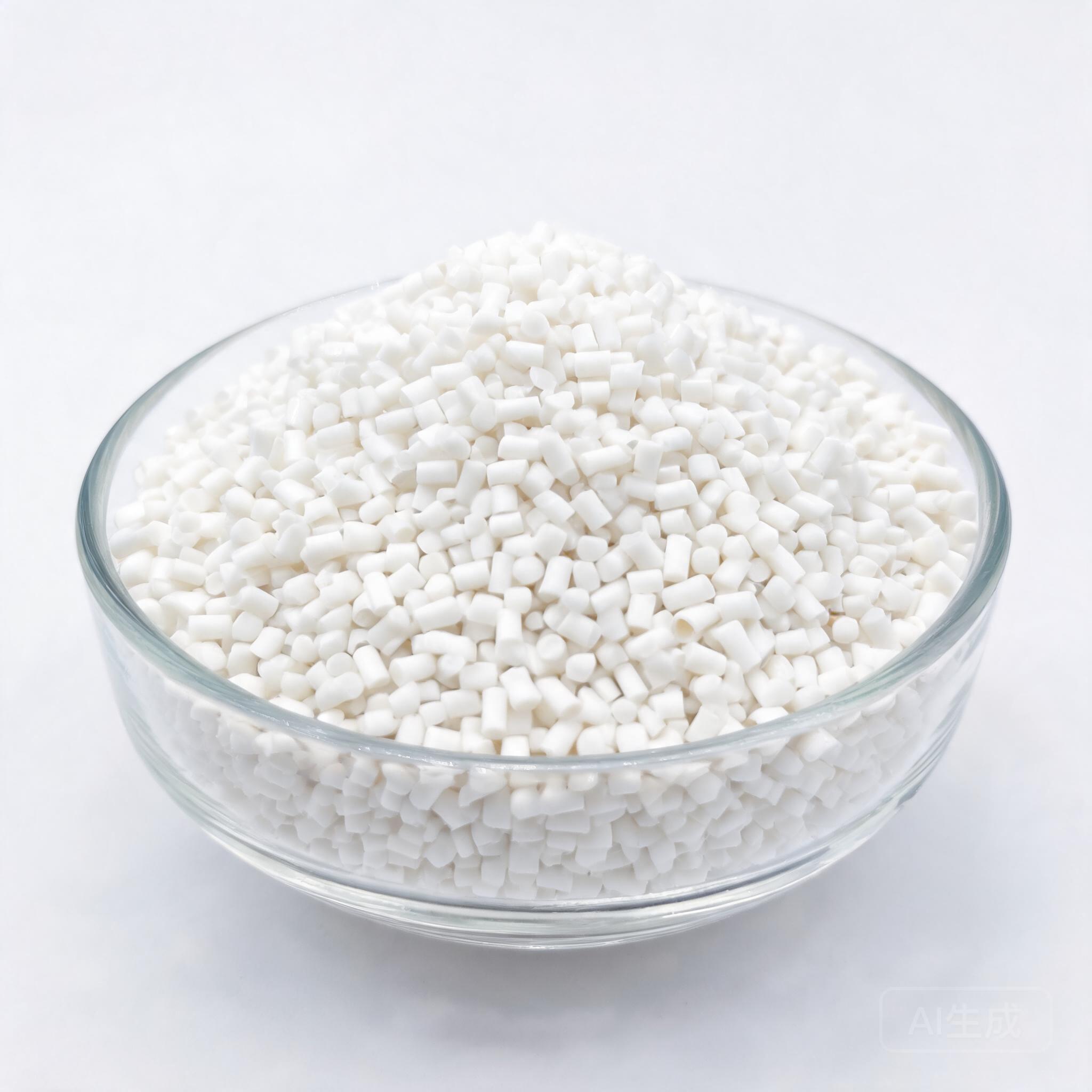
Titanium dioxide (TiO2) comes in two crystalline forms used in plastics: rutile and anatase. The grade affects whiteness, opacity, durability, and processing behavior.
Rutile is the preferred grade for most plastic applications. It has higher refractive index, better UV resistance, and lower photocatalytic activity, which means it is less likely to cause polymer degradation. If your product is exposed to sunlight, such as outdoor film or packaging, rutile is the safe choice.
Anatase has a lower refractive index and higher photocatalytic activity. It is sometimes used for specific effects, such as a bluer undertone or where cost is a major factor. However, it can accelerate polymer degradation under UV exposure, so it is rarely recommended for outdoor use.
What to ask your supplier:
- Is the TiO2 rutile or anatase? Ask for the specific grade name and manufacturer.
- Is the TiO2 surface-treated? Surface treatments improve dispersion and weather resistance.
How Does TiO2 Content Affect Whiteness and Cost?
TiO2 content is the percentage of pure TiO2 in the masterbatch. Higher content gives more hiding power per kilogram of masterbatch, but it also increases the price per kilogram because TiO2 is the most expensive component.
The right content depends on your application and the level of whiteness or opacity you need. For thin films, you may need a higher TiO2 content to achieve opacity at a low letdown ratio. For thick-walled injection molded parts, a lower content may suffice because the wall thickness itself provides some opacity.
There is no universal "best" content. A masterbatch with 50% TiO2 may be more economical than one with 30% if you can use a lower letdown ratio. The total cost per finished part depends on both the masterbatch price and the letdown ratio. Ask your supplier for a cost-per-part calculation, not just the price per kilogram.
What to ask your supplier:
- What is the exact TiO2 content by weight?
- What letdown ratio do you recommend for my application to achieve the target opacity?
- Can you provide a sample and a trial formulation to test before ordering?
Why Carrier Resin Compatibility Matters
The carrier resin is the polymer matrix that holds the TiO2 particles. It must be compatible with the polymer you are processing. If the carrier is not compatible, you may see delamination, poor mechanical properties, or surface defects.
For example, a masterbatch with a polyethylene (PE) carrier works well with PE and polypropylene (PP) in many cases, but it is not suitable for engineering plastics like ABS or PC. Always match the carrier to your base resin, or use a universal grade that is designed for a range of polymers.
Many suppliers offer a universal white masterbatch that works with both PE and PP. This is convenient if you process both materials, but you should still verify compatibility with your specific grade and processing conditions.
What to ask your supplier:
- What is the carrier resin in this masterbatch?
- Is it compatible with my base polymer (e.g., PE, PP, ABS, PET)?
- Do you have a universal grade that works with PE and PP? (See the universal white masterbatch for PE/PP page.)
Dispersion Quality: The Hidden Factor in Surface Finish
Dispersion refers to how evenly the TiO2 particles are distributed throughout the masterbatch and, ultimately, in your final product. Poor dispersion leads to agglomerates that show up as specks, streaks, or a dull, uneven surface. It can also reduce mechanical strength.
Good dispersion is achieved through proper compounding—using high-quality equipment and additives that help wet out the TiO2 particles. A masterbatch with high TiO2 content is more difficult to disperse, so a supplier with good process control is critical.
You cannot judge dispersion from a sample chip alone. You need to test it in your own process. Ask the supplier for a dispersion test report, such as a melt filtration test or a film inspection, and request a trial run with your equipment.
What to ask your supplier:
- Do you have dispersion test data (e.g., filter pressure value, film specks count)?
- Can you provide a sample for a shop-floor trial?
- What is your quality control process for each batch?
How to Vet a White Masterbatch Manufacturer
When choosing a white masterbatch manufacturer, look beyond the price list. You want a supplier that can provide consistent quality and technical support.
Here are checks you can do before committing:
- Check the product catalog: Does the supplier offer a range of masterbatches, including a universal white grade? A broad catalog indicates experience. See Wanzhoutong's product catalog.
- Ask about production capacity: How many extrusion lines do they have? For example, Wanzhoutong, a factory-direct manufacturer in Shenzhen founded in 2012, has 12 extrusion lines. This gives an idea of production scale.
- Request samples and test data: A reliable supplier will provide samples and technical data without hesitation.
- Check OEM capabilities: If you need custom color matching, ensure the supplier offers OEM/ODM services. For instance, Wanzhoutong offers custom color matching and OEM/ODM for masterbatch, with an MOQ starting from 50 kg. See the OEM page.
- Consider location and logistics: If you are in Southeast Asia or Europe, a supplier in Shenzhen is well-positioned for shipping. Products are typically packed in 25 kg bags, which is standard for export.
You can also visit the manufacturer page to learn more about the factory's history and capabilities.
Buyer's Checklist: What to Confirm Before Ordering
Use this checklist to ensure you have all the information you need before placing an order:
| Item | What to Confirm |
|---|---|
| TiO2 Grade | Rutile or anatase? What is the specific grade and manufacturer? |
| TiO2 Content | Exact percentage by weight. Ask for the test certificate. |
| Carrier Resin | What polymer is used? Is it compatible with your base resin? |
| Dispersion Quality | Request dispersion test data and a sample for trial. |
| Letdown Ratio | What ratio is recommended for your application to achieve the target opacity? |
| Packaging | Standard packaging (e.g., 25 kg bags)? Any special requirements? |
| MOQ | What is the minimum order quantity? For custom colors, is the MOQ higher? |
| Lead Time | What is the production lead time for standard and custom orders? |
| Certifications | Ask if the product meets any relevant standards (e.g., REACH, RoHS) and request documentation. |
FAQ
What is the difference between rutile and anatase TiO2 in masterbatch?
Rutile has higher opacity and better UV resistance, making it suitable for outdoor and most general applications. Anatase is less durable and can cause polymer degradation under UV, so it is used only in specific cases. Always confirm the grade with your supplier.
How do I know what TiO2 content I need?
It depends on your application, wall thickness, and the whiteness level you need. Higher content gives more hiding power but costs more. Ask your supplier to recommend a content and letdown ratio based on your product, and test with samples.
Can I use a PE-based masterbatch with PP?
In many cases, a PE carrier works with PP because they are both polyolefins, but you should verify compatibility. A universal white masterbatch is designed for both PE and PP, which simplifies inventory. Confirm with your supplier.
How can I test dispersion quality before ordering?
Request a sample and run it on your own equipment. Look for specks, streaks, or surface roughness. Ask the supplier for dispersion test data, such as filter pressure value or film inspection results.
Next Steps
Choosing the right white masterbatch is about matching the TiO2 grade, content, carrier resin, and dispersion quality to your specific application. Start by requesting samples and technical data from a supplier that can demonstrate consistency and factory-direct capability.
If you are evaluating suppliers, consider Wanzhoutong, a Shenzhen-based manufacturer with 12 extrusion lines and custom color matching services. They offer a universal white masterbatch for PE/PP and can support OEM orders starting from 50 kg. Review their product catalog and factory information to see if they meet your requirements.
Remember: the most important step is to test the material in your own process. No specification sheet can replace a shop-floor trial.