
A comprehensive B2B guide for purchasing TPU flexible filament. Learn how Shore hardness (TPU 95A, 85A, 90A) affects print performance, critical printing parameters for flexible filament, and how to evaluate a TPU 3D printing filament manufacturer or supplier for wholesale sourcing.
BUYER GUIDE
- Shore hardness is the single most important spec: TPU 95A is the most common balance of flexibility and printability; 85A/90A offer softer parts but require more careful printer tuning.
- Printing flexible filament demands a direct-drive extruder and proper retraction settings. Bowden setups can work with TPU 95A but struggle with softer grades.
- When sourcing TPU filament wholesale, verify batch-to-batch diameter consistency, drying requirements, and MOQ terms. A reliable TPU 3D printing filament manufacturer should provide a technical data sheet (TDS) and a certificate of analysis (COA) per lot.
- Price per kilogram is not the only cost factor. Consider spool weight consistency, packaging for moisture protection, and shipping logistics.
1. Why TPU Flexible Filament?
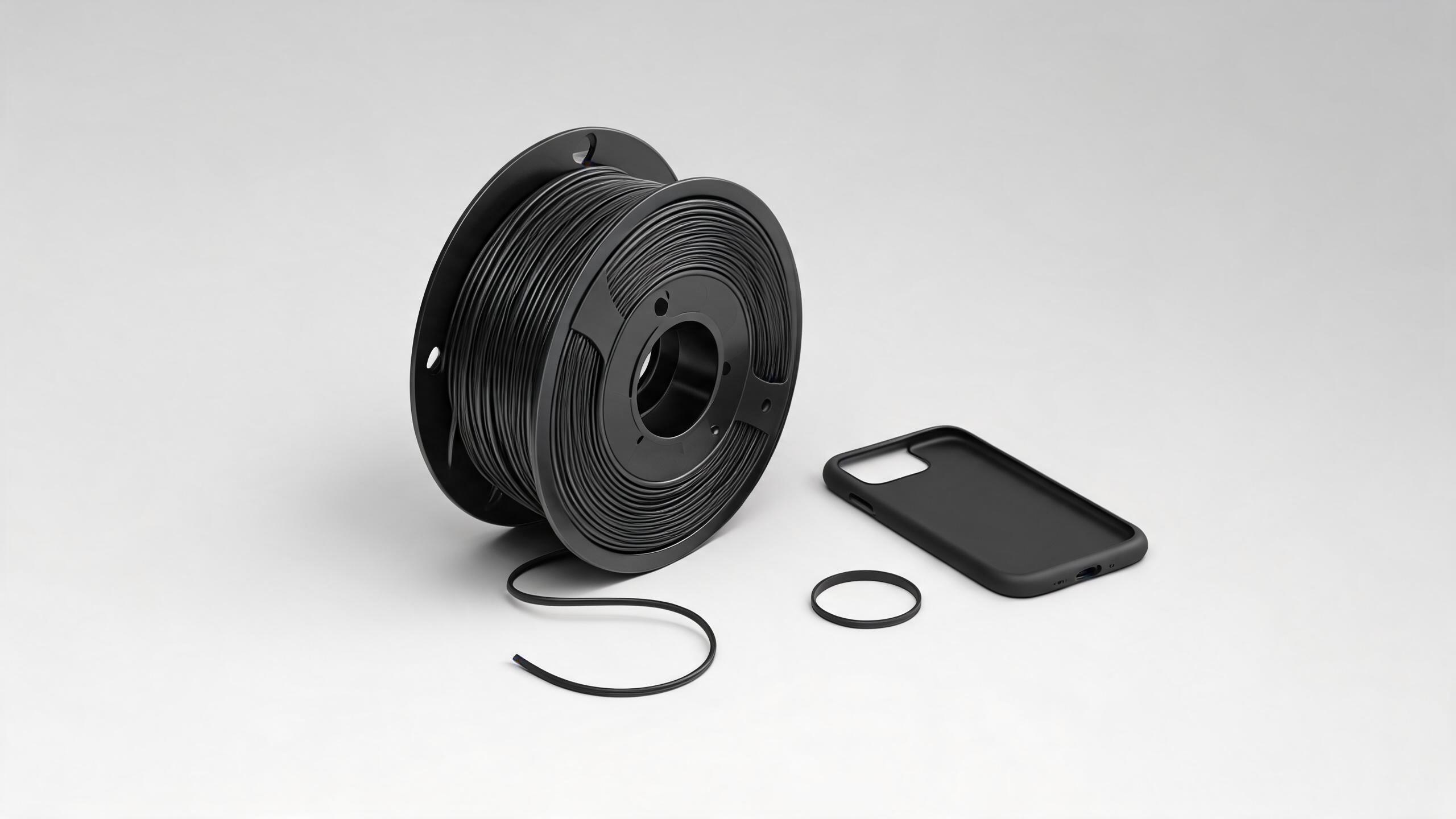
Thermoplastic polyurethane (TPU) is the dominant material in the flexible filament category. It combines rubber-like elasticity with the durability of a thermoplastic, making it suitable for gaskets, seals, vibration dampers, protective cases, medical devices, and custom tooling.
For a B2B buyer, the key question is not "is TPU good?" but "which TPU grade and supplier match my application and production volume?" This guide walks through the technical decisions and the commercial evaluation.
2. Understanding Shore Hardness: The Core Spec
Shore hardness measures a material's resistance to indentation. For TPU, the relevant scale is Shore A. The number directly correlates with flexibility:
| Shore A Value | Relative Flexibility | Typical Applications | Printing Difficulty |
|---|---|---|---|
| 70A – 80A | Very soft, rubber-like | Soft grips, shoe soles, medical tubing | High (requires direct-drive, slow speed) |
| 85A – 90A | Moderately soft | Gaskets, seals, phone cases, vibration mounts | Moderate |
| 95A – 98A | Semi-rigid, firm | Functional prototypes, bushings, industrial parts | Low (most printers handle this) |
TPU 95A is the most widely used flexible filament in the market. It offers enough flexibility for most industrial applications while remaining printable on a wider range of machines, including some Bowden setups. If you are evaluating a new product line, starting with TPU 95A is the safest bet.
For softer parts (e.g., overmolding-like grips), TPU 85A or TPU 90A are better choices. However, these require a direct-drive extruder and lower print speeds (20–30 mm/s).
A common mistake: assuming a softer Shore value always means "better." Softer TPU is more prone to jamming, stringing, and inconsistent extrusion. Match the hardness to the end-use mechanical requirement, not to a subjective feel.
3. TPU Printing: Key Parameters for Success
Flexible filament behaves differently from rigid plastics like PLA or ABS. Here are the critical parameters to control:
3.1 Extruder Type
Direct-drive extruders are strongly recommended for TPU below 95A. The short filament path from drive gear to hot end reduces buckling. For TPU 95A, a well-tuned Bowden system can work, but expect more retraction-related issues.
3.2 Print Speed
Reduce speed to 20–40 mm/s for TPU 95A, and 15–25 mm/s for softer grades. Higher speeds increase the risk of under-extrusion and filament compression in the Bowden tube.
3.3 Temperature
Typical nozzle temperature range: 210°C – 240°C. Bed temperature: 40°C – 60°C (PEI or glass bed with glue stick). Actual values depend on the specific TPU formulation; always check the manufacturer's TDS.
3.4 Retraction
Minimize retraction distance. For direct-drive: 0.5–1.5 mm. For Bowden: 2–4 mm. Retraction speed: 20–30 mm/s. Too much retraction can cause jamming because the soft filament deforms inside the drive gear.
3.5 Drying
TPU is hygroscopic. Moisture causes bubbles, popping sounds, and poor layer adhesion. Dry filament at 65°C – 75°C for 4–6 hours before printing. A dry box during printing is recommended.
4. Quality Indicators for TPU Filament
When evaluating a TPU filament wholesale supplier, look beyond the price per kilogram. These are the real quality indicators:
- Diameter tolerance: ±0.05 mm is standard; ±0.02 mm is premium. Inconsistent diameter causes flow variability and failed prints.
- Spool weight consistency: Some suppliers underfill spools by 5–10%. Verify net weight on a sample.
- Packaging: Vacuum-sealed bags with desiccant are essential. TPU absorbs moisture during transport if not properly sealed.
- Batch traceability: A responsible manufacturer provides a lot number and a COA for each batch.
- Printability across machines: Ask for a list of recommended print profiles. A supplier that only tests on one printer model may have hidden issues.
5. Sourcing TPU Filament Wholesale: What to Ask
If you are purchasing TPU filament for resale, internal production, or contract manufacturing, here is a checklist for supplier evaluation:
5.1 MOQ and Lead Time
Typical MOQ for TPU filament wholesale ranges from 50 kg to 500 kg per color. Lead time is usually 15–30 days for standard colors (black, white, natural). Custom colors require 30–45 days. Confirm these before ordering.
5.2 Color Matching
If you need a specific Pantone or RAL color, request a color chip sample first. Some manufacturers charge a color-matching fee for small batches.
5.3 Custom Formulation
Some TPU 3D printing filament manufacturers offer custom Shore hardness blends (e.g., 92A, 88A) or additives (antistatic, UV-resistant, food-contact grades). Ask if they can tailor the formula to your application.
5.4 Certifications
Common certifications for TPU filament include RoHS, REACH, and UL 94 HB (flammability). For medical or food-contact applications, additional certifications like ISO 10993 or FDA 21 CFR may be required. These are available upon request from qualified manufacturers.
5.5 Shipping and Logistics
TPU filament is relatively dense (1.10–1.25 g/cm³). A 1 kg spool occupies about 2.5–3 liters of volume. For container shipments, standard 20-foot containers hold approximately 1,200–1,500 spools depending on packaging. Confirm whether the supplier offers FOB, CIF, or DDP terms.
6. Comparing TPU 95A vs. Softer Grades (85A, 90A)
This comparison helps you decide which Shore hardness to stock or specify for a project:
| Parameter | TPU 95A | TPU 85A / 90A |
|---|---|---|
| Flexibility | Firm, semi-rigid | Soft, rubber-like |
| Print speed (recommended) | 30–50 mm/s | 15–30 mm/s |
| Extruder requirement | Direct-drive or Bowden (tuned) | Direct-drive only |
| Retraction sensitivity | Moderate | High |
| Layer adhesion | Good | Excellent (if dry) |
| Typical part durability | High abrasion resistance | High tear resistance |
| Common failure modes | Stringing, oozing | Jamming, under-extrusion |
7. Common Mistakes When Buying TPU Flexible Filament
- Buying based on price alone: Cheap TPU often has poor diameter tolerance, inconsistent Shore hardness, or high moisture content. A failed print run costs more than the material savings.
- Ignoring drying requirements: Even "factory-sealed" TPU can arrive with moisture if the vacuum seal is compromised. Always dry before first use.
- Assuming all TPU 95A is the same: Different manufacturers use different polyurethane formulations. One supplier's 95A may print at 215°C, another's at 235°C. Always test a sample spool before committing to a wholesale order.
- Overlooking spool dimensions: Some spools do not fit certain filament dryers or holders. Confirm the spool inner diameter (typically 50–56 mm) and outer diameter (200–220 mm).
8. Evaluating a TPU 3D Printing Filament Manufacturer
When you contact a TPU 3D printing filament manufacturer, ask these questions to assess their capability:
- What is your production capacity per month? (e.g., 50 tons/month indicates a medium-to-large manufacturer.)
- Do you perform in-house QC on every batch? (Look for answers about diameter measurement, Shore hardness testing, and tensile strength checks.)
- Can you provide a sample reel for testing? (Most reputable manufacturers offer 0.5–1 kg samples at cost or free for qualified buyers.)
- What is your defect rate and return policy? (A standard is ≤2% defect rate; anything higher is a red flag.)
- Do you offer private labeling or OEM packaging? (If you plan to resell, this is critical.)
9. FAQ: TPU Flexible Filament Buying
Q: Can I print TPU on an Ender 3 (Bowden)?
Yes, for TPU 95A. Use a slow speed (25–30 mm/s), reduce retraction, and consider upgrading to a metal extruder arm. Softer grades (85A) are very difficult on Bowden.
Q: What is the shelf life of TPU filament?
If stored in a sealed bag with desiccant at 20–25°C, TPU can last 12–18 months. Once opened, use within 6 months or re-dry before each use.
Q: How do I test if my TPU filament is dry?
Extrude a small amount at normal temperature. If you hear popping or see steam bubbles, the filament is wet. A dry filament produces a smooth, consistent strand.
Q: Is TPU recyclable?
Yes, but only if it is a single-grade, uncontaminated scrap. Mixed Shore hardness or colors reduce recyclability. Some manufacturers accept returns of defective spools for reprocessing.
Q: What is the minimum order quantity for TPU filament wholesale?
This varies by supplier. Common MOQs are 50 kg (for standard colors) to 500 kg (for custom colors). Contact the manufacturer directly for current terms.
10. Next Steps for Buyers
If you are evaluating TPU filament for your business, here is a practical workflow:
- Define your application: Shore hardness, color, required certifications, and estimated monthly volume.
- Request samples from 2–3 manufacturers. Test printability on your equipment.
- Compare TDS and COA for diameter tolerance, Shore hardness consistency, and tensile strength.
- Negotiate MOQ, lead time, and payment terms (typically T/T or L/C for wholesale orders).
- Place a trial order (e.g., 50–100 kg) before committing to a full container.
For more information on TPU filament specifications or to request a sample, contact our sales team. We supply TPU 95A, 85A, and custom Shore hardness grades with full batch traceability and competitive wholesale pricing.