
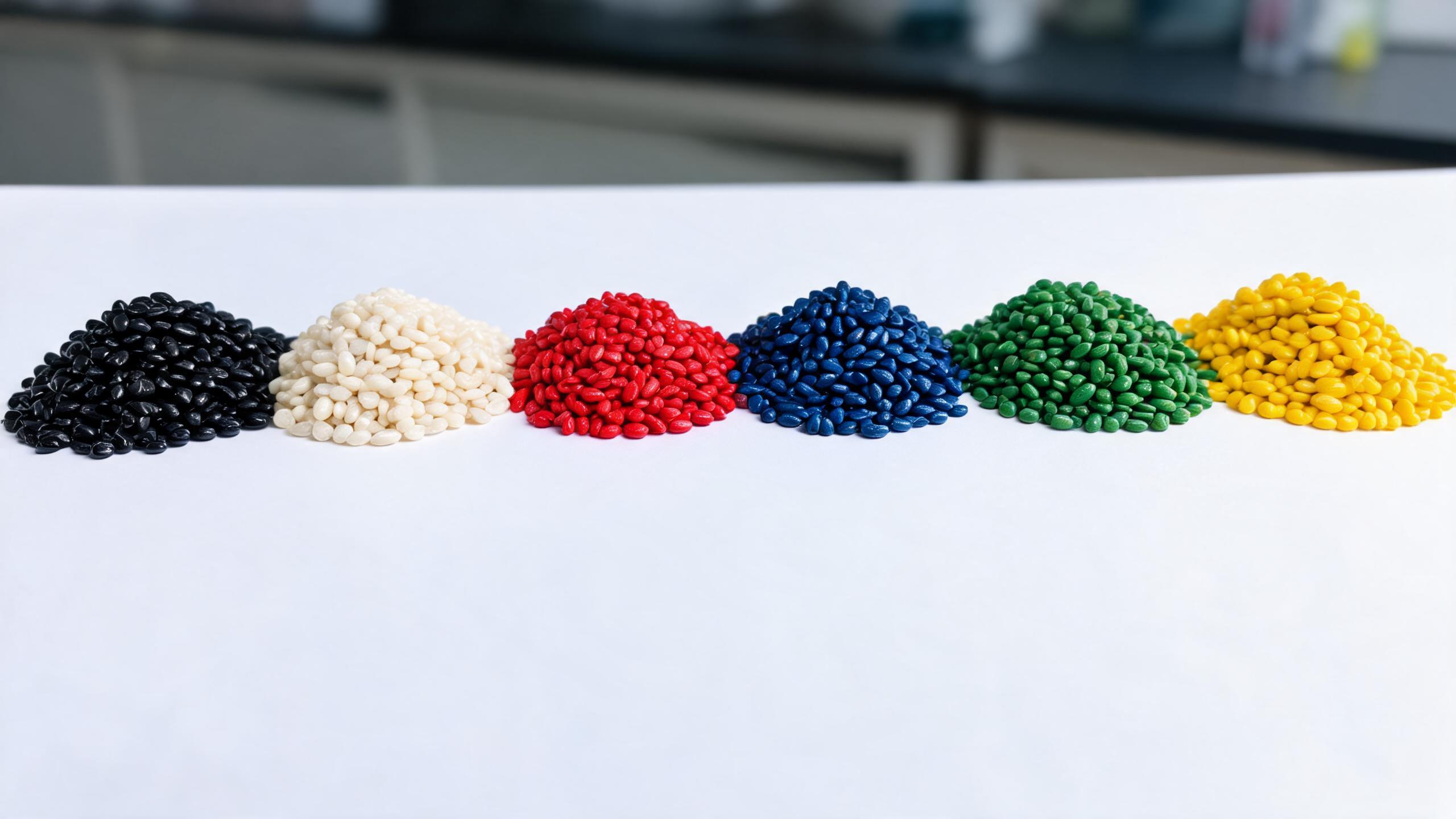
A practical guide for plastic manufacturers on how to evaluate and select a color masterbatch supplier. Covers key selection criteria, quality indicators, common pitfalls, and what to ask before placing an order. Includes specific considerations for black masterbatch and white masterbatch.
BUYER GUIDE
• Evaluate a color masterbatch manufacturer on carbon black dispersion, carrier resin compatibility, and lot-to-lot consistency — not just price.
• Black masterbatch and white masterbatch have distinct quality criteria: jetness vs. opacity, dispersion vs. brightness. Know the difference before comparing quotes.
• A reliable supplier provides a technical data sheet (TDS), a certificate of analysis (COA) per lot, and a clear lead time — if they can't, that's a red flag.
• Always request a sample run under your actual processing conditions (injection, extrusion, blow molding) before committing to bulk orders.
Selecting the right color masterbatch supplier is one of the most consequential decisions a plastic manufacturer makes. The wrong choice leads to rejected batches, machine downtime, color inconsistency across production runs, and unhappy end customers. The right choice gives you predictable processing, consistent color, and a technical partner who helps you solve problems.
This guide walks through what to look for in a color masterbatch manufacturer, how to evaluate black masterbatch and white masterbatch specifically, and what questions to ask before you place your first order.
What Is Color Masterbatch and Why Supplier Selection Matters
Color masterbatch is a concentrated mixture of pigments or additives encapsulated in a carrier resin. It is produced in pellet form and added to natural or uncolored polymer during processing. The carrier resin must be compatible with the base polymer (e.g., PE, PP, ABS, PS, PET) to ensure uniform dispersion and strong bonding.
A poor-quality masterbatch — or a mismatched carrier — causes visible streaking, weak mechanical properties, clogged screens, and inconsistent color from one batch to the next. These problems cost time and material. A qualified color masterbatch manufacturer controls for these variables at every production stage.
Key Selection Criteria for a Color Masterbatch Manufacturer
1. Carrier Resin Compatibility
The carrier resin in the masterbatch must match or be compatible with the base polymer you are processing. Common carrier resins include:
- LDPE / LLDPE — for film extrusion, blow molding, general packaging
- PP — for automotive parts, household goods, woven bags
- ABS / SAN — for electronics housings, consumer appliances
- PET — for bottles, sheets, strapping
A reputable color masterbatch manufacturer can recommend the correct carrier based on your application. If they offer only a "universal" carrier, ask for test data proving compatibility with your specific resin. Universal carriers can work but may reduce dispersion quality in certain polymers.
2. Pigment Quality and Dispersion
Dispersion is the single most important technical parameter. Poorly dispersed pigment particles cause surface defects, reduced strength, and inconsistent color. Look for a supplier who provides:
- Fineness of dispersion data (measured in microns, typically ≤ 15 µm for injection molding, ≤ 20 µm for film)
- Filter pressure value (FPV) test results — lower FPV indicates better dispersion
- A dispersion guarantee in their technical data sheet
3. Lot-to-Lot Consistency
Plastic production runs often span weeks or months. If the masterbatch color shifts between lots, every product made after the change will be visibly different. Ask the manufacturer:
- Do you perform spectrophotometric measurement on every batch?
- What is your Delta E (ΔE) tolerance? (Industry standard is ΔE ≤ 1.0 for most applications; tighter for automotive or electronics.)
- Can you provide a certificate of analysis (COA) per lot?
4. Processing Temperature Range
Different plastics process at different temperatures. A masterbatch designed for PE (160–200°C) may degrade in PET (260–280°C) or PC (280–310°C). Confirm that the masterbatch's recommended processing temperature range covers your actual machine settings.
5. MOQ, Lead Time, and Packaging
B2B buyers often need predictable supply. Clarify:
- Minimum order quantity (MOQ) — can they accommodate trial orders of 25–50 kg?
- Standard lead time for repeat orders
- Packaging options (25 kg bags, 500 kg jumbo bags, octabins, etc.)
- Whether they offer custom color matching services and the typical turnaround for that
Black Masterbatch: Specific Considerations
Black masterbatch is the most widely used type of color masterbatch globally. It is used for everything from agricultural film and construction pipes to automotive trim and electronics. Despite its ubiquity, quality varies enormously.
| Parameter | What to Look For | Why It Matters |
|---|---|---|
| Carbon black content | Typically 30–50% for general use; up to 60% for high-jetness applications | Higher loading reduces let-down ratio but requires better dispersion |
| Jetness (color depth) | Measured by L* value (lower = darker); ask for spectrophotometric data | Determines visual appearance — low jetness looks gray, not black |
| Dispersion quality | Fineness ≤ 15 µm; filter pressure value (FPV) < 0.5 bar·cm²/g | Poor dispersion causes visible specks and weakens film or pipe |
| UV resistance | Ask if carbon black grade is selected for UV stability | Critical for outdoor applications like geomembrane or agricultural film |
| Carrier resin | Must match your base polymer (PE, PP, ABS, etc.) | Incompatible carrier causes poor adhesion and processing issues |
A common mistake is buying black masterbatch based only on price. Low-cost masterbatch often uses recycled carbon black, poor dispersion, or a generic carrier. The result: you use more masterbatch to achieve the same color, your machine screens clog more often, and your final product has visible defects. The effective cost per good part is higher than a slightly more expensive, high-quality masterbatch.
White Masterbatch: Specific Considerations
White masterbatch relies on titanium dioxide (TiO₂) as the primary pigment. TiO₂ is expensive, so this is where a manufacturer's sourcing and formulation skill matters most.
| Parameter | What to Look For | Why It Matters |
|---|---|---|
| TiO₂ content | Typically 50–70% for standard white; up to 80% for high-opacity | Higher loading reduces let-down ratio but requires excellent dispersion |
| Opacity / hiding power | Measured by contrast ratio (CR) — ask for CR value at a given film thickness | Determines how thin a layer you need to hide the substrate — directly affects material cost |
| Whiteness index (WI) | Higher WI = brighter white; ask for CIE whiteness value | Critical for food packaging, medical devices, consumer goods |
| Dispersion | Fineness ≤ 20 µm; FPV < 1.0 bar·cm²/g | Poor dispersion causes visible streaks and reduces mechanical strength |
| TiO₂ grade | Rutile grade preferred for outdoor use; anatase for indoor applications | Rutile offers better UV resistance and durability |
For white masterbatch, the balance between TiO₂ content and dispersion is critical. A supplier who loads 75% TiO₂ but cannot disperse it properly will give you a product that looks gray, streaks during processing, and wears out your screw and barrel faster. Ask for a dispersion guarantee in writing.
Red Flags When Evaluating a Color Masterbatch Manufacturer
- No technical data sheet. A legitimate manufacturer provides a TDS with pigment content, carrier resin, processing temperature range, and dispersion data.
- No certificate of analysis per lot. Without COA, you have no way to verify consistency between shipments.
- Vague lead times. A reliable supplier gives a clear lead time (e.g., 7–10 working days for standard colors, 15–20 for custom matches).
- Unwilling to provide samples. Any serious manufacturer will send 5–10 kg for you to test under your actual production conditions.
- Price significantly below market average. Masterbatch raw materials (pigments, carrier resin, additives) have known cost floors. A price that seems too good usually means corners were cut on pigment quality or dispersion.
How to Conduct a Supplier Evaluation: A Step-by-Step Process
- Request a technical data sheet for the masterbatch grades you are considering.
- Ask for a sample (5–10 kg) and run it on your actual production line under normal conditions.
- Compare the sample against your current masterbatch on color (spectrophotometer), dispersion (visual inspection under light, or filter pressure test), and mechanical properties (tensile strength, elongation).
- Request a COA from a recent production lot to verify they track quality data per batch.
- Clarify logistics: MOQ, lead time, packaging, incoterm, payment terms.
- Ask about custom color matching — turnaround time, minimum quantity for custom shades, and whether they charge a color matching fee.
- Check references if possible — ask for a customer in a similar industry.
FAQ: Common Questions About Color Masterbatch Selection
Q: What is the typical let-down ratio for black masterbatch?
A: It depends on the carbon black content. For a 40% carbon black masterbatch, a typical let-down ratio is 1–3% (1–3 kg per 100 kg of base resin). For high-jetness applications, you may need 4–6%. Always confirm with the manufacturer's TDS.
Q: Can I use the same white masterbatch for film and injection molding?
A: Not always. Film-grade masterbatch requires finer dispersion and different carrier rheology to avoid streaks. Injection molding masterbatch can tolerate slightly coarser dispersion but needs better thermal stability. Check the TDS for recommended processing methods.
Q: How do I know if a masterbatch is compatible with my resin?
A: The carrier resin should be the same or compatible with your base polymer. For example, a PE carrier works with PE, PP, and some PS grades, but not with ABS or PET. The manufacturer should state the compatible polymers on the TDS.
Q: What is a reasonable lead time for custom color matching?
A: Typically 7–15 working days for a match, plus 5–10 days for sample production and shipping. Some manufacturers charge a color matching fee, which may be waived for large orders.
Q: Should I test masterbatch from multiple suppliers?
A: Yes. Request samples from 2–3 qualified color masterbatch manufacturers and run them under identical conditions. Compare not just the final color but also processing stability, machine cleanliness, and scrap rate.
Conclusion
Choosing the right color masterbatch supplier is a technical decision, not just a commercial one. A good color masterbatch manufacturer provides clear technical data, consistent quality, and responsive support. They help you reduce scrap, improve throughput, and deliver a better product to your customers.
When evaluating suppliers for black masterbatch or white masterbatch, focus on dispersion quality, carrier resin compatibility, and lot-to-lot consistency. Request samples, run production trials, and ask for documented quality data. The time you invest in supplier evaluation pays back in fewer rejected batches and more predictable production.
If you are currently evaluating suppliers or need technical assistance with a specific application, feel free to reach out with your requirements. We can discuss your base polymer, processing method, and color target to recommend the right masterbatch grade.