
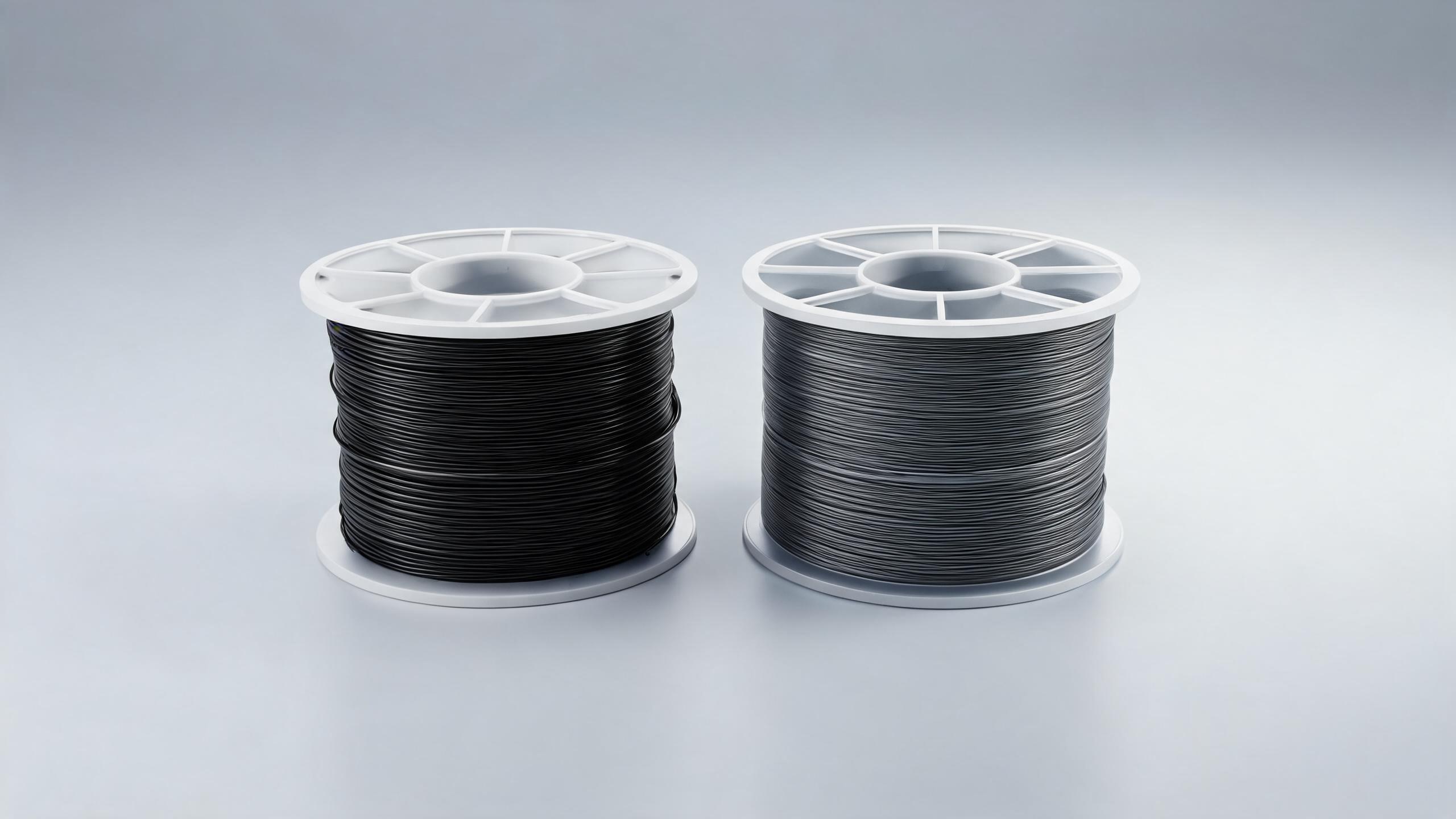
A practical comparison of 1.75mm vs 2.85mm filament for B2B buyers and importers, covering extrusion tolerance, print quality, printer compatibility, and wholesale sourcing considerations for Southeast Asia and Europe.
BUYER GUIDE
If you import or wholesale 3D printing filament, the 1.75mm vs 2.85mm question is not just a technical detail — it determines which printers your customers can use, how much waste you absorb from out-of-tolerance spools, and whether you need to stock two separate SKUs. This guide compares the two diameters from a B2B perspective: extrusion tolerance, print quality, printer compatibility (Ultimaker-style 2.85mm systems vs standard 1.75mm), and sourcing considerations for filament importers in Southeast Asia and Europe.
- 1.75mm dominates the consumer and prosumer market; 2.85mm is largely confined to legacy Ultimaker and a few industrial systems.
- Diameter tolerance (typically ±0.02–0.05mm) directly affects print reliability — tighter tolerance reduces jams and under-extrusion.
- 2.85mm filament uses more material per meter, so cost-per-part can be higher even if price per kg is similar.
- Before committing to a diameter, verify your target customers' printer models — compatibility is the single biggest demand driver.
- For importers, stocking both diameters increases inventory risk; focus on one unless demand clearly justifies the other.
Why filament diameter matters in B2B procurement
Filament diameter is not a cosmetic spec. It determines the cross-sectional area of material fed into the hotend. A 1.75mm filament has a cross-sectional area of about 2.405 mm², while 2.85mm filament has about 6.379 mm² — roughly 2.65 times more material per linear millimeter. This means the extruder must push more volume for 2.85mm, which requires a more powerful motor and a different hotend geometry. Most printers are designed for one diameter only, and using the wrong size leads to poor extrusion or clogs.
For B2B buyers, the practical implications are inventory complexity, customer support, and quality control. You need to know which diameter your market actually uses before placing large orders.
Extrusion tolerance: the spec that makes or breaks your spool
Extrusion tolerance refers to how much the filament diameter can vary along its length. Industry-standard tolerances are typically ±0.02mm for premium filament, ±0.03mm for good quality, and ±0.05mm for budget grades. This variation affects the volumetric flow rate into the hotend. A wider-than-nominal section can cause jams, while a narrower section can cause under-extrusion and weak parts.
For 2.85mm filament, the same absolute tolerance (±0.02mm) represents a smaller percentage of the diameter compared to 1.75mm. For example, ±0.02mm on a 1.75mm filament is about 1.14% variation, while on 2.85mm it's only 0.70%. In theory, this makes 2.85mm more forgiving in terms of relative variation. However, in practice, 2.85mm filament is often produced on older lines with wider tolerances, and the larger diameter can amplify the effect of any ovality or out-of-roundness.
When sourcing, always request the tolerance spec from the manufacturer. A reputable supplier will provide a typical range and a maximum deviation. For critical applications, ask for a certificate of analysis (CoA) or a batch test report. If a supplier cannot state a tolerance, treat that as a red flag. For a worked example of how tolerance specs translate into real print reliability, see our 1.75mm filament comparison covering specs and tolerance.
Print quality: does diameter affect the final part?
Print quality is influenced more by the printer's calibration and the filament's material properties than by diameter alone. However, diameter affects how precisely the extruder can control flow. With 1.75mm, the extruder motor has finer control over the volume of material because each step of the motor moves a smaller volume. This can lead to more accurate extrusion during rapid direction changes, which is why many high-speed printers favor 1.75mm.
2.85mm filament, due to its larger volume, requires a more powerful extruder and is often used in systems with direct-drive extruders that can handle the higher torque. Some users report that 2.85mm is less prone to buckling in Bowden setups because the larger diameter is stiffer. But this advantage is marginal and printer-specific.
For most applications, print quality is comparable if both filaments are within tolerance and the printer is properly calibrated. The real differentiator is not the diameter itself but the consistency of the filament — both along the spool and between batches. If you print mainly with PLA, our PLA printing parameters guide breaks down the temperature and speed settings that matter more than diameter.
Printer compatibility: 1.75mm vs 2.85mm systems
The most critical factor for B2B buyers is printer compatibility. The 1.75mm diameter is the de facto standard for the vast majority of desktop 3D printers, including those from Creality, Prusa, Bambu Lab, and most other brands. It is also used in many industrial systems. The 2.85mm diameter is primarily associated with Ultimaker printers and a few other systems like the LulzBot TAZ series and some German industrial machines.
| Diameter | Common Printer Brands | Market Share | Typical Use Case |
|---|---|---|---|
| 1.75mm | Creality, Prusa, Bambu Lab, Anycubic, Raise3D | ~80%+ of desktop market | Prototyping, education, small-batch production |
| 2.85mm | Ultimaker, LulzBot, some industrial FDM | Legacy but still active | Professional, research, some production |
If your customer base uses Ultimaker printers (common in European universities and design studios), you may need 2.85mm filament. However, note that Ultimaker has been transitioning to a new filament system that supports both diameters with swappable print cores, but the default for many newer models is still 2.85mm. For most other markets, 1.75mm is the safer bet.
When targeting Southeast Asia, the market is dominated by 1.75mm due to the prevalence of Creality and other Chinese brands. In Europe, 2.85mm has a more significant presence due to Ultimaker's popularity, but 1.75mm is still the majority. Always analyze your target region's printer install base before choosing which diameter to stock.
Sourcing and wholesale considerations for importers
As an importer in Southeast Asia or Europe, your sourcing strategy should account for the following:
- MOQ and pricing: 2.85mm filament uses more material per meter, so the same weight of filament yields fewer meters. This can affect your per-unit cost and freight calculations. Always compare cost per meter, not just per kg.
- Supplier capability: Not all filament manufacturers produce both diameters. Some specialize in 1.75mm. Verify that your supplier has consistent production lines for the diameter you need, and ask for tolerance data.
- Inventory risk: Stocking both diameters doubles your SKU count and increases the risk of slow-moving inventory if one diameter doesn't sell. Start with one diameter based on market research, and only add the second if customer demand justifies it.
- Logistics: Filament spools are bulky. The diameter doesn't affect packaging much, but the total weight and volume of your shipment will. Plan your container utilization accordingly.
Quality checklist for filament sourcing
Whether you choose 1.75mm or 2.85mm, use this checklist to evaluate suppliers:
- Request a material datasheet (TDS) and safety data sheet (SDS) for each material type.
- Ask for the diameter tolerance in writing. A reliable supplier will state e.g., ±0.02mm.
- Check for roundness: ask if they measure ovality, not just diameter.
- Inquire about batch consistency: do they test every spool or only sample?
- Request a free sample or a small trial order before committing to a full container.
- Verify certifications relevant to your market, such as RoHS, REACH, or UL (if applicable).
FAQ: 1.75mm vs 2.85mm filament
Is 2.85mm filament stronger than 1.75mm?
No. The diameter does not affect the material strength. The mechanical properties depend on the polymer and the print settings. A 2.85mm filament is just thicker; it doesn't make the printed part stronger.
Can I use 1.75mm filament in a 2.85mm printer?
No, not without a special adapter or a different hotend. The extruder and hotend are designed for a specific diameter. Using the wrong size will cause feeding issues and clogs.
Why do some printers use 2.85mm?
Historically, 2.85mm was used because it was easier to push with early extruder designs and less prone to buckling in long Bowden tubes. Ultimaker adopted it and it became a standard for their line. Today, 1.75mm is more common because it allows finer extrusion control and is compatible with a wider range of printers.
What is the standard tolerance for good filament?
Premium filament typically has ±0.02mm tolerance. Good quality is ±0.03mm, and budget filament may be ±0.05mm or worse. For professional use, stick to ±0.02mm.
Conclusion: which diameter should you stock?
For most B2B buyers, especially those targeting the broader desktop 3D printing market, 1.75mm is the safer choice due to its overwhelming market share and compatibility with the majority of printers. However, if you have a specific customer base using Ultimaker systems, especially in European education or professional sectors, you may need to offer 2.85mm as a niche SKU.
Before finalizing your sourcing plan, talk to your existing customers and run a quick survey. The decision should be driven by the printers your market actually uses, not by industry hype. And when in doubt, start with 1.75mm and expand later based on demand. Diameter is only one part of the material decision — for a full material-level comparison, read our PLA vs PETG vs ABS buyer's guide.
If you are evaluating filament suppliers, request detailed specs and samples. A reliable partner will be transparent about tolerance, batch consistency, and material certifications. For further guidance on filament sourcing or to discuss your specific requirements, feel free to contact our team.