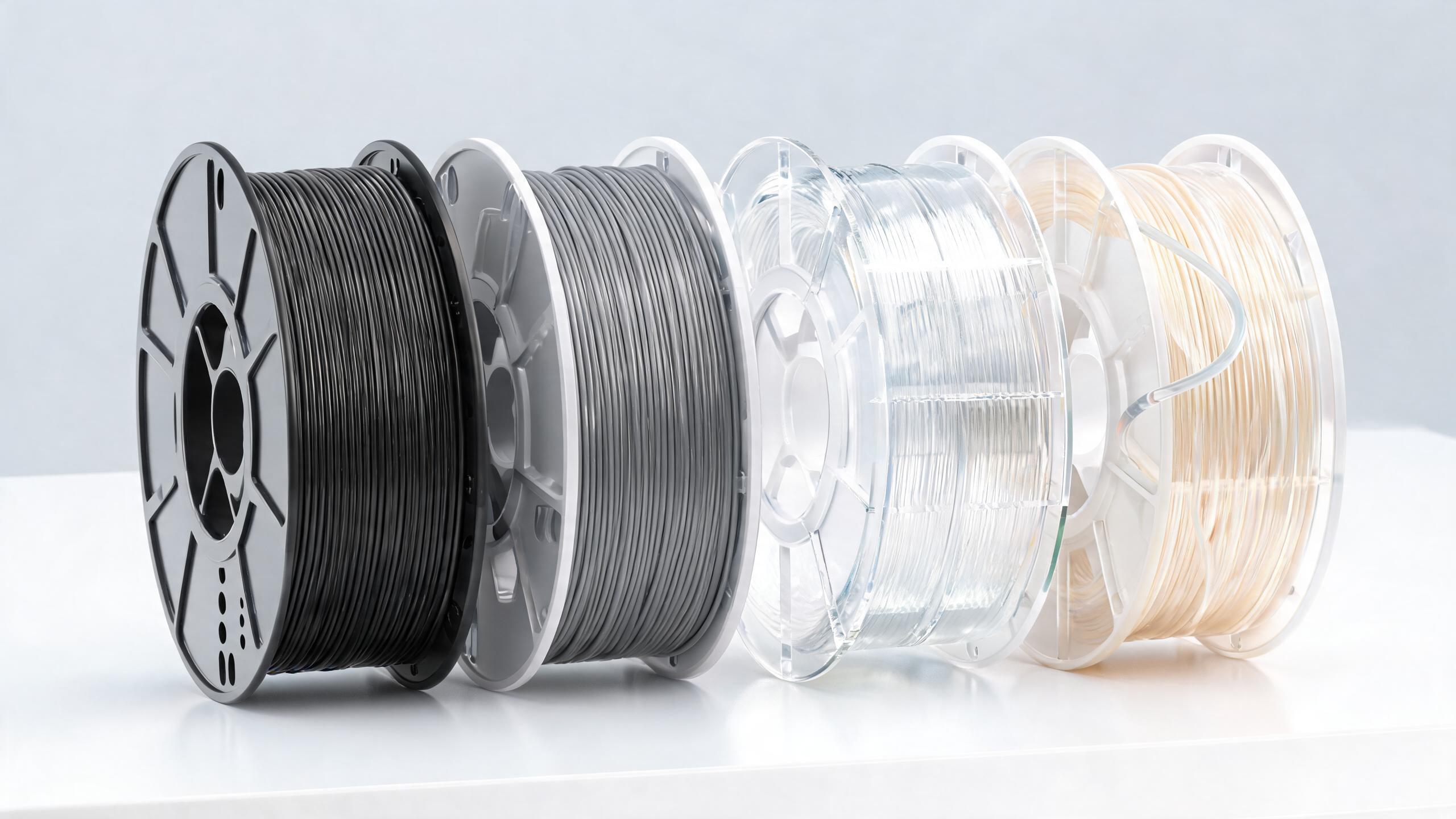
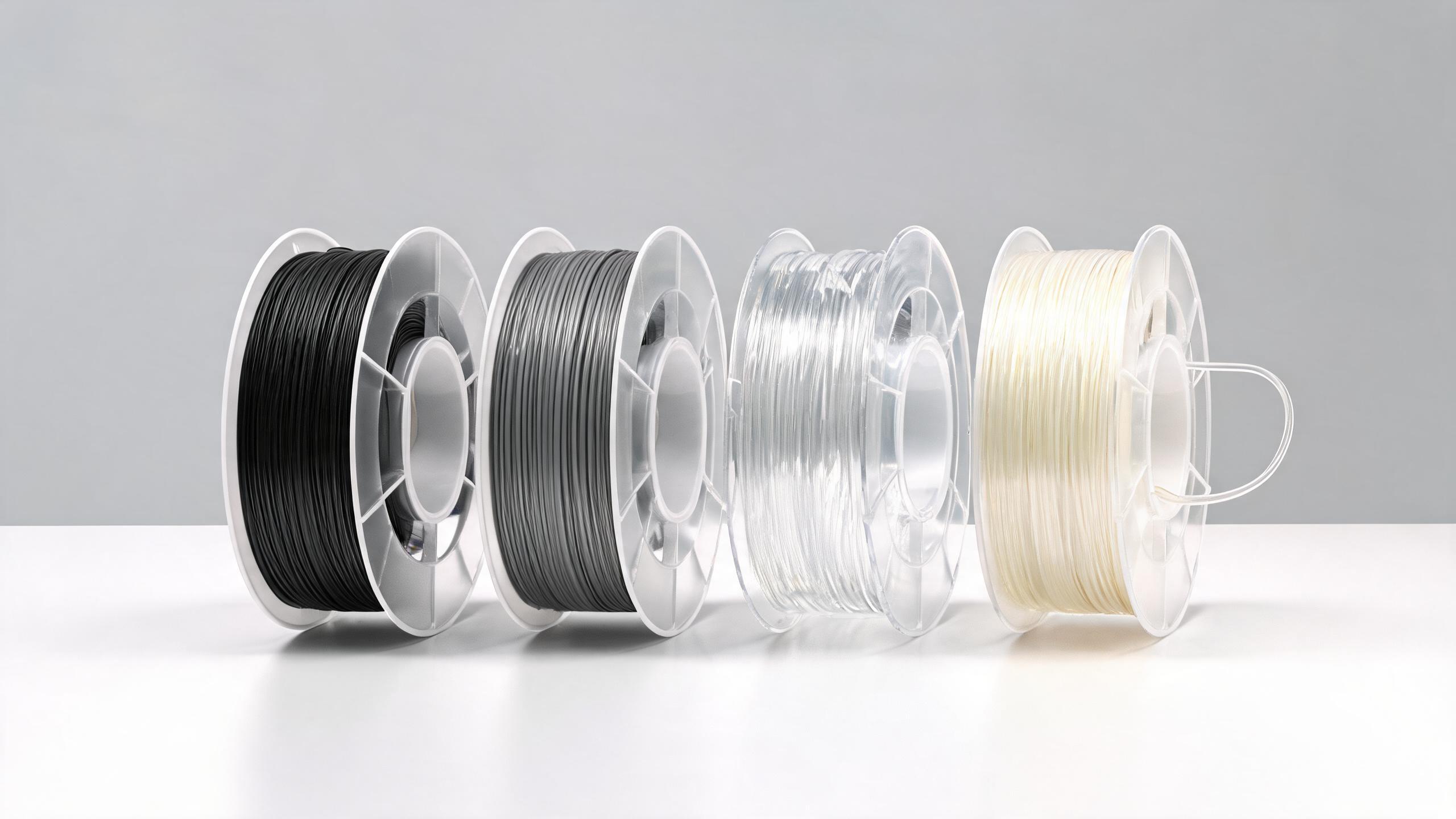
A practical, data-driven comparison of the four most common 3D printing filaments—PLA, PETG, ABS, and TPU—covering strength, heat resistance, flexibility, print difficulty, applications, and cost. Written for procurement teams and engineers who need to match material properties to production requirements without guesswork.
B2B MATERIAL SELECTION GUIDE
PLA vs PETG vs ABS vs TPU: A Practical Comparison for Procurement Teams
Choosing the right 3D printing filament is not a technical detail—it is a cost decision. The material you specify determines part strength, heat tolerance, chemical resistance, print yield, and post-processing labor. Pick the wrong one and you will see it in scrap rates and field failures, not in the price per kilogram.
This guide compares the four most common engineering filaments—PLA, PETG, ABS, and TPU—across the metrics that matter for production: mechanical strength, heat resistance, flexibility, print reliability, application fit, and total cost. It is written for procurement engineers and sourcing teams who need a defensible material selection, not a hobbyist overview.
- PLA is the cheapest and easiest to print, but its low heat resistance (50–60°C) disqualifies it for most functional or outdoor parts.
- PETG is the best all-rounder for production: good strength, ~80°C heat resistance, easy printing, and no toxic fumes. Most B2B buyers should start here.
- ABS offers higher impact strength and heat resistance (~100°C) but requires an enclosed printer and ventilation due to styrene fumes during printing.
- TPU is the only true flexible option (Shore 60A–95A). It is slower to print and costs more per part, but it is irreplaceable for seals, gaskets, and vibration-damping parts.
- Price per kilogram is only part of the cost. Factor in print failure rate, print speed, and post-processing time when comparing materials.
Why Material Selection Matters in B2B Procurement
A prototype in PLA that works on a bench will fail in a 60°C warehouse in summer. A PETG part that is rigid enough for a bracket may creep under sustained load. An ABS enclosure printed in an open-frame machine will warp and delaminate. These are not print-quality issues—they are material-property mismatches.
For procurement, the cost of a wrong material choice includes:
- Field failures and warranty claims
- Rework and reprinting labor
- Delayed production schedules
- Multiple qualification rounds with the same supplier
The goal of this guide is to help you shortlist materials based on your part's operating environment, mechanical requirements, and production volume—before you request quotes.
The Four Filaments at a Glance
| Property | PLA | PETG | ABS | TPU |
|---|---|---|---|---|
| Heat resistance (HDT) | 50–60°C | 70–80°C | 95–105°C | 60–80°C (varies by hardness) |
| Tensile strength | ~50 MPa | ~50 MPa | ~40 MPa | 25–50 MPa (varies by hardness) |
| Impact resistance | Low (brittle) | Good | Excellent | Excellent (absorbs impact) |
| Flexibility | Rigid | Semi-rigid | Rigid | Flexible (Shore 60A–95A) |
| Chemical resistance | Poor | Good | Good (resists oils, fuels) | Good (resists oils, mild chemicals) |
| Print difficulty | Very easy | Easy–moderate | Moderate–hard (requires enclosure) | Moderate–hard (requires direct drive) |
| Fumes / ventilation | None (sweet smell) | Mild, safe | Strong styrene fumes—ventilation required | Mild, safe |
| Typical price range (USD/kg) | $15–$30 | $20–$40 | $20–$40 | $30–$70 |
| Common applications | Prototypes, jigs, visual models | Functional parts, enclosures, chemical containers | Automotive, appliance housings, high-heat parts | Seals, gaskets, dampers, wearables |
Note: Values are typical ranges for standard grades. Actual properties vary by brand, color, and manufacturer. Always request a technical datasheet (TDS) from your supplier and test under your specific conditions.
PLA: The Low-Cost Workhorse (With Limits)
What PLA Is
Polylactic acid (PLA) is a biodegradable thermoplastic made from renewable resources like corn starch or sugarcane. It is the most widely used 3D printing filament because it prints easily, has no toxic fumes, and is inexpensive.
Strengths for B2B Use
- Lowest material cost among the four (typically $15–$30/kg)
- Easiest to print: no heated bed required (though recommended), minimal warping, wide temperature window
- High stiffness and good surface finish for visual parts
- No fumes—safe for office and light workshop environments
- Dimensional accuracy is excellent for form-fit prototypes
Critical Limitations
- Heat resistance is poor: PLA softens and deforms at 50–60°C. A part left in a car on a summer day will warp.
- Brittle under impact: PLA snaps rather than bends. Not suitable for load-bearing or drop-prone parts.
- Poor UV and weather resistance: degrades in sunlight over time.
- Creeps under sustained load: a PLA bracket holding weight will slowly deform.
When to Choose PLA
PLA is the right choice for:
- Form-fit prototypes and design verification models
- Jigs and fixtures in low-temperature environments
- Visual mock-ups for client presentations
- Casting patterns (lost-PLA casting)
- Short-run production where the part will not see heat, load, or impact
PETG: The Production-Ready All-Rounder
What PETG Is
Polyethylene terephthalate glycol (PETG) is a modified version of the PET used in water bottles. The glycol modification reduces crystallinity, making it easier to 3D print while retaining good strength and chemical resistance.
Strengths for B2B Use
- Excellent balance of strength, durability, and printability
- Heat resistance up to ~80°C—handles most indoor and many outdoor environments
- Good chemical resistance to water, mild acids, and alcohols
- Impact resistant—far less brittle than PLA
- Low warping—prints reliably on open-frame printers with a heated bed
- No toxic fumes—safe for office environments
- Good layer adhesion—parts are watertight, suitable for fluid containers
Limitations
- Not as heat-resistant as ABS (~80°C vs ~100°C)
- Softer surface—scratches more easily than ABS
- Stringing and oozing during printing requires tuned retraction settings
- Not as rigid as PLA—slightly more flexible, which may matter for precision parts
When to Choose PETG
PETG is the default choice for functional parts that do not require extreme heat resistance:
- Enclosures and housings for electronics
- Chemical and water containers
- Brackets, clamps, and mounting fixtures
- Spare parts and replacement components
- Outdoor parts in moderate climates (with UV-stabilized grades)
ABS: High Heat and Impact, With Handling Costs
What ABS Is
Acrylonitrile butadiene styrene (ABS) is a petroleum-based thermoplastic widely used in injection molding (think LEGO bricks, appliance housings, automotive trim). It has a long track record in manufacturing.
Strengths for B2B Use
- Heat resistance up to ~100°C—the best of the four
- Excellent impact strength and toughness—absorbs shock without cracking
- Good chemical resistance to oils, greases, and fuels
- Machinable and sandable—easy to post-process for smooth finishes
- Widely available in many colors and specialty blends (e.g., ABS+)
Limitations
- Requires an enclosed printer: ABS shrinks as it cools, causing warping and layer delamination on open-frame machines
- Strong styrene fumes during printing—requires ventilation or a fume extraction system
- Higher print difficulty: bed temperature (100–110°C), chamber temperature, and adhesion management are critical
- Slower production due to the need for controlled cooling
When to Choose ABS
ABS is the right choice when the part must survive heat and impact:
- Automotive components (dashboards, ducts, brackets)
- Appliance housings that see heat
- Enclosures for electronics in warm environments
- Parts that will be glued, sanded, or painted
- Tooling and fixtures in warm workshops
TPU: Flexible Parts That No Rigid Material Can Replace
What TPU Is
Thermoplastic polyurethane (TPU) is a flexible, rubber-like filament. It comes in different hardness grades, measured on the Shore scale—typically Shore 60A (soft) to Shore 95A (firm).
Strengths for B2B Use
- True flexibility and elasticity—the only option among the four for parts that must bend, stretch, or compress
- Excellent abrasion resistance
- Good impact absorption and vibration damping
- Good chemical resistance to oils and mild chemicals
- Wide hardness range—you can match the durometer to the application
Limitations
- Slower printing: flexible filament requires lower speeds (typically 20–40 mm/s) to avoid jams
- Requires a direct-drive extruder: Bowden-style printers struggle with flexible filament
- Higher cost per kilogram ($30–$70/kg)
- Lower strength than rigid materials—not for load-bearing structural parts
- Tolerances are harder to control due to flexibility
When to Choose TPU
TPU is the only choice for parts that must flex:
- Seals and gaskets
- Vibration-damping mounts and bushings
- Protective covers and bumpers
- Wearables and medical devices
- Hoses and tubing
- Conveyor components and rollers
Head-to-Head Comparisons Buyers Ask About
PLA vs PETG
This is the most common comparison for buyers moving from prototyping to production.
| Criterion | PLA | PETG |
|---|---|---|
| Heat resistance | 50–60°C | 70–80°C |
| Impact resistance | Low (brittle) | Good |
| Print difficulty | Very easy | Easy–moderate |
| Fumes | None | Mild |
| Cost per kg | $15–$30 | $20–$40 |
| Best for | Prototypes, visual models | Functional parts, enclosures |
Verdict: PETG is worth the small price premium for any part that will be handled, shipped, or used in warm conditions. PLA is fine for internal prototypes only.
PLA vs ABS
Both are rigid materials, but they serve very different environments.
| Criterion | PLA | ABS |
|---|---|---|
| Heat resistance | 50–60°C | 95–105°C |
| Impact resistance | Low | Excellent |
| Print difficulty | Very easy | Moderate–hard (enclosure required) |
| Fumes | None | Strong styrene—ventilation required |
| Post-processing | Hard to sand (melts) | Easy to sand, glue, paint |
| Best for | Quick prototypes | Functional parts in warm/high-impact environments |
Verdict: If the part stays in a cool, controlled environment and is not subject to impact, PLA is the cost-effective choice. If it sees heat, impact, or needs a smooth painted finish, ABS justifies its handling costs.
PETG vs ABS
This is the key decision for functional production parts.
| Criterion | PETG | ABS |
|---|---|---|
| Heat resistance | 70–80°C | 95–105°C |
| Impact resistance | Good | Excellent |
| Chemical resistance | Good (water, mild acids) | Good (oils, fuels) |
| Print difficulty | Easy–moderate | Moderate–hard |
| Enclosure required? | No | Yes |
| Fumes | Mild, safe | Strong—ventilation required |
| Warping risk | Low | High |
| Surface finish | Slightly soft, scratches easily | Hard, machinable, paintable |
Verdict: Choose PETG for easier printing, lower facility requirements, and better chemical resistance to water and mild acids. Choose ABS when the part needs higher heat resistance, harder surface finish, or resistance to oils and fuels.
PLA vs TPU
These materials are at opposite ends of the flexibility spectrum.
| Criterion | PLA | TPU |
|---|---|---|
| Flexibility | Rigid | Flexible (Shore 60A–95A) |
| Heat resistance | 50–60°C | 60–80°C |
| Print speed | Fast (60–100 mm/s) | Slow (20–40 mm/s) |
| Cost per kg | $15–$30 | $30–$70 |
| Best for | Rigid prototypes | Flexible seals, gaskets, dampers |
Verdict: These are not substitutes. If your part must flex, TPU is the only option. If it must be rigid, PLA is cheaper and faster to print.
Cost Comparison: Price per Kilogram Is Only the Beginning
Material cost per kilogram is the easiest number to compare, but it is not the full picture. For a fair comparison, consider the total cost per good part:
| Cost Factor | PLA | PETG | ABS | TPU |
|---|---|---|---|---|
| Material cost (USD/kg) | $15–$30 | $20–$40 | $20–$40 | $30–$70 |
| Typical print speed | Fast (60–100 mm/s) | Moderate (40–70 mm/s) | Moderate (40–60 mm/s) | Slow (20–40 mm/s) |
| Failure rate risk | Low | Low–moderate | High (warping, delamination) | Moderate (jams, extrusion issues) |
| Enclosure / ventilation cost | None | None | Required (enclosure + ventilation) | None (but direct-drive extruder required) |
| Post-processing | Minimal | Minimal | Often required (sanding, smoothing) | Minimal |
The real cost ranking from cheapest to most expensive per finished part is typically:
- PLA — lowest material cost, fast printing, low failure rate
- PETG — slightly higher material cost, but reliable printing and minimal post-processing
- ABS — moderate material cost, but failure rate and post-processing add labor
- TPU — highest material cost and slowest printing
For high-volume production, the difference between PLA and PETG per part is often negligible. The difference between PETG and ABS can be significant due to ABS's higher failure rate and post-processing needs.
Application Scenarios: Which Material for Which Job
Jigs and Fixtures (Workshop Tooling)
- Low-temperature shop: PLA is sufficient and cheapest
- Warm shop or near machinery: PETG is safer
- Fixtures that see impact or repeated handling: ABS
Enclosures and Housings (Electronics, Controls)
- Indoor, room temperature: PETG
- Outdoor or warm environments: ABS (or UV-stabilized PETG)
- High-heat environments (near motors, engines): ABS
Fluid Handling (Containers, Fittings, Pipes)
- Water and mild chemicals at room temperature: PETG
- Oils, fuels, and solvents: ABS
- Flexible hoses and seals: TPU
Seals, Gaskets, and Dampers
- Any application requiring flexibility: TPU
- No rigid material can substitute
Prototypes and Design Verification
- Visual models and form-fit checks: PLA
- Functional prototypes that will be tested: PETG
- Prototypes that must survive impact or heat: ABS
Consumer Products (Wearables, Handles, Guards)
- Flexible components: TPU
- Rigid components with good finish: PETG or ABS (ABS if painted)
Print Difficulty: What Your Production Team Needs to Know
Print difficulty directly affects yield, labor hours, and scrap rates. Here is what each material demands from your equipment and operators:
PLA — Easiest
- Nozzle temperature: 190–220°C
- Bed temperature: 50–60°C (optional but recommended)
- Enclosure: Not required
- Key risk: Low. Minimal warping, forgiving temperature window
- Operator skill: Basic
PETG — Easy to Moderate
- Nozzle temperature: 230–250°C
- Bed temperature: 70–85°C
- Enclosure: Not required
- Key risk: Stringing and oozing; requires tuned retraction settings
- Operator skill: Basic to intermediate
ABS — Moderate to Hard
- Nozzle temperature: 230–260°C
- Bed temperature: 100–110°C
- Enclosure: Required (to prevent warping and delamination)
- Ventilation: Required (styrene fumes)
- Key risk: Warping, layer separation, poor bed adhesion
- Operator skill: Intermediate to advanced
TPU — Moderate to Hard
- Nozzle temperature: 220–250°C
- Bed temperature: 30–60°C
- Extruder: Direct drive required (Bowden will struggle)
- Key risk: Jams, buckling in the extruder, slow print speeds
- Operator skill: Intermediate
How to Qualify a Filament Supplier
Once you have shortlisted a material, the next step is qualifying a filament supplier. Use this checklist:
- Request a technical datasheet (TDS) — verify the claimed properties (tensile strength, HDT, Shore hardness) match your requirements
- Check batch-to-batch consistency — ask how the supplier controls diameter tolerance (typically ±0.02–0.05 mm) and moisture content
- Ask about drying requirements — PETG and TPU are hygroscopic; a supplier should specify recommended drying conditions
- Verify packaging — vacuum-sealed with desiccant is the industry standard for moisture-sensitive materials
- Request a sample spool — run a test print with your own settings before committing to volume
- Confirm MOQ and lead time — filament availability varies by color and grade
Frequently Asked Questions
Can I use one printer for all four materials?
Technically yes, but not optimally. PLA and PETG can share an open-frame printer. ABS requires an enclosure and ventilation. TPU requires a direct-drive extruder. A single machine cannot serve all four well without significant reconfiguration.
Is PETG as strong as ABS?
In tensile strength, PETG is comparable or slightly better (~50 MPa vs ~40 MPa for ABS). However, ABS has better impact resistance and heat resistance. "Stronger" depends on the failure mode you care about.
Why does ABS smell so bad during printing?
ABS contains styrene, which releases fumes when heated. These fumes are an occupational health concern in poorly ventilated spaces. Always print ABS in an enclosed printer with ventilation or a fume extractor.
Can I paint or glue PLA parts?
PLA is difficult to sand (it melts and gums up sandpaper) and many adhesives do not bond well to it. ABS is much easier to sand, glue, and paint. PETG is intermediate.
What is the most cost-effective material for high-volume production?
For rigid parts, PETG offers the best balance of cost, reliability, and performance. PLA is cheaper but limits your application range. ABS has higher hidden costs (enclosure, ventilation, post-processing, failure rate).
How do I store moisture-sensitive filaments?
PETG and TPU absorb moisture from the air, which causes poor print quality (bubbles, stringing, reduced strength). Store them in sealed containers with desiccant, and dry them before printing if exposed to humid air. PLA is less sensitive but still benefits from dry storage.
Final Recommendation for B2B Buyers
Start your material selection with two questions:
- Does the part need to flex? If yes, the only option is TPU.
- What temperature will the part see in service?
- Under 60°C, no impact, no chemicals → PLA is the low-cost choice
- Under 80°C, some impact, some chemicals → PETG is the balanced choice
- Over 80°C, high impact, oils/fuels → ABS is the performance choice
- Needs to bend, stretch, or dampen vibration → TPU
For most B2B production, PETG is the recommended default. It prints reliably, handles real-world conditions, and avoids the facility requirements of ABS. If you are unsure, request a sample spool of PETG and test it against your actual part specifications before committing to a material standard.
Need help selecting the right filament for your application? Contact our team with your part requirements—operating temperature, mechanical loads, and production volume—and we will recommend a material and grade that fits your process.