
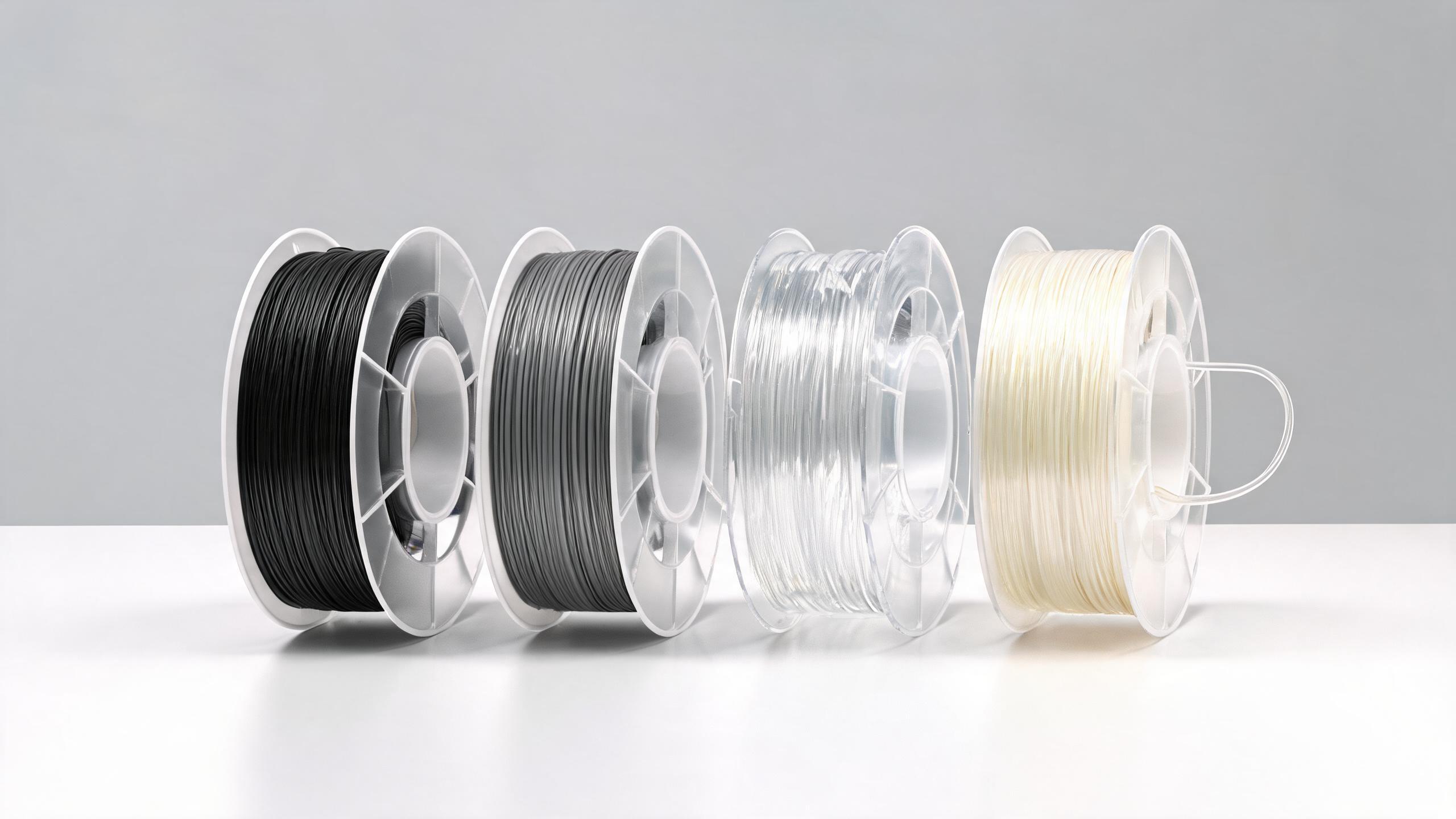
Compare PLA, PETG, and ABS across strength, heat resistance, toughness, printability, warping risk, applications, and cost. Includes supplier evaluation criteria for B2B procurement, referencing factory-direct supply with 12 extrusion lines and strict diameter tolerance control.
BUYER GUIDE · 3D PRINTING FILAMENT
When you source filament for production, prototypes, or end-use parts, the choice between PLA, PETG, and ABS is rarely about personal preference. It is about matching material properties to your application, your printer fleet, and your cost targets. For B2B buyers and engineers, the wrong pick can mean failed batches, rework, or parts that fail in the field.
This guide compares PLA vs PETG vs ABS across the criteria that matter most in procurement: strength, heat resistance, toughness, printability, warping risk, applications, and total cost. You will also get a practical supplier evaluation checklist—including what to verify about diameter tolerance, extrusion capacity, and color matching—so you can make a decision with confidence.
- PLA is the lowest-cost, easiest-to-print option, but it deforms above ~50–60°C and is brittle—best for prototypes, visual models, and low-stress indoor parts.
- PETG offers the best balance of strength, toughness, and chemical resistance with minimal warping—ideal for functional parts, jigs, and outdoor use.
- ABS provides the highest heat resistance and impact strength, but requires an enclosed printer to manage warping and fumes—best for automotive, electronics, and high-temperature environments.
- For B2B orders, verify supplier consistency: diameter tolerance, spool weight accuracy, and color match capability are as important as the material type.
Why Material Choice Matters in B2B Sourcing
In consumer 3D printing, you can experiment with different filaments and accept some waste. In B2B production, every spool must perform identically. A batch that prints well today and fails tomorrow can halt your line. That is why professional buyers look beyond the brand name and ask for measurable specifications.
Three materials dominate the market: PLA, PETG, and ABS. Each has a distinct property profile. Understanding the differences helps you match the material to the application, avoid over-engineering (and overpaying), and set realistic expectations for your team.
PLA vs PETG vs ABS: The Head-to-Head Comparison
The table below summarizes the key differences. Use it as a quick reference, then read the detailed sections for nuance.
| Property | PLA | PETG | ABS |
|---|---|---|---|
| Tensile strength | ~50 MPa (moderate) | ~50–55 MPa (similar to ABS, but stiffer) | ~40–50 MPa (lower than PETG in some tests) |
| Heat resistance (HDT) | ~50–60°C | ~70–80°C | ~90–110°C |
| Impact toughness | Low (brittle) | High (ductile) | High (impact-resistant) |
| Printability | Excellent (low temp, no enclosure needed) | Good (slightly higher temp, but forgiving) | Moderate (high temp, requires enclosure) |
| Warping risk | Low | Low to moderate | High (prone to lifting and cracking) |
| Chemical resistance | Poor (degrades in solvents) | Good (resists many chemicals) | Good (resists oils and fuels) |
| UV resistance | Poor (degrades in sunlight) | Good (with UV stabilizers) | Poor (unless UV-stabilized) |
| Typical cost per kg | $15–25 | $20–30 | $20–35 |
| Common applications | Prototypes, models, low-stress parts | Functional parts, jigs, outdoor items | Automotive, electronics, high-heat parts |
PLA: The Prototype Workhorse
PLA (Polylactic Acid) is a biodegradable thermoplastic derived from renewable resources like corn starch. It is the most popular filament for hobbyists and professionals alike because it prints easily at low temperatures (190–220°C) and requires no heated bed or enclosure.
Strengths and Weaknesses
Strengths: Excellent dimensional accuracy, low warping, and a wide range of colors and finishes. It is also the most affordable filament, making it ideal for high-volume prototyping where cost per part matters.
Weaknesses: Low heat resistance (parts deform in a hot car or near a heat source), poor impact strength (drops can crack), and it degrades under UV light. It is also not suitable for food contact or outdoor use without special coatings.
Best Use Cases
- Concept models and visual prototypes
- Fit-testing and form-factor validation
- Low-stress jigs and fixtures used indoors
- Educational and architectural models
If your application involves any heat, sunlight, or mechanical stress, PLA is likely not the right choice. For B2B buyers, PLA is best for internal prototyping and design iterations, not for end-use parts.
PETG: The Balanced Performer
PETG (Polyethylene Terephthalate Glycol) is a modified version of the plastic used in water bottles. It combines the ease of printing with better mechanical properties than PLA. In the PETG vs PLA strength debate, PETG generally wins on toughness and heat resistance while maintaining comparable tensile strength.
Strengths and Weaknesses
Strengths: High impact resistance, good chemical resistance, and low warping. It prints at slightly higher temperatures (230–250°C) but does not require an enclosure. PETG also has excellent layer adhesion, which contributes to its strength.
Weaknesses: Can be stringy if not tuned correctly, and it absorbs moisture from the air, requiring proper drying. It is also slightly more expensive than PLA.
Best Use Cases
- Functional parts that need durability (brackets, clips, gears)
- Jigs and fixtures for manufacturing
- Outdoor items that resist UV and moisture
- Food-safe containers (with proper certification)
For most B2B applications that are not heat-intensive, PETG is the safest all-rounder. It bridges the gap between PLA and ABS, offering strength without the warping headaches.
ABS: The Industrial Standard
ABS (Acrylonitrile Butadiene Styrene) is the workhorse of injection molding and has been used in 3D printing for years. It offers the highest heat resistance and impact strength of the three, making it the go-to for functional parts that face real-world conditions.
Strengths and Weaknesses
Strengths: Excellent heat resistance (up to ~110°C), high impact strength, and good chemical resistance. It is also machinable and can be sanded or glued easily.
Weaknesses: High warping risk due to shrinkage during cooling. Requires a heated bed (100–110°C) and ideally an enclosed printer to maintain ambient temperature. It also emits fumes (styrene) that require ventilation. Printing ABS is less forgiving than PLA or PETG.
Best Use Cases
- Automotive parts (dashboards, clips, housings)
- Electronics enclosures that experience heat
- Functional prototypes that must survive drop tests
- End-use parts for industrial machinery
If your parts will be exposed to heat, impact, or chemicals, ABS is often the right choice—provided your printing setup can handle it. For B2B buyers, ABS is a premium material for demanding applications.
How to Decide: A Practical Selection Framework
Instead of memorizing specs, use this decision tree based on your application requirements:
- What is the operating temperature? If above 70°C, choose ABS (or a specialty material). If below 60°C, PETG or PLA both work.
- Will the part face impact or stress? If yes, choose PETG or ABS. PLA is too brittle.
- Is the part exposed to sunlight or chemicals? PETG is the best default; ABS needs UV stabilizers.
- Do you have an enclosed printer? If not, avoid ABS and stick with PLA or PETG.
- What is your tolerance for print failure? If you need high yield, PETG offers the best balance of properties and printability.
For most B2B buyers, PETG is the recommended default because it minimizes risk while delivering functional performance. Use PLA for cheap prototyping and ABS only when heat or impact requirements demand it.
Supplier Evaluation: Beyond the Material
Once you have chosen the material, the next step is selecting a reliable supplier. For B2B orders, consistency is everything. Here are the key quality indicators to check:
Diameter Tolerance
Filament diameter directly affects extrusion consistency. A tolerance of ±0.05 mm is common, but a tighter tolerance (e.g., ±0.02 mm) reduces print variability. Ask your supplier for their tolerance specification and how they control it.
Production Capacity
Can the supplier handle your order volume without delays? For example, a factory with 12 extrusion lines can produce large quantities efficiently, but you should confirm lead times and MOQ (minimum order quantity) upfront.
Color Matching
If you need brand-specific colors, verify the supplier's color matching capability. A good supplier will use Pantone or custom color references and provide samples before mass production.
Consistency Across Batches
Ask for batch test reports or samples from different production runs. Inconsistent filament can cause jams, poor adhesion, or weak parts.
- Diameter tolerance: request the spec (e.g., ±0.03 mm) and how it is measured.
- Spool weight: verify net weight (e.g., 1 kg) and winding quality to avoid tangles.
- Drying recommendations: ask about moisture absorption and packaging (vacuum-sealed with desiccant is best).
- Custom color: confirm lead time for color matching and sample approval.
- Certifications: request material data sheets (TDS) and safety data sheets (SDS).
Cost Considerations for B2B Buyers
Price per kilogram is only part of the total cost. Consider the cost of failed prints, rework, and downtime. A cheaper filament that warps or clogs can cost more in the long run.
For large orders, factory-direct pricing can reduce unit costs significantly. Suppliers with in-house extrusion lines can offer better price breaks and more consistent quality than resellers. Always ask for tiered pricing based on volume.
FAQ: Common Questions from Buyers
Which is stronger: PETG or PLA?
In terms of tensile strength, PETG and PLA are similar (around 50 MPa), but PETG is much tougher and more impact-resistant. PLA is brittle and will crack under stress, while PETG bends and absorbs impact. For functional parts, PETG is the stronger choice.
ABS vs PETG: Which is better for outdoor use?
PETG has better UV resistance and is more weather-resistant. ABS degrades in sunlight unless UV-stabilized. For outdoor parts, PETG is generally the better choice.
Can I print ABS without an enclosure?
Technically yes, but warping and cracking are very likely. ABS requires a stable ambient temperature (above 40°C) to prevent the layers from cooling too quickly. An enclosure is strongly recommended for consistent results.
What is the easiest material to print?
PLA is the easiest—low temperature, no enclosure, minimal warping. PETG is also easy but requires slightly higher temperatures and may need drying. ABS is the hardest due to warping and fumes.
Final Recommendations
Here is a quick summary for your next procurement decision:
- Choose PLA for low-cost prototyping, visual models, and parts that will not see heat or stress.
- Choose PETG for functional parts, jigs, outdoor items, and any application where you need a balance of strength and printability.
- Choose ABS for high-heat environments, impact-prone parts, and end-use components where you can manage the printing conditions.
When you have selected the material, evaluate suppliers on their technical specs, production capacity, and quality control. A supplier with factory-direct production, such as one with 12 extrusion lines, can offer better consistency and pricing for B2B orders. Always request samples and test prints before committing to a large volume.
If you are sourcing filament for your production line, contact us to discuss your requirements. We can provide detailed specifications, custom color matching, and reliable supply for your projects.