
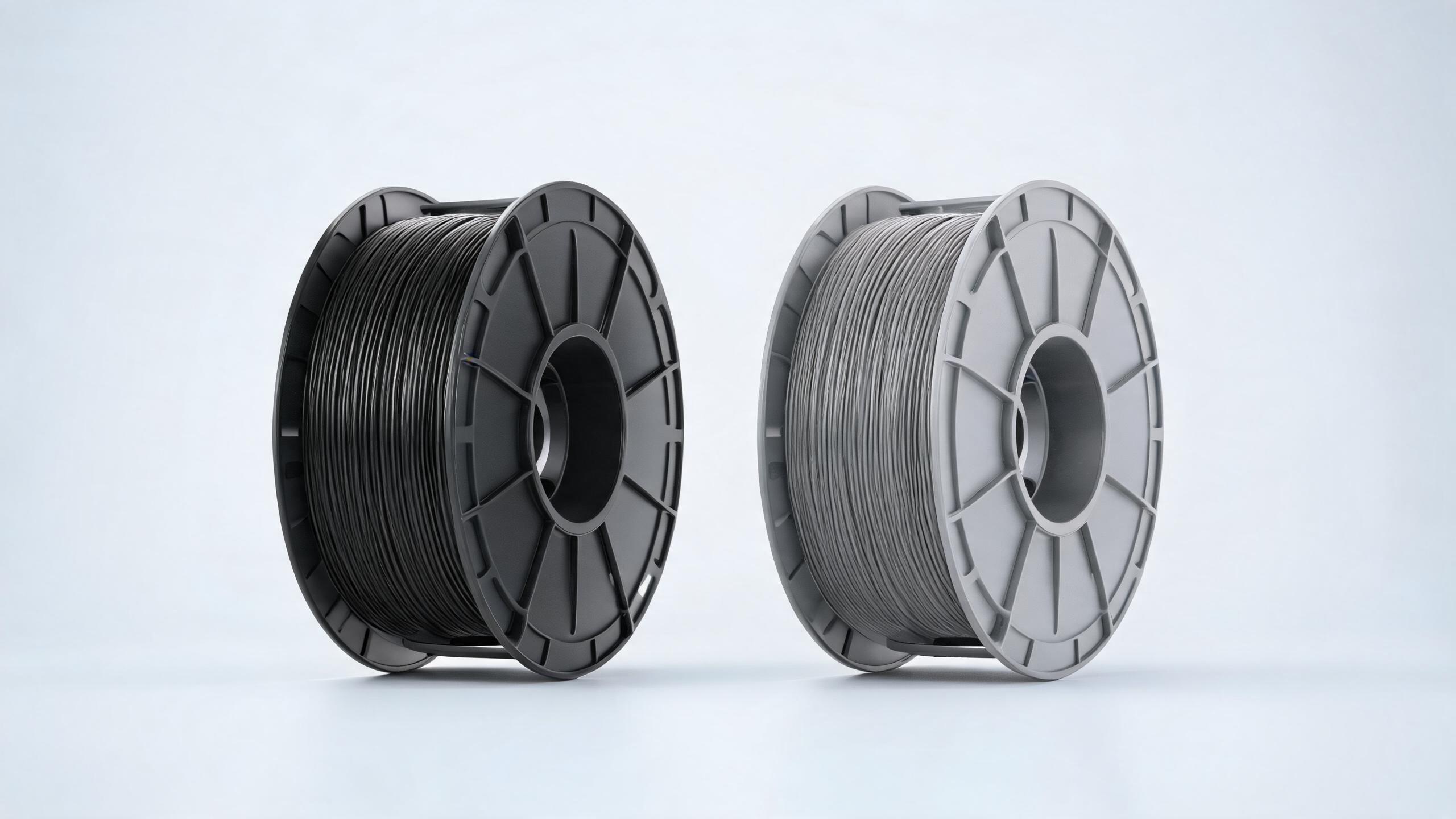
Compare PLA and ABS 3D printing filament for B2B applications: material properties, printing temperatures, strength, heat resistance, warping, and selection criteria. A practical guide for engineers and procurement teams.
BUYER GUIDE · MATERIAL SELECTION
When sourcing 3D printing filament for production, prototyping, or end-use parts, the choice between PLA and ABS is one of the most frequent decisions engineers and procurement teams face. Both are commodity thermoplastics, but they behave very differently under heat, stress, and printing conditions. Choosing wrong can mean failed prints, rejected parts, or rework costs that add up quickly across a production run.
This guide compares PLA vs ABS filament on the properties that actually matter in a B2B context: material characteristics, printing parameters, mechanical strength, heat resistance, warping behavior, and application fit. We also give you a practical framework for deciding between the two—whether you are a contract manufacturer, an in-house prototyping shop, or an OEM sourcing parts.
- PLA is dimensionally stable, easy to print, and best for visual prototypes, jigs, and low-temperature applications. It deforms above ~50–60°C.
- ABS offers higher impact strength and heat resistance (softening around 90–100°C), but requires an enclosed printer and controlled environment to avoid warping.
- For functional parts that see mechanical load or heat, ABS is often the safer choice—if your workflow can handle its printing demands.
- Always verify actual material data sheets from your filament supplier; values vary by brand and grade.
PLA vs ABS: The Basics
PLA (polylactic acid) is a biodegradable polyester derived from renewable resources like corn starch or sugarcane. It is the most common filament for desktop 3D printing because it prints easily, has low odor, and produces crisp details. ABS (acrylonitrile butadiene styrene) is a petroleum-based thermoplastic known for toughness and heat resistance. It is widely used in injection molding and is a standard material for functional prototypes and end-use parts in automotive, electronics, and consumer goods.
For B2B buyers, the fundamental question is not which material is “better” overall, but which one meets your part requirements and production constraints. Below, we break down the comparison by the key decision factors.
Material Properties: What the Data Sheets Don’t Always Tell You
Manufacturers publish typical values for tensile strength, flexural strength, heat deflection temperature (HDT), and impact resistance. However, actual performance depends on layer adhesion, infill density, print orientation, and the specific grade of resin. Here is a general comparison based on common filament grades:
| Property | PLA (typical) | ABS (typical) | What it means for your part |
|---|---|---|---|
| Tensile strength | ~50 MPa | ~40–45 MPa | PLA is stiffer and stronger in tension, but more brittle. |
| Impact resistance | Low (brittle) | High (ductile) | ABS absorbs shock without cracking; PLA can shatter. |
| Heat deflection temp (HDT @ 0.45 MPa) | ~55–65°C | ~90–100°C | ABS holds shape at higher service temperatures. |
| Glass transition temp (Tg) | ~60°C | ~105°C | Above Tg, material softens and loses rigidity. |
| Flexural modulus | ~3.5 GPa | ~2.3 GPa | PLA is more rigid; ABS flexes more before yield. |
| Density | ~1.24 g/cm³ | ~1.04 g/cm³ | ABS parts are lighter for the same volume. |
| Biodegradability | Compostable (industrial) | Not biodegradable | Recycling and disposal pathways differ. |
Note: These are typical ranges for standard grades. High-performance variants (e.g., PLA+ or ABS+ with additives) can shift these numbers. Always request the manufacturer’s technical data sheet (TDS) and test under your own conditions.
Printing Temperature and Settings: What You Need to Know
Printing parameters directly affect part quality, throughput, and failure rates. Here is a side-by-side of recommended settings for PLA vs ABS on typical FDM printers:
| Parameter | PLA | ABS |
|---|---|---|
| Nozzle temperature | 190–220°C | 220–250°C |
| Bed temperature | 20–60°C (often none) | 90–110°C |
| Enclosure required | No | Yes (recommended) |
| Cooling fan | Full (100%) | Low or off (0–30%) |
| Print speed | 40–60 mm/s | 30–50 mm/s (slower for accuracy) |
| Chamber temperature | Ambient | 40–60°C (if controlled) |
| Odor / fumes | Mild, sweet | Strong, potentially irritating |
| Bed adhesion | Easy (blue tape, glass) | Needs heated bed + adhesive (ABS slurry, hairspray) |
Key operational implications:
- PLA runs on almost any printer, even open-frame models. Lower temperatures mean less energy consumption and faster cycles.
- ABS demands a heated bed and an enclosure to prevent warping and layer delamination. This adds capital cost if your printers aren’t already enclosed.
- ABS emits styrene fumes; in a production environment, you may need ventilation or filtration to meet workplace safety standards.
Strength and Durability: PLA vs ABS Strength
“Strength” is not a single number. Buyers should consider tensile strength, flexural strength, impact resistance, and fatigue behavior. PLA has higher tensile and flexural strength than ABS in many standard tests, but it is brittle. ABS is tougher—it deforms plastically before breaking, making it suitable for parts that experience shock, vibration, or repeated stress.
For example, a PLA part might snap when dropped, while an ABS part might dent or bend. For enclosures, brackets, or snap-fit components that must survive handling and assembly, ABS is often preferred. For static, low-impact parts like display models or fixtures that won’t be stressed, PLA’s stiffness is an advantage.
Layer adhesion also matters: ABS generally has better interlayer bonding when printed in a warm environment, which improves its overall strength compared to PLA printed with excessive cooling. However, if ABS warps or delaminates due to poor environmental control, its effective strength drops dramatically.
Heat Resistance: The Decisive Factor for Many Applications
Heat resistance is where ABS clearly outperforms PLA. PLA softens and deforms at temperatures as low as 50–60°C, which is easily reached inside a car on a sunny day or near electronic components. ABS can withstand continuous service up to about 90–100°C, making it suitable for under-hood automotive parts, electronics housings, and appliances.
If your application involves any exposure to heat—even ambient warehouse temperatures in tropical climates—PLA may not be suitable. Always check the HDT of the specific filament grade you plan to source. Some PLA blends (like PLA+ or high-heat PLA) have improved HDT, but they still fall short of ABS.
Warping and Dimensional Accuracy
Warping is the #1 practical issue with ABS. As the material cools, it shrinks unevenly, causing corners to lift and parts to distort. PLA, with its lower shrinkage and lower printing temperature, is much more dimensionally stable. For parts requiring tight tolerances or large flat surfaces, PLA is easier to print accurately.
However, ABS warping can be mitigated with:
- An enclosed chamber to maintain even temperature.
- A heated bed at 100–110°C.
- Proper bed adhesion (ABS slurry, PEI sheet, or specialized adhesives).
- Design adjustments: rounded corners, less aggressive overhangs, and even wall thickness.
If you are outsourcing production, ask your supplier how they control warping. A supplier with enclosed printers and experience in ABS will produce far more reliable parts than one using open-frame machines.
Application Fit: When to Choose PLA, When to Choose ABS
Here is a practical guide based on common B2B applications:
| Application | Recommended | Reason |
|---|---|---|
| Visual prototypes, concept models | PLA | Fine detail, easy to print, low cost |
| Fit-testing and assembly mock-ups | PLA | Dimensional accuracy, no warping |
| Jigs, fixtures, and tooling (low heat) | PLA or ABS | PLA for rigidity, ABS for toughness |
| Functional parts under mechanical stress | ABS | Impact resistance, ductility |
| Parts exposed to heat (e.g., near motors, engines) | ABS | Higher HDT |
| Outdoor parts (UV exposure) | Neither (consider ASA) | Both degrade under UV; ASA is a better alternative |
| Food contact or biocompatible applications | PLA (if certified) | PLA is often food-safe in specific grades; ABS is not |
Note: For outdoor or high-UV applications, ASA is a common alternative to ABS with similar properties but better UV resistance. For high-temperature engineering applications, you may need polycarbonate (PC) or nylon. This article focuses on PLA vs ABS, but we mention these to help you scope your options.
Cost and Supply Chain Considerations
In bulk B2B purchasing, filament price per kilogram is often similar for PLA and ABS, but total cost of ownership includes waste, reprints, and printer requirements. PLA’s ease of printing can reduce failure rates and labor costs. ABS’s need for enclosed printers and ventilation may require additional capital expenditure if your facility isn’t already equipped.
Supply chain stability is another factor. PLA is produced from agricultural feedstocks, which can be subject to commodity price fluctuations. ABS is petroleum-based, so its price tracks crude oil. Both are widely available from multiple manufacturers, but you should qualify your supplier for consistent diameter tolerance (±0.02 mm is common for premium filament) and moisture content, as wet filament causes print defects.
Quality Control and Supplier Qualification
When sourcing filament for production, ask your supplier for:
- Technical data sheets (TDS) with actual measured values, not just marketing ranges.
- Batch-to-batch consistency reports (diameter, roundness, moisture content).
- Certificates of analysis (CoA) for critical applications.
- Packaging that prevents moisture absorption (vacuum-sealed with desiccant).
- Clear handling and storage instructions.
If you are outsourcing printing, verify that the service provider uses appropriate printers for the material. For ABS, they should have enclosed printers and a documented process for warping control. Ask for sample prints or a test batch before committing to volume.
Environmental and Safety Considerations
PLA is biodegradable under industrial composting conditions, but it does not readily degrade in landfills. ABS is recyclable in theory, but mixed plastic waste is often not economically recycled. If your company has sustainability goals, consider the end-of-life options for your parts.
Safety: ABS emits styrene fumes during printing, which can be irritating. In a production environment, ensure adequate ventilation or use a filtration system. PLA is generally considered low-emission, but all 3D printing produces ultrafine particles; proper ventilation is recommended regardless.
How to Decide: A Simple Framework
Use this decision tree for your specific part:
- Will the part be exposed to temperatures above 50°C? If yes, ABS (or a higher-temperature material) is required. PLA will fail.
- Will the part experience impact, vibration, or repeated stress? If yes, ABS is safer due to its toughness.
- Is dimensional accuracy critical and warping unacceptable? PLA is easier, but ABS can work with proper controls.
- Do you have enclosed printers and ventilation? If not, PLA is more practical.
- What is the part’s function? Visual prototype → PLA; functional prototype or end-use → ABS.
For many B2B operations, having both materials in your supply chain is the most flexible approach. Use PLA for rapid iteration and ABS for parts that must survive real-world conditions.
FAQ: Common Questions from Buyers
Is PLA stronger than ABS?
In terms of tensile and flexural strength, PLA often shows higher values. However, ABS is tougher and more impact-resistant. “Stronger” depends on the load type. For static loads, PLA may suffice; for dynamic or impact loads, ABS is better.
Can I print ABS on an open-frame printer?
Technically yes, but warping is likely, especially for larger parts. An enclosure is strongly recommended for consistent results. If you must use an open-frame printer, keep the room warm and use a heated bed with good adhesion.
What temperature does PLA deform at?
PLA starts to soften around 50–60°C (glass transition). Heat deflection temperature (HDT) is typically 55–65°C at low load. Avoid leaving PLA parts in hot environments.
Is ABS food-safe?
Standard ABS is not considered food-safe due to potential additives and the porous surface that can harbor bacteria. For food contact, use food-grade PLA or other certified materials.
Can I recycle PLA or ABS?
PLA can be industrially composted, but recycling streams are limited. ABS can be reground and reprocessed, but quality degrades with each cycle. Check with your local waste management for options.
Final Recommendations for Sourcing
When you send a request for quotation (RFQ) for 3D printing services or filament supply, specify:
- Material type and grade (e.g., PLA 4043D, ABS M30).
- Required mechanical properties (if any) and test standards.
- Heat resistance requirements (HDT, service temperature).
- Dimensional tolerances and surface finish.
- Volume and delivery schedule.
Ask for a material data sheet and a sample print before production. This protects you from surprises and ensures the supplier understands your requirements.
If you are evaluating suppliers for filament or printed parts, we welcome your inquiry. We can provide detailed specifications, samples, and production quotes based on your application. Contact our engineering team to discuss your project.