
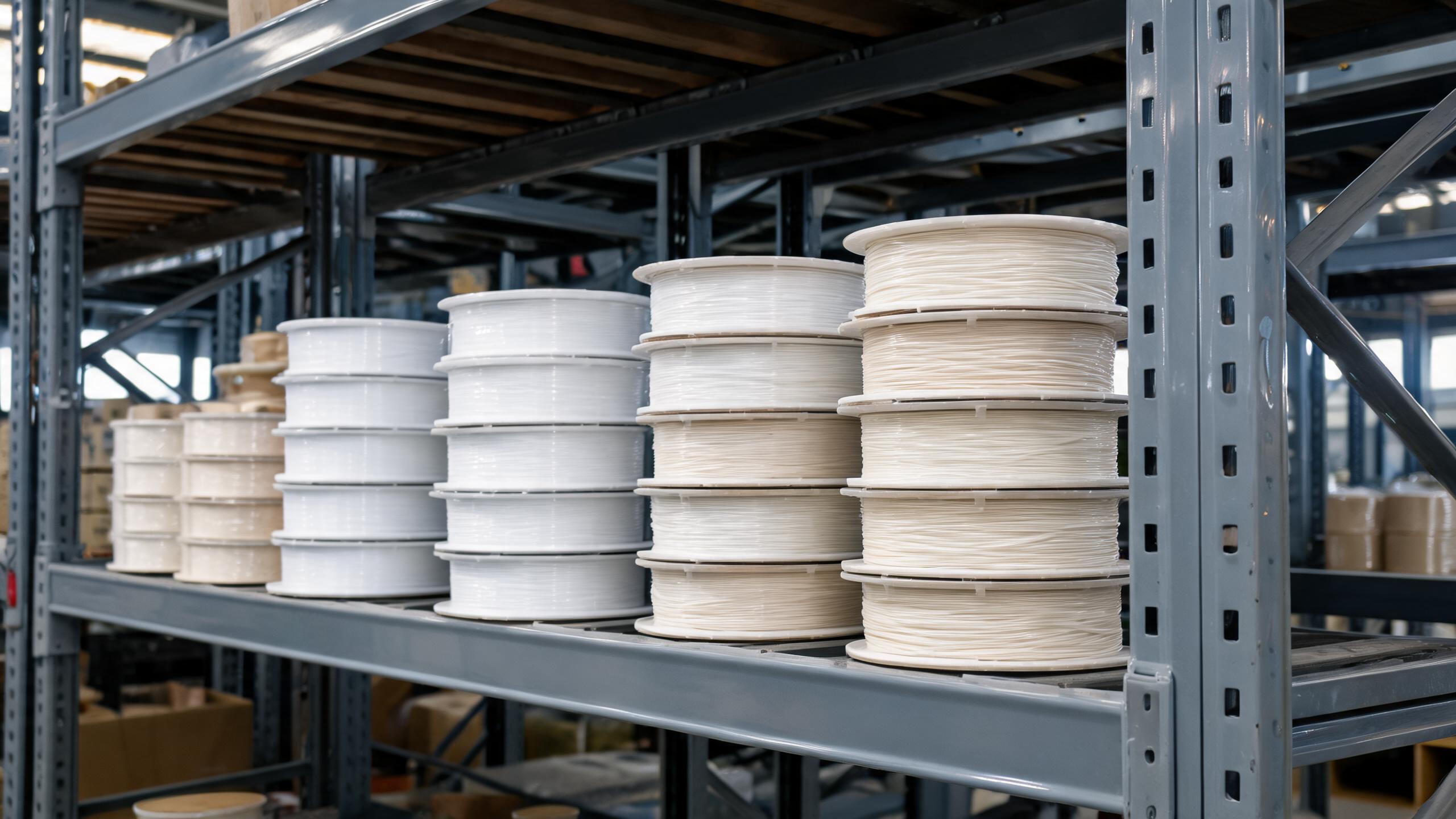
A practical guide for B2B buyers sourcing PLA filament wholesale. Covers key quality specs, supplier evaluation criteria, bulk purchasing considerations, and common pitfalls to avoid when selecting PLA filament suppliers for 1.75mm filament.
B2B BUYER GUIDE
• PLA filament quality varies significantly between suppliers — diameter tolerance and spool winding are the two most common failure points.
• For bulk PLA filament, MOQ typically starts at 50–100 kg per color; larger orders (500 kg+) often unlock better per-kg pricing.
• Always request a material data sheet (MDS) and a pre-shipment sample before committing to a full container order.
• The most common diameter for FDM printers is 1.75mm — verify that your supplier can hold ±0.03mm tolerance consistently.
• A supplier's lead time, packaging method, and shipping terms are as important as the filament price itself.
Why PLA Filament Wholesale Demands Careful Sourcing
PLA (polylactic acid) is the most widely used 3D printing material globally. It accounts for a large share of all filament consumed by hobbyists, schools, prototyping shops, and production facilities. For a B2B buyer sourcing PLA filament wholesale, the challenge is not finding a supplier — it is finding a PLA filament supplier who can deliver consistent quality at scale, on time, and without hidden issues.
This guide covers what to look for when evaluating bulk PLA filament suppliers, with a focus on the most common diameter — PLA filament 1.75mm — and the practical criteria that separate reliable partners from one-time shippers.
1. Know the Critical Quality Parameters for Bulk PLA Filament
When you order a pallet or container of PLA filament, every spool must perform the same way. Below are the specifications you should request from every potential supplier.
Diameter Tolerance
For PLA filament 1.75mm, the industry standard is ±0.05mm. Better suppliers hold ±0.03mm or even ±0.02mm. A tighter tolerance means fewer clogs, less under-extrusion, and more consistent layer adhesion across a production run.
Ask the supplier for their diameter control data — a production log showing measurements taken every 10–20 meters along the entire spool. If they cannot provide this, consider it a red flag.
Spool Winding Quality
Poor winding causes tangles mid-print, which wastes time and material. In a bulk order, rewinding even 5% of spools can eat into your margin. Ask the supplier:
- What winding tension do they use?
- Do they use automated winding machines or manual winding?
- Can they provide a video of the winding process on request?
Moisture Content & Packaging
PLA is hygroscopic — it absorbs moisture from the air. Filament that arrives wet will produce brittle prints with surface defects. For bulk PLA filament, verify that the supplier:
- Vacuum-seals each spool in an aluminum foil bag with desiccant.
- Stores finished spools in a climate-controlled room (below 30% RH).
- Ships with moisture indicator cards inside each box.
| Parameter | Acceptable Range | Preferred Range |
|---|---|---|
| Diameter (1.75mm) | ±0.05mm | ±0.03mm or tighter |
| Ovality | ≤0.05mm | ≤0.02mm |
| Moisture content (as shipped) | <0.2% | <0.1% |
| Tensile strength (MPa) | 50–60 | 60+ |
| Printing temperature range | 190–220°C | 195–215°C (narrower = more stable) |
2. Supplier Evaluation Checklist for PLA Filament Wholesale
Not all PLA filament suppliers are equal. Use this checklist when vetting a new source.
Production Capacity & Lead Time
- How many extrusion lines do they operate?
- What is their monthly output in metric tons?
- What is the typical lead time for a repeat order of 500 kg? For a first order?
- Can they handle rush orders? At what premium?
A supplier with 10+ extrusion lines and a monthly capacity above 50 tons is generally better equipped to handle large, consistent orders than a small workshop with 2–3 lines.
Raw Material Sourcing
PLA filament quality starts with the resin. Reputable suppliers use virgin PLA resin from known manufacturers (NatureWorks, TotalEnergies Corbion, or equivalent). Some use recycled or blended material to lower cost — this can affect print quality and consistency.
Ask the supplier:
- What brand of PLA resin do you use?
- Do you use virgin, recycled, or blended material?
- Can you provide a certificate of analysis (CoA) for each resin batch?
Color Matching & Consistency
If you order bulk PLA filament in multiple colors, batch-to-batch color consistency matters. A slight shift in pigment can make parts from different production runs look mismatched.
Request:
- A color card or Pantone reference for each standard color.
- A sample spool from the batch you intend to order.
- A written guarantee that color will not vary beyond ΔE < 2.0 between batches.
Certifications & Compliance
Depending on your end market, you may need:
- REACH (EU chemical regulation)
- RoHS (restriction of hazardous substances)
- MSDS (material safety data sheet)
- ISO 9001 (quality management system)
Not every supplier carries all certifications. Confirm which ones they hold and whether they can provide copies. Do not assume — verify.
3. Pricing Structure for Bulk PLA Filament
Pricing for PLA filament wholesale depends on volume, color, packaging, and shipping terms. Below is a typical structure (actual prices vary by market conditions and supplier).
| Order Quantity | Typical Price Range (USD/kg, FOB) | Notes |
|---|---|---|
| 50–200 kg | $10–$14 | Often MOQ for first order; per-color minimums may apply |
| 200–500 kg | $8–$11 | Better per-kg pricing; mixed colors usually allowed |
| 500–1,000 kg | $6–$9 | Common for resellers and print farms |
| 1,000+ kg (full pallet or container) | $5–$7 | Best pricing; negotiate incoterms and payment terms |
A lower per-kg price is not always the best deal. Factor in shipping cost, customs duties, payment terms (T/T vs L/C), and the cost of rejected spools. A $6/kg filament that arrives with 10% defective spools is more expensive than $8/kg filament with 0.5% defects.
4. Common Mistakes B2B Buyers Make When Sourcing PLA Filament
Mistake 1: Ordering Full Container Without a Sample
Even if the supplier has good reviews, order a sample spool first. Print with it under your standard settings. Measure the diameter every 5 meters. Check for brittleness, stringing, and layer adhesion. A sample order of 5–10 kg is a small investment compared to a full container of unusable filament.
Mistake 2: Ignoring the Spool Hub Size
Most desktop printers use spools with a 50–54mm hub hole. Some industrial printers use larger hubs. Confirm the spool dimensions match your equipment. A 75mm hub spool will not fit a standard Bambu Lab, Prusa, or Creality machine without an adapter.
Mistake 3: Not Specifying Packaging for Sea Freight
If shipping by sea, filament can sit in a container for 30–60 days in high humidity. Standard vacuum packaging may not be enough. Request:
- Double-layer vacuum bags.
- Additional desiccant packs (10g+ per spool).
- Cardboard dividers between spool layers to prevent crushing.
Mistake 4: Overlooking the Supplier's Export Experience
A supplier who has never exported to your country may not understand documentation requirements (certificate of origin, HS code classification, fumigation certificates for wooden pallets). Ask for their export track record and a sample shipping document pack.
5. How to Start a Relationship with a New PLA Filament Supplier
Step 1: Send a Clear RFQ
Include in your request for quotation:
- Target diameter (e.g., PLA filament 1.75mm).
- Desired quantity per color and total quantity.
- Target price range (if you have one).
- Preferred incoterm (FOB, CIF, EXW).
- Required certifications.
- Delivery timeline.
Step 2: Request a Sample Kit
Ask for 3–5 spools in your target colors. Test them on your printers. Keep a log of:
- Print success rate (first-layer adhesion, no clogs).
- Dimensional accuracy of printed parts.
- Surface finish consistency.
Step 3: Negotiate Payment Terms
For first orders, most suppliers require 30–50% deposit with T/T, balance before shipment. For repeat orders, you may negotiate 30% deposit, 70% against copy of shipping documents, or L/C at sight.
Step 4: Plan for Quality Control
If your order is large enough, consider hiring a third-party inspection company (SGS, Bureau Veritas, TÜV) to inspect the goods before shipment. The cost (typically $300–$800 per inspection) is small compared to the risk of receiving a non-conforming container.
Frequently Asked Questions
What is the standard MOQ for PLA filament wholesale?
Most suppliers set a minimum order of 50–100 kg per color for first orders. Some accept smaller quantities (20–30 kg) at a higher per-kg price. For custom colors or special formulations, MOQ may be 200 kg or more.Can I mix colors in a single bulk order?
Yes, most PLA filament suppliers allow mixed colors within the same order, as long as each color meets the per-color minimum. Confirm this in writing before placing the order.How long does PLA filament last in storage?
When stored in a cool, dry place (below 25°C, under 30% RH) and kept in sealed bags with desiccant, PLA filament can last 12–18 months without significant degradation. After opening, use within 3–6 months or re-dry before printing.What is the difference between standard PLA and PLA+?
PLA+ (or PLA Pro) typically has modified additives for improved impact resistance, lower brittleness, and better layer adhesion. It prints at slightly higher temperatures (210–230°C). If your application requires stronger parts, ask the supplier for PLA+ pricing and specifications.Do I need to pay import duties on PLA filament?
Import duties vary by country. The HS code for PLA filament is generally 3916.90 (monofilament of plastics) or 3920.10 (plates, sheets, film of polymers of ethylene). Check with your customs broker for the correct classification and duty rate for your destination.Next Steps for B2B Buyers
Sourcing PLA filament wholesale is a repeatable process: define your quality criteria, vet suppliers against a checklist, test samples, negotiate terms, and build a quality control plan. The suppliers who invest in consistent production, transparent communication, and proper packaging are the ones worth building a long-term relationship with.
If you are currently evaluating PLA filament suppliers for your next bulk order, we welcome your inquiry. We can provide detailed specifications, current pricing for bulk PLA filament in 1.75mm diameter, and arrange sample shipments for your evaluation.
Contact us to discuss your PLA filament wholesale requirements →