
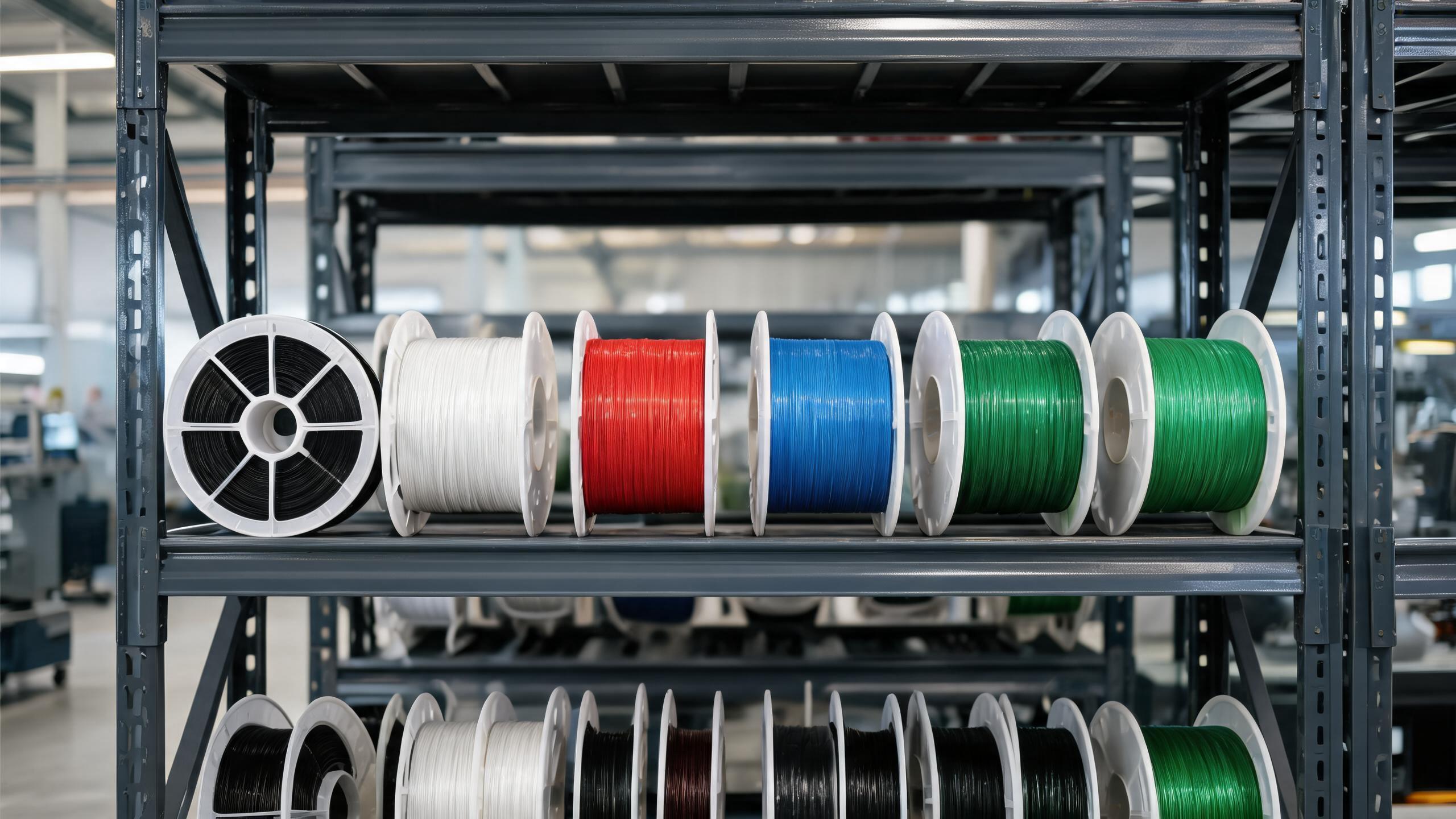
A practical guide for B2B buyers on sourcing bulk 3D printer filament. Covers material selection, quality control, supplier evaluation, MOQ considerations, and common pitfalls—backed by real-world criteria, not marketing fluff.
B2B SOURCING GUIDE
How to Choose Bulk 3D Printer Filament for Wholesale
If you are sourcing bulk 3D printer filament for resale, production, or service operations, the difference between a reliable supplier and a bad one can cost you thousands in waste, returns, and lost customers. This guide is written for procurement managers, wholesalers, and distributors who need practical criteria—not marketing language—to evaluate 3D filament manufacturers and 3D printer filament suppliers.
1. Material consistency (diameter tolerance ±0.02 mm or better) is the single most important spec.
2. Always request a pre-production sample and test for layer adhesion, brittleness, and clogging.
3. Verify the supplier's MOQ, lead time, and packaging for your target market.
4. Check for relevant certifications (RoHS, REACH, UL) depending on your end-use industry.
5. A supplier with documented quality control processes is worth more than one with the lowest price.
1. Know Your Material Requirements First
Before contacting any wholesale 3D printer filament supplier, define your application. The same supplier may offer 10+ materials, but not all are suited for your buyers.
| Material | Typical Use Case | Key Property | Common Pitfall |
|---|---|---|---|
| PLA | Prototypes, decorative parts, education | Easy to print, low warping | Brittle, low heat resistance |
| PETG | Functional parts, food contact (if certified) | Stronger than PLA, chemical resistant | Hygroscopic; requires dry storage |
| ABS | Automotive, engineering, outdoor use | High impact strength, heat resistant | Fumes, warping; needs enclosure |
| TPU/TPE | Flexible parts, gaskets, wearables | Elasticity, abrasion resistance | Slow print speed, stringing |
| Nylon (PA) | Gears, tools, industrial parts | High strength, wear resistant | Very hygroscopic; must be dried before printing |
| Polycarbonate (PC) | High-temp applications, structural parts | Extreme strength, heat deflection | Requires high nozzle temp (260°C+) and enclosure |
| Composite (CF/GF) | Aerospace, automotive, high-stiffness parts | Stiffness, dimensional stability | Abrasive; requires hardened nozzle |
What to ask the supplier:
- Do you offer virgin-grade material, or is it recycled?
- What is the percentage of additives (colorants, fillers)?
- Do you provide a material data sheet (TDS) with mechanical properties?
2. Diameter Tolerance: The Spec That Matters Most
For FDM/FFF printers, filament diameter consistency directly affects print quality. A variation of ±0.05 mm can cause under-extrusion, jams, or poor layer adhesion.
| Tolerance Grade | Typical Range | Best For |
|---|---|---|
| Premium | ±0.02 mm | Engineering, medical, precision parts |
| Standard | ±0.03 mm | General prototyping, education, hobby |
| Economy | ±0.05 mm | Low-cost production, non-critical parts |
How to verify:
- Ask for a diameter consistency report (usually a graph showing deviation over 100+ meters).
- Request a sample spool and measure at 10 random points along the filament.
- Check that the supplier uses closed-loop extrusion control (laser measurement systems).
3. Quality Control: What a Reliable Supplier Should Have
Not all 3D filament manufacturers run the same QC. A serious supplier will have documented processes for:
- Incoming raw material inspection – virgin pellets tested for melt flow index (MFI) and moisture content.
- In-process monitoring – laser diameter gauges, tension control, and cooling zone temperature logging.
- Final product testing – spool weight, winding tension, vacuum sealing, and batch traceability.
- Packaging – moisture-proof vacuum bags with desiccant, because most filaments (especially PETG, Nylon, TPU) absorb moisture from the air.
Red flags to watch:
- The supplier cannot provide a QC checklist or test report.
- They avoid answering questions about raw material source.
- They offer only one price for all materials (suggests no differentiation in quality).
- Samples arrive with inconsistent diameter or tangled spools.
4. MOQ, Lead Time, and Packaging
When sourcing bulk 3D printer filament, you need to match the supplier's production capabilities with your sales velocity.
| Factor | Typical Wholesale Range | What to Confirm |
|---|---|---|
| MOQ per SKU | 50–500 kg (50–500 spools of 1 kg) | Can they split across colors or materials? |
| Lead time | 7–30 days after sample approval | Peak season surcharges? Rush order fee? |
| Packaging | 1 kg spool (standard), 2.5 kg, 5 kg, or bulk spool (10+ kg) | Vacuum-sealed with desiccant? Spool type (cardboard vs plastic)? |
| Labeling | Neutral, private label, or OEM | Minimum order for custom branding? Artwork fees? |
Practical tip: If you are a new distributor, start with a smaller MOQ (e.g., 50 kg per color) to test the market. Many 3D printer filament suppliers offer trial orders at a slightly higher per-kg price.
5. Certifications and Compliance
Depending on your target market and end-use, certain certifications may be mandatory or a competitive advantage.
- RoHS (Restriction of Hazardous Substances) – required for EU market.
- REACH (Registration, Evaluation, Authorisation of Chemicals) – EU chemical safety.
- UL 94 (Flammability rating) – for electronics or appliance parts.
- FDA (Food contact) – for PLA or PETG used in food-related prints.
- ISO 9001 – indicates the supplier has a quality management system (not product-specific, but a good sign).
What to ask:
- "Do you have third-party test reports for RoHS/REACH?"
- "Is your PLA food-contact certified? Under which standard?"
- "Can you provide a certificate of analysis (COA) per batch?"
6. Common Mistakes When Buying Wholesale 3D Printer Filament
Mistake #2: Not testing for brittleness. Some suppliers add too much recycled material, making filament snap during printing or spooling.
Mistake #3: Ignoring moisture sensitivity. Even premium filament absorbs moisture if not vacuum-sealed. Always check packaging quality.
Mistake #4: Skipping the pre-production sample. A 1 kg sample spool costs little but can reveal issues that would multiply across 500 kg.
7. How to Evaluate a Supplier (Checklist)
Use this checklist when contacting potential 3D filament manufacturers:
- Do they have a dedicated sales contact (not just a web form)?
- Can they provide a material data sheet (TDS) and safety data sheet (SDS)?
- What is their diameter tolerance? Ask for a written spec.
- Do they offer free or paid samples? How many kg?
- What is their typical lead time for bulk orders?
- Can they do private label / custom spool color?
- Do they have third-party certifications (RoHS, REACH, etc.)?
- What is their return policy for defective filament?
- Do they have a minimum order quantity for trial vs. repeat orders?
- Can they provide references from other distributors?
8. Frequently Asked Questions
Q: What is the standard spool weight for wholesale?
A: Most wholesale 3D printer filament is sold in 1 kg spools. Some suppliers also offer 2.5 kg, 5 kg, or bulk spools (10–20 kg) for industrial users.
Q: Can I get custom colors?
A: Yes, but MOQ for custom color is typically higher (200–500 kg per color). Standard colors (black, white, grey, red, blue) usually have lower MOQ.
Q: How do I avoid filament that is brittle or snaps?
A: Request a sample and perform a simple bend test: bend a 10 cm piece 180 degrees. If it snaps, the material is too brittle. Also check the vacuum seal and desiccant.
Q: What is the typical price range for bulk PLA filament?
A: Prices vary by region, material, and order volume. Contact suppliers directly for a quote based on your specific MOQ and delivery terms.
Q: Do I need to pay for samples?
A: Many reputable suppliers charge a nominal fee for samples (refundable on first order) or require you to cover shipping. Free samples are rare for bulk B2B.
9. Next Steps
If you are ready to source bulk 3D printer filament for your business, start by defining your material needs, target market, and acceptable quality level. Then reach out to 3–5 3D printer filament suppliers with a clear RFQ (request for quotation) that includes:
- Material type(s) and color(s)
- Estimated annual volume per SKU
- Desired packaging and labeling
- Target price range (per kg)
- Required certifications
Most serious manufacturers will respond within 2–3 business days. If they don't, that may be a sign of their responsiveness—or lack thereof.
For more information about our product range and capabilities, please contact our sales team or browse our filament catalog.