
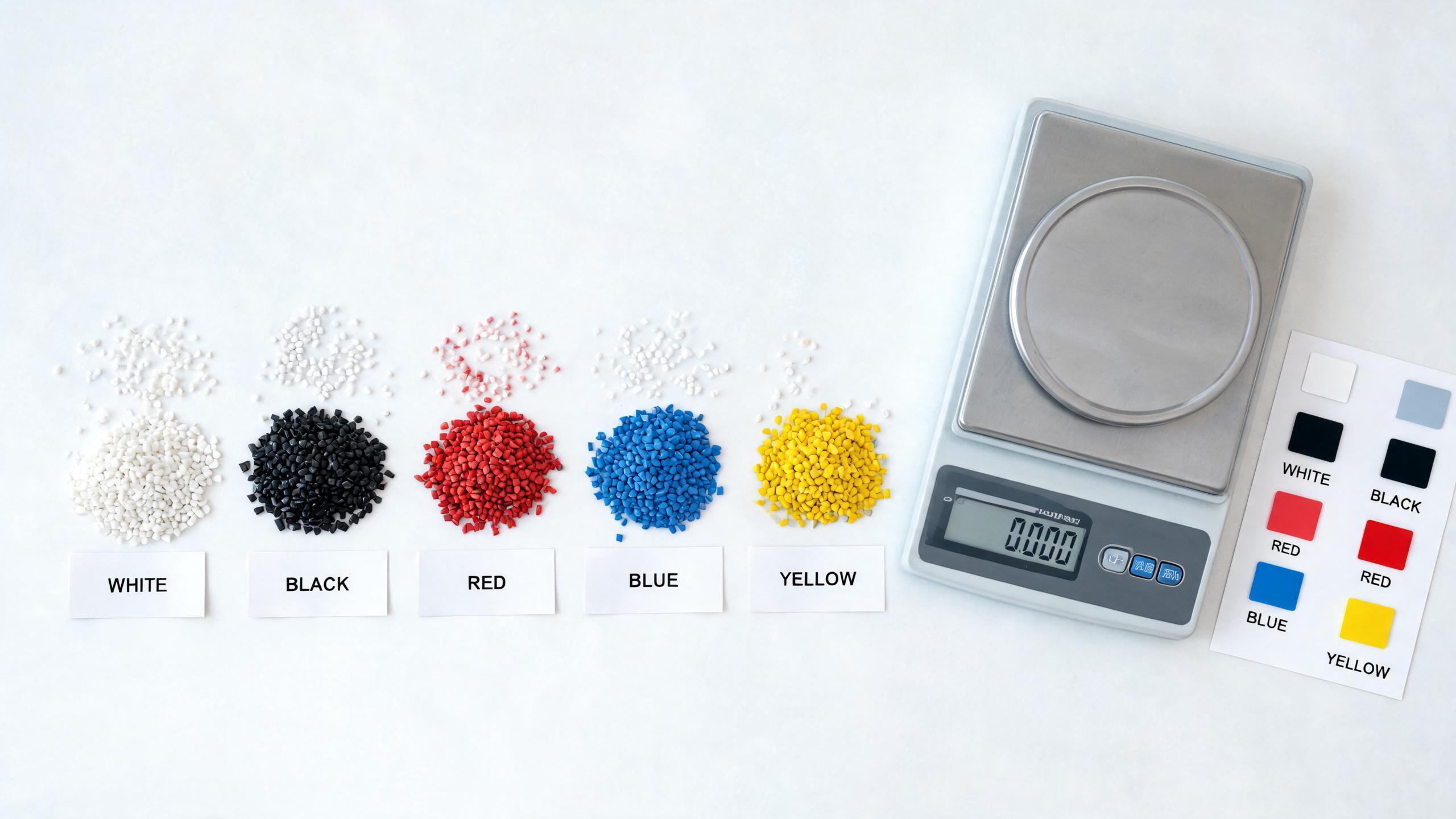
A practical B2B guide to color masterbatch applications across injection molding, extrusion, blow molding, and film processes. Covers carrier resin compatibility, pigment dispersion, heat stability, recommended letdown ratios, troubleshooting common defects like color migration and dispersion streaks, and what procurement teams should verify with suppliers before ordering.
BUYER GUIDE — COLOR MASTERBATCH
Color Masterbatch in Plastic Manufacturing: Selection, Letdown Ratios, and Processing Guide
For procurement teams and process engineers sourcing plastic color masterbatch, the buying decision is rarely about "which color looks better." It is about whether the colour masterbatch will disperse evenly in your resin, survive your processing temperatures, meet your target shade batch after batch, and arrive with consistent quality across shipments.
This guide covers the practical side of pigmentos masterbatch selection and use: carrier resin compatibility, dispersion quality, heat stability, recommended letdown ratios for injection molding, extrusion, blow molding, and film processes, plus troubleshooting for the most common defects buyers and processors encounter.
• Carrier resin must match your base polymer — mismatch causes poor dispersion and mechanical failure.
• Letdown ratio is application-specific: injection molding typically 1–4%, film often 3–6%, masterbatch concentration varies by pigment load.
• Verify heat stability against your processing temperature, not just the melting point of the resin.
• Ask suppliers for dispersion test reports and batch-to-batch shade consistency data before committing to volume orders.
What Color Masterbatch Is — and What It Is Not
A color masterbatch is a concentrated mixture of pigments or dyes encapsulated in a carrier resin. It is manufactured by dispersing high-load pigments into the carrier through twin-screw extrusion, then pelletizing the result. The processor adds these pellets to natural resin at a controlled ratio — the letdown ratio — during molding or extrusion.
The key difference from using raw pigment powder: masterbatch delivers pre-dispersed pigment. This means:
- Cleaner handling — no airborne pigment dust in your workshop
- Better dispersion — the pigment has already been wetted and distributed by the masterbatch manufacturer
- Consistent dosing — pellets meter accurately, unlike powders that can segregate or clump
For a masterbatch manufacturing company, the core technical challenge is dispersion. Poorly dispersed pigment shows up as streaks, specks, or inconsistent color in the finished part. This is why buyers should evaluate a supplier's dispersion capability, not just their color matching service.
Selection Criteria: What to Verify Before You Order
1. Carrier Resin Compatibility
The carrier resin in the masterbatch must be compatible with your base polymer. Common pairings:
| Base Resin | Recommended Carrier | Notes |
|---|---|---|
| PP (Polypropylene) | PP homopolymer or copolymer | Use PP carrier for best compatibility; LDPE carrier can work but may affect mechanical properties |
| PE (HDPE, LDPE, LLDPE) | LDPE or LLDPE | LDPE carrier flows well and disperses easily in film and blow molding |
| ABS | ABS or SAN | Carrier must match the SAN phase for proper bonding |
| PS (Polystyrene) | GPPS or HIPS | Match the PS grade for clarity or impact properties |
| PET / PBT | PET or special low-melt carriers | Requires specialized carriers; standard polyolefin carriers will not work |
| PA (Nylon) | PA or specialty carrier | High processing temperatures demand heat-stable carrier and pigments |
If the carrier is incompatible, you may see delamination, reduced impact strength, or surface defects — even if the color looks correct. Always confirm the carrier resin with your supplier before production.
2. Pigment Dispersion Quality
Dispersion is measured by how finely and uniformly pigment particles are distributed in the carrier. Poor dispersion leads to:
- Color streaks and specks in the finished part
- Reduced tinting strength (you need more masterbatch to hit the shade)
- Inconsistent color across different parts in the same run
Ask your supplier for a dispersion test report — typically a filter pressure value (FPV) test or a film inspection under magnification. A reputable masterbatch manufacturing company will have this data available upon request.
3. Heat Stability
Every pigment has a maximum temperature above which it degrades — changing shade, losing strength, or releasing gases. Your processing temperature must stay below this limit.
| Process | Typical Melt Temperature | Heat Stability Requirement |
|---|---|---|
| Injection molding (PP/PE) | 200–260°C | Standard organic pigments usually sufficient |
| Injection molding (ABS/PC) | 230–290°C | High-heat-stable pigments required for PC |
| Film extrusion (LDPE/LLDPE) | 160–220°C | Standard stability acceptable; residence time matters |
| PET preform injection | 270–290°C | Special high-heat pigments mandatory |
| Nylon molding | 240–300°C | High-heat-stable pigments only |
If your process runs at the higher end of the temperature range, specify high-heat-stable pigmentos masterbatch grades. Do not assume standard grades will survive.
4. Lightfastness and Weather Resistance
For outdoor applications — agriculture film, automotive parts, outdoor furniture — verify the pigment's lightfastness rating (on a scale of 1–8, with 8 being best). Organic pigments like phthalocyanine blue and green are generally stable; some reds and oranges fade quickly in UV exposure. Inorganic pigments like titanium dioxide and iron oxides offer excellent lightfastness but limited color brightness.
5. Regulatory Compliance
If your finished products go to food contact, toys, or medical applications, the masterbatch must comply with relevant regulations — EU 10/2011 for food contact plastics, EN 71 for toys, FDA 21 CFR for food contact in the US market. Confirm with your supplier which certifications they hold and which standards the specific masterbatch grade meets.
Recommended Letdown Ratios by Application
The letdown ratio — the percentage of masterbatch added to natural resin — depends on three factors: the pigment concentration in the masterbatch, the target shade depth, and the application's dispersion requirements.
| Application | Typical Letdown Ratio | Notes |
|---|---|---|
| Injection molding — thin-wall parts | 1–3% | Higher ratios for deep shades or when using low-concentration masterbatch |
| Injection molding — thick-wall parts | 1–2% | Lower ratio sufficient; over-dosing can affect mechanical properties |
| Blow molding (bottles, containers) | 2–4% | Higher for opaque containers; lower for translucent effects |
| Blown film | 3–6% | Film requires higher loading for opacity; thin film needs fine dispersion |
| Cast film | 2–5% | Depends on film thickness and opacity target |
| Extrusion (pipe, profile) | 1–3% | UV-stable pigments may require higher loading |
| Rotational molding | 2–5% | Requires fine particle size for uniform coating |
Rule of thumb: start at the lower end of the recommended range, run a trial, and adjust. Over-dosing masterbatch wastes money and can degrade impact strength or surface appearance.
Application-Specific Considerations
Injection Molding
Injection color masterbatch is the most common application. Key factors:
- Screw design: A general-purpose screw with adequate mixing sections helps disperse the masterbatch. Low-compression screws may leave streaks.
- Back pressure: Increasing back pressure improves mixing but slows the cycle. Find the balance.
- Mold temperature: Affects surface finish and color uniformity, especially for glossy parts.
- Drying: Some masterbatches are hygroscopic (especially with PA or PET carriers). Check the supplier's recommendation — drying at 80–90°C for 2–4 hours may be required.
Extrusion (Pipe, Profile, Sheet)
Extrusion runs at lower temperatures but longer residence times. The risk is thermal degradation over time, especially if the extruder stops or slows. Verify the masterbatch's heat stability for the full residence time, not just the nominal temperature.
For pipe and profile, UV stability is often critical. Confirm the pigment system is suitable for outdoor exposure if the end product will be installed outdoors.
Blow Molding
Blow molding requires the masterbatch to withstand parison formation and stretching. The letdown ratio affects parison sag — higher pigment loading can change melt flow. For food-grade bottles, confirm the masterbatch complies with food contact regulations. For opaque bottles, higher letdown ratios (3–4%) are common; for translucent or natural effects, keep it at 1–2%.
Film Extrusion
Film is the most demanding application for dispersion. A single undispersed pigment agglomerate — invisible in a thick molded part — becomes a visible spec or pinhole in a 20-micron film.
For blown film:
- Use masterbatch with the finest dispersion grade available
- Higher letdown ratios (3–6%) are needed for opacity
- Verify the masterbatch does not affect bubble stability
- Check for gel formation — caused by carrier resin degradation or pigment agglomeration
Common Quality Issues and Troubleshooting
1. Color Migration
Symptom: Color bleeds from the plastic into adjacent materials, or migrates to the surface over time.
Causes: Using dyes instead of pigments; insufficient pigment loading; incompatible carrier resin; plasticizers in the formulation that carry colorants to the surface.
Solution: Switch to pigment-based masterbatch with higher molecular weight pigments. For PVC applications, verify the masterbatch is formulated for PVC and uses non-migrating pigments. Test with a migration test (e.g., contact with white PVC or food simulant) before production.
2. Dispersion Streaks (Color Streaks, Specks)
Symptom: Visible lines, streaks, or specks of concentrated color in the finished part.
Causes: Poor dispersion in the masterbatch itself; inadequate mixing in the molding machine; incorrect letdown ratio; incompatible carrier resin that doesn't melt at the same rate as the base resin.
Solution:
- Verify the masterbatch dispersion quality with a filter test or film check
- Increase back pressure or screw RPM to improve mixing
- Check that the carrier resin melts at a similar temperature to the base resin
- Confirm the letdown ratio is within the recommended range — too low can cause under-dispersion
3. Shade Variation (Batch-to-Batch or Within a Run)
Symptom: Color differs between parts in the same run, or between shipments of the same masterbatch.
Causes: Inconsistent pigment dosing during masterbatch production; variations in base resin color (recycled resin); processing temperature fluctuations; moisture in the resin or masterbatch.
Solution:
- Ask your supplier for batch-to-batch color consistency data (ΔE values)
- Standardize your processing conditions — temperature, screw speed, cycle time
- Use the same base resin supplier and grade
- Dry the masterbatch if recommended by the supplier
4. Reduced Mechanical Properties
Symptom: Parts are weaker, more brittle, or show surface defects after adding color.
Causes: Over-dosing masterbatch; incompatible carrier resin; excessive pigment loading affecting crystallinity; moisture degradation.
Solution: Reduce the letdown ratio to the minimum needed for the shade. Verify the carrier resin matches the base polymer. Check the masterbatch's pigment concentration — a high-concentration masterbatch (40–60% pigment) allows lower letdown ratios.
5. Surface Defects (Splay, Hazing, Poor Gloss)
Symptom: Silver streaks, cloudy appearance, or reduced gloss on the part surface.
Causes: Moisture in the masterbatch or resin; volatile components in the pigment system; processing temperature too high causing degradation.
Solution: Dry the masterbatch before use. Reduce processing temperature if possible. Verify the masterbatch is formulated for your process and free of volatile additives.
What Procurement Should Ask a Masterbatch Supplier
Before placing a volume order, verify these points with your supplier:
| Question | Why It Matters |
|---|---|
| What carrier resin is used, and is it compatible with my base polymer? | Incompatible carrier causes dispersion issues and mechanical failure |
| What is the pigment concentration (by weight)? | Determines the letdown ratio you need; higher concentration means lower dosing |
| What is the maximum processing temperature the masterbatch can withstand? | Prevents thermal degradation and shade shift |
| Do you provide a dispersion test report (FPV or film inspection)? | Verifies the masterbatch will disperse cleanly in your process |
| What is the batch-to-batch color consistency (ΔE value)? | Ensures shade stability across shipments |
| What certifications does this grade hold (food contact, toy safety, etc.)? | Required for regulated end-use applications |
| What is the MOQ and lead time? | Affects your inventory planning and production schedule |
| Do you provide custom color matching services? | Needed if you require a specific brand shade or Pantone match |
Cost Considerations
The price of plastic color masterbatch varies significantly based on:
- Pigment type: Inorganic pigments (titanium dioxide, carbon black, iron oxides) are cheaper; organic pigments (phthalocyanine, quinacridone) cost more; special-effect pigments (pearl, metallic) are premium
- Pigment concentration: Higher concentration means more pigment per kilogram, hence higher price
- Carrier resin: Engineering resin carriers (PET, PA) cost more than polyolefin carriers
- Additives: UV stabilizers, antistatic agents, and other functional additives increase cost
- Custom color matching: One-time development fees may apply
A common procurement mistake is comparing prices per kilogram without considering the letdown ratio. A higher-priced masterbatch with 50% pigment concentration may be more economical than a cheaper one with 20% concentration, because you use less of it.
Working with a Masterbatch Manufacturing Company
When selecting a supplier, look beyond the price list:
- Technical support: Can they help troubleshoot processing issues? Do they offer on-site support for large orders?
- Custom color matching: What is their turnaround time for matching a specific shade? Do they provide samples for trial?
- Consistency: Ask for production batch records and quality control data. A reliable masterbatch manufacturing company should be able to show you their QC process — from raw material inspection to finished batch testing.
- Logistics: What packaging options are available (25 kg bags, 500 kg bulk bags, palletized)? What is the lead time for standard and custom grades?
For regulated industries, verify certifications directly — request copies of relevant certificates and check their validity. Do not rely on verbal assurances.
FAQs
Can I use the same masterbatch for injection molding and film extrusion?
Technically possible if the carrier resin and pigment system are compatible, but not recommended. Film requires finer dispersion and different letdown ratios. Using an injection-grade masterbatch in film often results in specks or pinholes. Use application-specific grades for best results.What is the difference between masterbatch and compound?
Masterbatch is a concentrated pigment (typically 20–60% pigment) added to natural resin at a low letdown ratio. Compound is pre-colored resin where the pigment is fully incorporated at the final concentration — you use it directly without adding natural resin. Masterbatch offers more flexibility and lower inventory costs; compound offers consistency and simplicity.How do I calculate how much masterbatch I need?
Multiply the total resin weight by the letdown ratio. For example, 1000 kg of resin at 2% letdown ratio requires 20 kg of masterbatch. Always order slightly more (5–10%) to account for trial runs and process losses.Can masterbatch be used with recycled resin?
Yes, but be aware that recycled resin may have inconsistent color and melt flow, which affects the final shade. You may need a higher letdown ratio or a masterbatch with stronger tinting strength to achieve consistent color. Verify compatibility with your supplier.How should masterbatch be stored?
Store in a cool, dry environment away from direct sunlight. Keep bags sealed when not in use to prevent moisture absorption. Most masterbatches have a shelf life of 12–24 months under proper storage conditions. Check the supplier's recommendation.Final Recommendations for Buyers
- Always run a trial before volume ordering. Test the masterbatch in your actual production conditions — your machine, your resin, your process parameters. A lab test cannot fully predict production behavior.
- Verify the carrier resin. This is the most common cause of compatibility issues, and it is easy to overlook when comparing prices.
- Ask for dispersion and heat stability data. These two factors determine whether the masterbatch will work in your process.
- Check batch-to-batch consistency. If your supplier cannot provide ΔE data, consider that a risk signal.
- Plan for custom color matching lead time. If you need a specific shade, factor in 1–3 weeks for development and sample approval.
A reliable colour masterbatch supplier is not just a vendor — they are a technical partner who helps you avoid defects, reduce waste, and maintain consistent product quality. Choose based on technical capability and reliability, not just price per kilogram.
This guide is intended for general reference. Specific recommendations may vary based on your resin grade, processing equipment, and end-use requirements. Always consult your masterbatch supplier for application-specific advice and request samples for trial before committing to volume orders.