
A detailed B2B comparison of 1.75mm 3D printer filaments: PLA, ABS, PETG, and TPU. This guide covers mechanical specs, dimensional tolerance, printing conditions, and application suitability to help procurement professionals and manufacturers select the right material for their production needs.
MATERIAL SELECTION GUIDE
Why Filament Choice Matters in Production
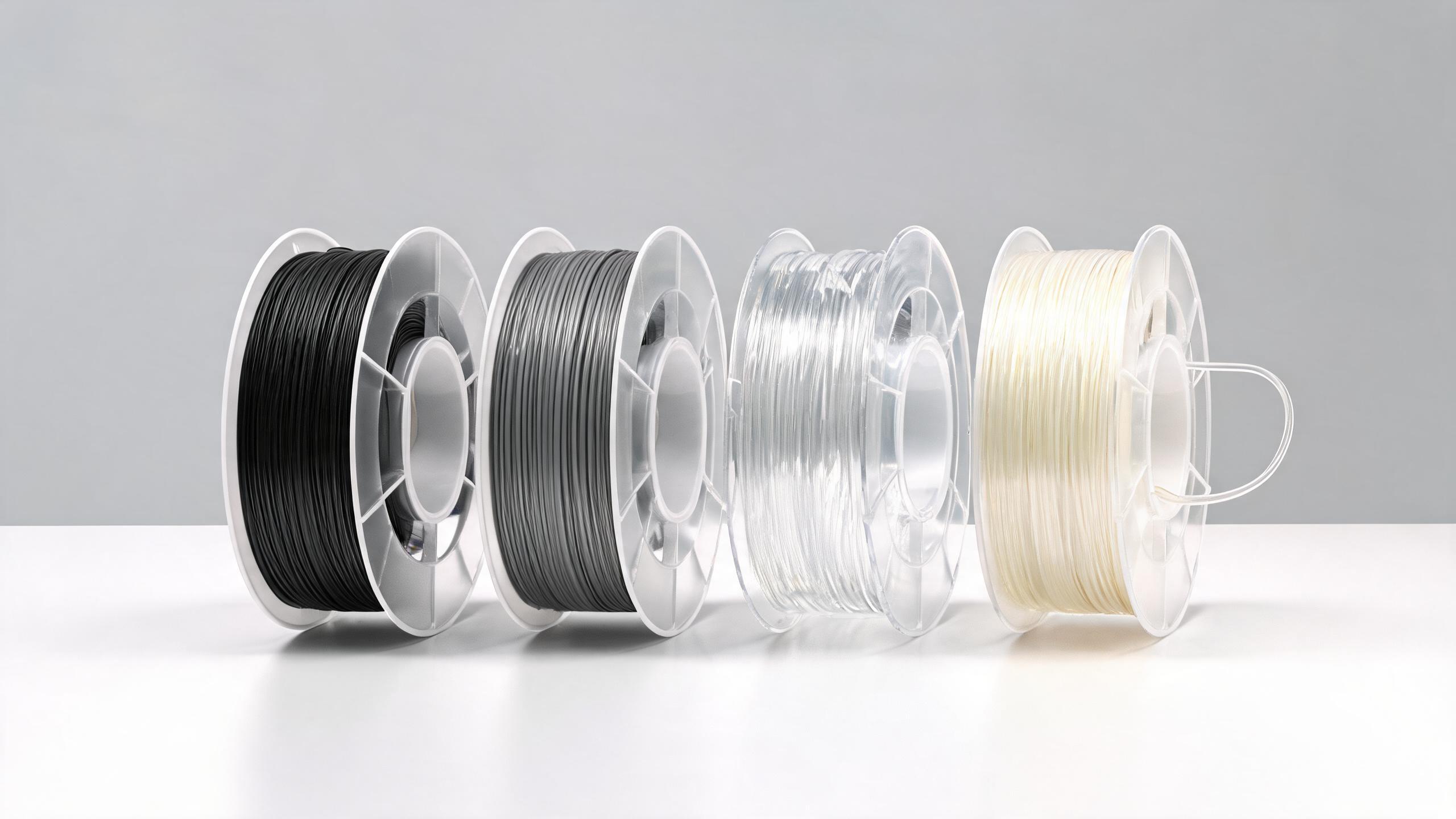
For buyers sourcing 1.75mm 3D printer filament for resale, manufacturing, or prototyping, the material decision directly impacts part strength, surface finish, print consistency, and end-user satisfaction. PLA, ABS, PETG, and TPU each serve different applications, and understanding their mechanical properties, dimensional tolerance, and printing requirements is essential for making informed procurement decisions.
This guide compares the four most common 1.75mm filament types across key specifications: tensile strength, elongation at break, glass transition temperature, printing temperature, bed adhesion requirements, and dimensional tolerance. We also cover common procurement pitfalls and quality indicators to look for when evaluating suppliers.
- PLA is the easiest to print and most cost-effective, but has low heat resistance and brittleness — ideal for prototyping and decorative parts.
- ABS offers higher strength and temperature resistance but requires a heated bed and enclosure; warping is a common issue.
- PETG balances strength, chemical resistance, and ease of printing — a good mid-range option for functional parts.
- TPU is flexible and impact-resistant, but printing speed is slower and requires direct-drive extruders for best results.
- Dimensional tolerance of ±0.05mm is standard for premium filaments; ±0.10mm is acceptable for general use but may cause feed issues in tight Bowden setups.
PLA Filament 1.75mm: The Baseline for Easy Printing
PLA (Polylactic Acid) is the most widely used 1.75mm 3D printing filament. It is derived from renewable resources like corn starch or sugarcane, making it biodegradable under industrial composting conditions. For procurement, PLA is the lowest-cost option and offers the widest compatibility with consumer and industrial FDM printers.
Key Specifications
| Property | Typical Value | Notes for Buyers |
|---|---|---|
| Tensile Strength | 50–60 MPa | Sufficient for non-load-bearing parts |
| Elongation at Break | 3–5% | Brittle; prone to cracking under impact |
| Glass Transition Temp (Tg) | 55–65°C | Parts deform in hot cars or near heat sources |
| Printing Temperature | 190–220°C | Low-temperature printing reduces energy cost |
| Bed Temperature | 20–60°C (optional) | Works on unheated beds with blue tape or glue stick |
| Dimensional Tolerance | ±0.05mm (premium), ±0.10mm (standard) | Premium grade ensures consistent extrusion |
| Odor | Mild, sweet | No harmful fumes; safe for office environments |
When to Choose PLA
- Prototyping: Low cost and fast iteration make it ideal for concept models and form-fit testing.
- Education and hobbyist markets: Easy to print with minimal setup; safe for classrooms.
- Decorative parts: Smooth surface finish with good layer adhesion; accepts sanding and painting.
- Low-temperature environment: Parts that will not be exposed to heat above 50°C.
Procurement Considerations
When sourcing 1.75mm PLA filament, check for consistent diameter and roundness. A tolerance of ±0.05mm is preferred for Bowden tube systems, as wider variation can cause jams. Also verify the material is free of contaminants — some low-cost filaments contain recycled content that reduces print quality. Ask suppliers for a material data sheet (MDS) and a sample spool before bulk orders.
1.75mm ABS 3D Printing Filament: Strength and Heat Resistance
ABS (Acrylonitrile Butadiene Styrene) is a petroleum-based thermoplastic known for its toughness, impact resistance, and higher heat tolerance. It is the standard material for automotive components, power tools, and consumer electronics enclosures. However, it requires more controlled printing conditions than PLA.
Key Specifications
| Property | Typical Value | Notes for Buyers |
|---|---|---|
| Tensile Strength | 40–50 MPa | Slightly lower than PLA but more ductile |
| Elongation at Break | 10–50% | Much tougher; absorbs impact without shattering |
| Glass Transition Temp (Tg) | 100–110°C | Parts can withstand hot environments |
| Printing Temperature | 220–260°C | Requires an all-metal hotend for consistent flow |
| Bed Temperature | 80–110°C | Heated bed mandatory; enclosure recommended |
| Dimensional Tolerance | ±0.05mm (premium), ±0.10mm (standard) | Premium grade reduces warping risk |
| Odor | Strong, chemical | Ventilation required; fumes may be harmful |
When to Choose ABS
- Functional prototypes: Parts that need to withstand mechanical stress or moderate heat.
- Automotive and industrial parts: Dashboards, brackets, housings, and ducting.
- Post-processing: ABS can be sanded, drilled, and vapor-smoothed with acetone for a glossy finish.
- End-use parts: High durability required for repeated use.
Procurement Considerations
ABS is more sensitive to moisture absorption than PLA. Filament that has absorbed humidity will produce bubbles, stringing, and weak layer adhesion. Request vacuum-sealed packaging with desiccant. Also confirm the supplier's manufacturing process — some ABS blends contain additives to reduce warping, which can affect print consistency. A tolerance of ±0.05mm is strongly recommended for ABS due to its higher shrinkage rate.
1.75mm PETG 3D Printing Filament: The Balanced Performer
PETG (Polyethylene Terephthalate Glycol-modified) combines the ease of printing found in PLA with the strength and chemical resistance of ABS. It is becoming the preferred material for functional parts, mechanical components, and food-contact applications (when certified). PETG is less brittle than PLA and less prone to warping than ABS.
Key Specifications
| Property | Typical Value | Notes for Buyers |
|---|---|---|
| Tensile Strength | 50–60 MPa | Comparable to PLA, but with higher ductility |
| Elongation at Break | 5–15% | More flexible than PLA, less than ABS |
| Glass Transition Temp (Tg) | 80–85°C | Good heat resistance for indoor use |
| Printing Temperature | 230–260°C | Similar to ABS; requires stable hotend |
| Bed Temperature | 60–80°C | Heated bed recommended; no enclosure needed |
| Dimensional Tolerance | ±0.05mm (premium), ±0.10mm (standard) | Premium grade critical for mechanical fit |
| Odor | Mild, slightly sweet | Low fume emission; safe for office use |
When to Choose PETG
- Mechanical parts: Gears, brackets, and enclosures that require strength and moderate flexibility.
- Chemical-resistant applications: PETG resists many acids, bases, and alcohols.
- Outdoor use: UV resistance is better than ABS (though not as good as ASA).
- Food contact: When certified, PETG is safe for food storage containers and kitchen tools.
Procurement Considerations
PETG is hygroscopic and must be dried before printing. Suppliers should provide moisture-proof packaging. Also check for stringing issues — some PETG blends have higher oozing tendency. A tolerance of ±0.05mm is important for precision parts. Ask for a sample to test layer adhesion and surface finish before committing to large volumes.
1.75mm TPU Flexible Filament: Elasticity and Impact Absorption
TPU (Thermoplastic Polyurethane) is a flexible filament that can stretch and compress. It is used for applications requiring shock absorption, grip, or flexibility, such as phone cases, gaskets, seals, and footwear components. TPU is more challenging to print than rigid filaments due to its elasticity.
Key Specifications
| Property | Typical Value | Notes for Buyers |
|---|---|---|
| Tensile Strength | 20–40 MPa | Lower than rigid filaments, but high elongation |
| Elongation at Break | 300–800% | Extremely stretchable; returns to shape |
| Glass Transition Temp (Tg) | -30 to -50°C | Remains flexible at low temperatures |
| Printing Temperature | 210–250°C | Requires direct-drive extruder for best results |
| Bed Temperature | 30–60°C | Heated bed optional; use glue stick for adhesion |
| Dimensional Tolerance | ±0.05mm (premium), ±0.10mm (standard) | Premium grade reduces feed issues |
| Odor | Mild, plastic-like | Low fume emission; no special ventilation needed |
When to Choose TPU
- Gaskets and seals: Compressible and conforms to irregular surfaces.
- Protective covers: Phone cases, drone bumpers, and edge guards.
- Medical devices: Orthotics, splints, and prosthetic components (when certified).
- Automotive: Vibration dampeners, bushings, and flexible ducts.
Procurement Considerations
TPU is the most sensitive to moisture — it can absorb up to 1.5% of its weight in water. Always request vacuum-sealed packaging with desiccant. Also, TPU requires a direct-drive extruder for reliable feeding; Bowden setups may cause jams due to the material's flexibility. Confirm the Shore hardness (e.g., 85A, 95A) — softer grades are more flexible but harder to print. A tolerance of ±0.05mm is recommended for consistent extrusion.
Side-by-Side Comparison: PLA vs ABS vs PETG vs TPU
| Property | PLA | ABS | PETG | TPU |
|---|---|---|---|---|
| Tensile Strength (MPa) | 50–60 | 40–50 | 50–60 | 20–40 |
| Elongation at Break (%) | 3–5 | 10–50 | 5–15 | 300–800 |
| Glass Transition Temp (°C) | 55–65 | 100–110 | 80–85 | -30 to -50 |
| Printing Temp (°C) | 190–220 | 220–260 | 230–260 | 210–250 |
| Bed Temp (°C) | 20–60 | 80–110 | 60–80 | 30–60 |
| Enclosure Required | No | Yes | No | No |
| Dimensional Tolerance (premium) | ±0.05mm | ±0.05mm | ±0.05mm | ±0.05mm |
| Moisture Sensitivity | Low | Medium | High | Very High |
| Relative Cost | $ | $$ | $$ | $$$ |
| Common Applications | Prototypes, decorative | Functional, automotive | Mechanical, food contact | Flexible, impact-absorbing |
How to Evaluate Filament Quality as a Buyer
When sourcing 1.75mm 3D printer filament, the following factors determine whether a supplier can deliver consistent quality:
1. Dimensional Tolerance
The diameter of the filament must be consistent along the entire spool. A tolerance of ±0.05mm is the industry standard for premium filament. Wider tolerances (±0.10mm or more) can cause under-extrusion, jams, and inconsistent layer adhesion. Request a diameter consistency report from the supplier.
2. Roundness and Ovality
Filament that is not perfectly round will feed unevenly through the extruder gear. Ask for ovality measurements — the difference between the maximum and minimum diameter should be less than 0.02mm.
3. Moisture Content
All thermoplastics absorb moisture from the air. Filament that is not properly dried and sealed will produce bubbles, stringing, and weak parts. Verify that the supplier uses vacuum-sealed packaging with desiccant and a moisture barrier bag.
4. Material Purity
Some low-cost filaments contain recycled material or filler additives that reduce print quality. Request a material data sheet (MDS) that lists the exact polymer composition. Premium filaments are made from virgin resin.
5. Spooling Quality
Poorly wound filament can tangle and cause feed failures. Check that the filament is wound evenly and tightly on the spool. Some suppliers offer spool-free or cardboard spool options for reduced waste.
Common Procurement Mistakes
- Choosing the cheapest option without testing: Low-cost filament often has wide tolerance and inconsistent quality, leading to print failures and customer complaints.
- Ignoring moisture sensitivity: Especially for PETG and TPU, moisture absorption is a major quality issue. Always request vacuum-sealed packaging.
- Assuming all filaments print the same: Each material has different printing temperature, bed adhesion, and cooling requirements. Provide clear specifications to your customers.
- Not verifying certification claims: If a supplier claims food-safe or medical-grade certification, request the actual certificate. Many claims are unsubstantiated.
FAQ
What is the best filament for beginners?
PLA is the easiest to print and most forgiving. It requires no heated bed, produces minimal odor, and has a wide printing temperature window. For resale, PLA is the highest volume segment.
Which filament is strongest?
For tensile strength, PLA and PETG are similar (50–60 MPa). For impact resistance, ABS and TPU are better. For heat resistance, ABS (Tg 100–110°C) outperforms the others.
Can I print TPU with a Bowden extruder?
It is possible but challenging. Soft TPU (Shore 85A or lower) tends to buckle in Bowden tubes. A direct-drive extruder is strongly recommended for reliable printing.
What is the standard tolerance for 1.75mm filament?
Premium filament is ±0.05mm. Standard filament is ±0.10mm. For Bowden systems, ±0.05mm is preferred to avoid jams.
How should I store filament?
Store in a dry, cool environment (below 25°C, below 20% humidity). Use airtight containers with desiccant. For TPU and PETG, vacuum-sealed bags are recommended.
Next Steps for Buyers
Selecting the right 1.75mm 3D printer filament depends on your application, budget, and printing environment. PLA is the safe choice for volume and ease, ABS for heat and impact, PETG for balanced performance, and TPU for flexibility.
When evaluating suppliers, prioritize those who provide dimensional tolerance data, moisture-proof packaging, and material purity certificates. Request samples before placing bulk orders to verify print quality and consistency.
For more information on our filament range or to request a quotation, please contact our sales team.