
A buyer's guide to the spool winding process—how tension control, cross-winding, tail fixation, and traceability affect tangle risk, print reliability, and receiving inspection. Includes a practical checklist you can run without lab equipment.
When you receive a pallet of 3D printing filament, the first thing you notice is the spool. But what matters is not the plastic hub or the label—it is how the filament was wound onto that spool. A poorly wound spool can jam, tangle, or break mid-print, costing you material, machine time, and customer trust. This article explains the winding process from a buyer's perspective and gives you a receiving-inspection checklist you can run without a lab.
- Winding quality directly affects tangle risk, print consistency, and waste.
- Look for consistent layer alignment, controlled cross-over points, secure tail fixation, and minimal spool wobble.
- You can assess most winding defects with a simple unwind test at receiving.
What Filament Winding Actually Involves
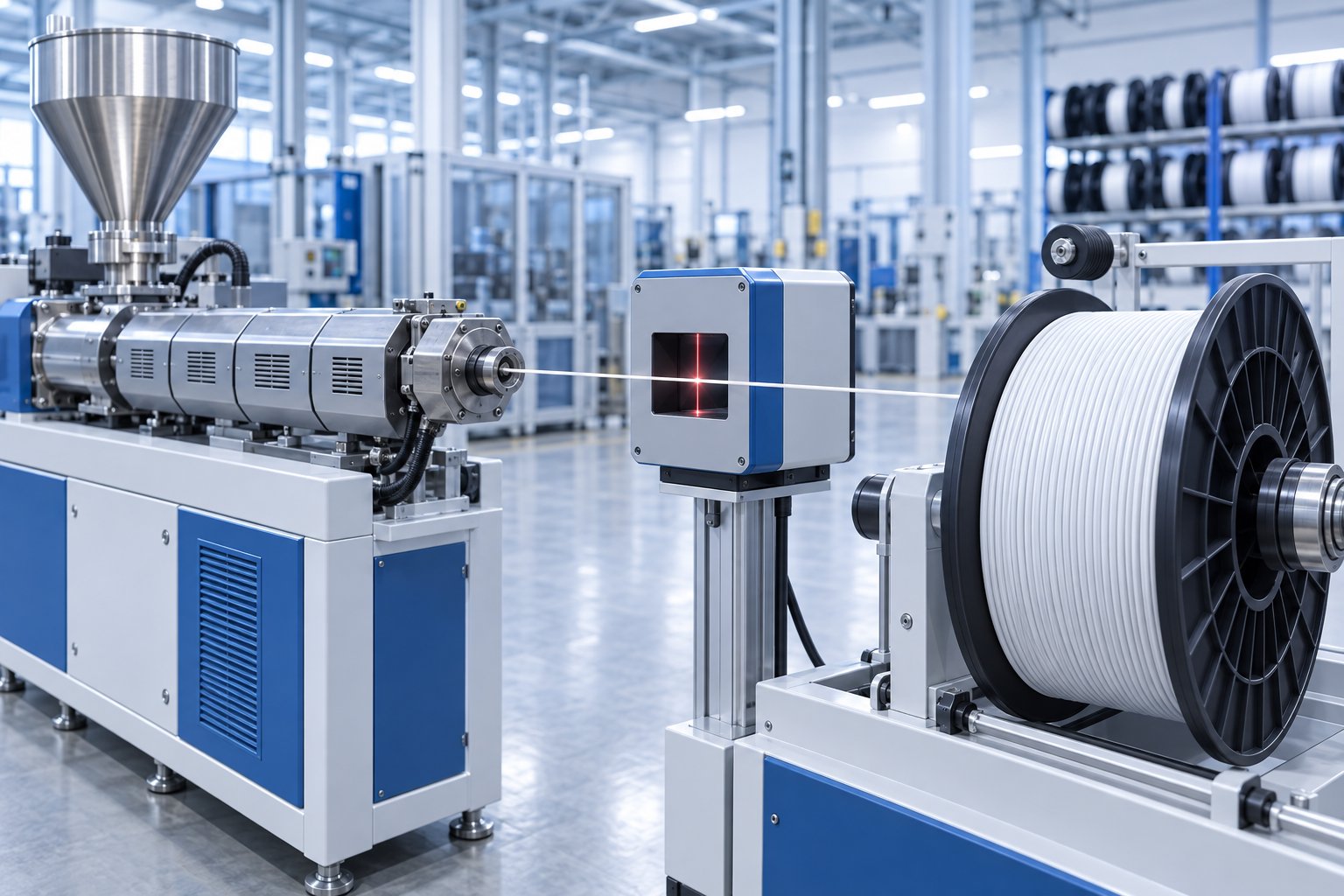
Winding is the step after extrusion and cooling. The filament is pulled from the extrusion line and guided onto a spool, layer by layer. Two things must be controlled at the same time: tension and traverse speed. If tension is too low, the filament can loosen and cross over itself; too high, and the filament may stretch or deform. Traverse speed determines how the filament lays side-to-side. The goal is a spool where every strand sits next to its neighbor without gaps or overlaps that later cause tangles.
The winding pattern is not random. Most filament is cross-wound, meaning the filament moves back and forth across the spool at an angle. Cross-winding distributes pressure evenly and makes the spool more stable during unwinding. Parallel layering—where strands run parallel to each other—is less common for 3D printing filament because it can trap the filament and cause tangles when the spool is nearly empty. However, some materials and spool designs may use a hybrid pattern.
Why Poor Winding Leads to Tangles and Print Failures
A tangle is not just an inconvenience; it can ruin a long print. When the filament crosses over itself, it creates a loop that tightens as the spool unwinds. The extruder pulls harder, the filament snaps, or the print pauses. In many cases, the root cause is poor winding tension or a bad tail fixation.
Another common issue is spool wobble. If the filament is wound unevenly—thicker on one side—the spool will not rotate smoothly. This causes inconsistent feed, visible layer lines, and even under-extrusion. For B2B buyers, these defects become visible only after the spool is used. That is why receiving inspection matters.
How Factories Control Winding Quality
Reliable filament manufacturers use inline tension control and automated winding machines. The machine monitors tension and adjusts the traverse speed to keep the filament pattern consistent. Some lines also use a filament guide that moves with the spool to prevent edge build-up.
After winding, the tail of the filament must be secured. A well-fixed tail holds the wound layers in place during shipping and storage. If the tail is loose, the outer layers can shift and create tangles. Some factories use a small clip or a tape tab; others rely on a slit in the spool. The method matters less than the result: the tail should not come loose during normal handling.
Batch traceability is another sign of a controlled process. Spools from the same production batch should have similar winding characteristics. If you see wide variation between spools in the same carton, the winding process may be inconsistent.
Receiving Inspection: A Practical Checklist for Buyers
You do not need a tensile tester to judge spool quality. The following checks can be done on a loading dock or in a warehouse, using only visual inspection and a short unwind test.
Layer Alignment
Look at the side of the spool. The layers should be even and tightly packed. Gaps between strands are a sign of low tension or inconsistent traverse. A few gaps are normal, especially near the edges, but large gaps or visible loose loops suggest a problem.
Cross-Over Points
Cross-overs are where the filament changes direction. They should be occasional and well-seated. If you see many cross-overs stacked in one area, the filament may tangle when unwound. Run your finger lightly along the surface—if you feel raised bumps or ridges, the winding may be too loose.
Tail Fixation
Check how the end of the filament is secured. It should not slip out when you lift the spool by the tail. A loose tail is a warning sign: the outer layers may shift during transit.
Spool Wobble
Place the spool on a flat surface and give it a gentle spin. It should rotate without a noticeable wobble. If the spool rocks or the filament mass is visibly off-center, the winding is uneven. This can cause print quality issues later.
Sample Unwind Test
Pull off about two meters of filament by hand. It should come off smoothly with light, consistent resistance. If it catches, snaps, or requires force, there is likely a tangle or a tight cross-over. Repeat this on two or three spools from the same batch. Consistency across spools is as important as the performance of a single spool.
| Check | What to Look For | Potential Risk if Failed |
|---|---|---|
| Layer alignment | Even, tight layers with minimal gaps | Tangling, inconsistent feed |
| Cross-over points | Occasional, well-seated | Snapping, print pauses |
| Tail fixation | Secure, does not slip | Loosened layers, tangles |
| Spool wobble | Rotates smoothly, no rocking | Poor layer adhesion, under-extrusion |
| Sample unwind | Comes off with light, consistent resistance | Jams, breaks, wasted material |
Why This Matters for Bulk Buyers
If you buy filament in bulk, winding defects multiply. A single bad spool might be an inconvenience; a pallet of them can halt production. Consistent winding is a sign of a disciplined factory. It also affects cost: poorly wound spools often lead to more waste, more downtime, and more returns.
When evaluating suppliers, ask about their winding process. Do they use automatic tension control? How do they fix the tail? Can they provide batch traceability? These questions help you separate reliable manufacturers from those who cut corners.
Related Considerations
Winding quality is one part of a larger picture. Spool dimensions and hub design also affect how the filament feeds in different printers. For a closer look at how spool sizes influence cost per kilogram, see Filament Spool Sizes and What Drives Cost per Kg.
Diameter tolerance is another factor that interacts with winding. A spool with tight winding but out-of-spec diameter can still cause extrusion issues. Our guide on why filament diameter tolerance matters for B2B buyers explains what to check.
Finally, even perfect winding can be undone by moisture. If you store filament in a humid environment, the material can absorb water and become brittle, leading to breaks that mimic winding defects. For storage and moisture control strategies, read 3D Printing Filament Storage and Moisture Control: A B2B Buyer's Guide.
FAQ
Can I check winding quality without opening the spool?
You can check the tail fixation and spool wobble without unwinding. For layer alignment and cross-overs, you need to look at the side of the spool, which is visible through most packaging. A full unwind test requires opening the spool, but it is worth doing on a sample.
Is cross-winding always better than parallel winding?
For most 3D printing filaments, cross-winding is preferred because it reduces tangle risk during unwinding. However, some materials and spool designs may use parallel or hybrid patterns. The key is that the winding is consistent and tension is controlled.
How do I know if my supplier has good winding control?
Ask about their winding equipment, tension control, and tail fixation method. Request batch traceability data. If possible, order a sample and run the receiving checklist above. Consistency across spools from the same batch is a strong indicator.
Winding is a small detail that has a big impact on your production. By including a few simple checks in your receiving process, you can avoid tangles, snapping, and wasted material—and hold your suppliers to a higher standard. If you need filament that is wound for consistency, contact us to discuss your requirements.