
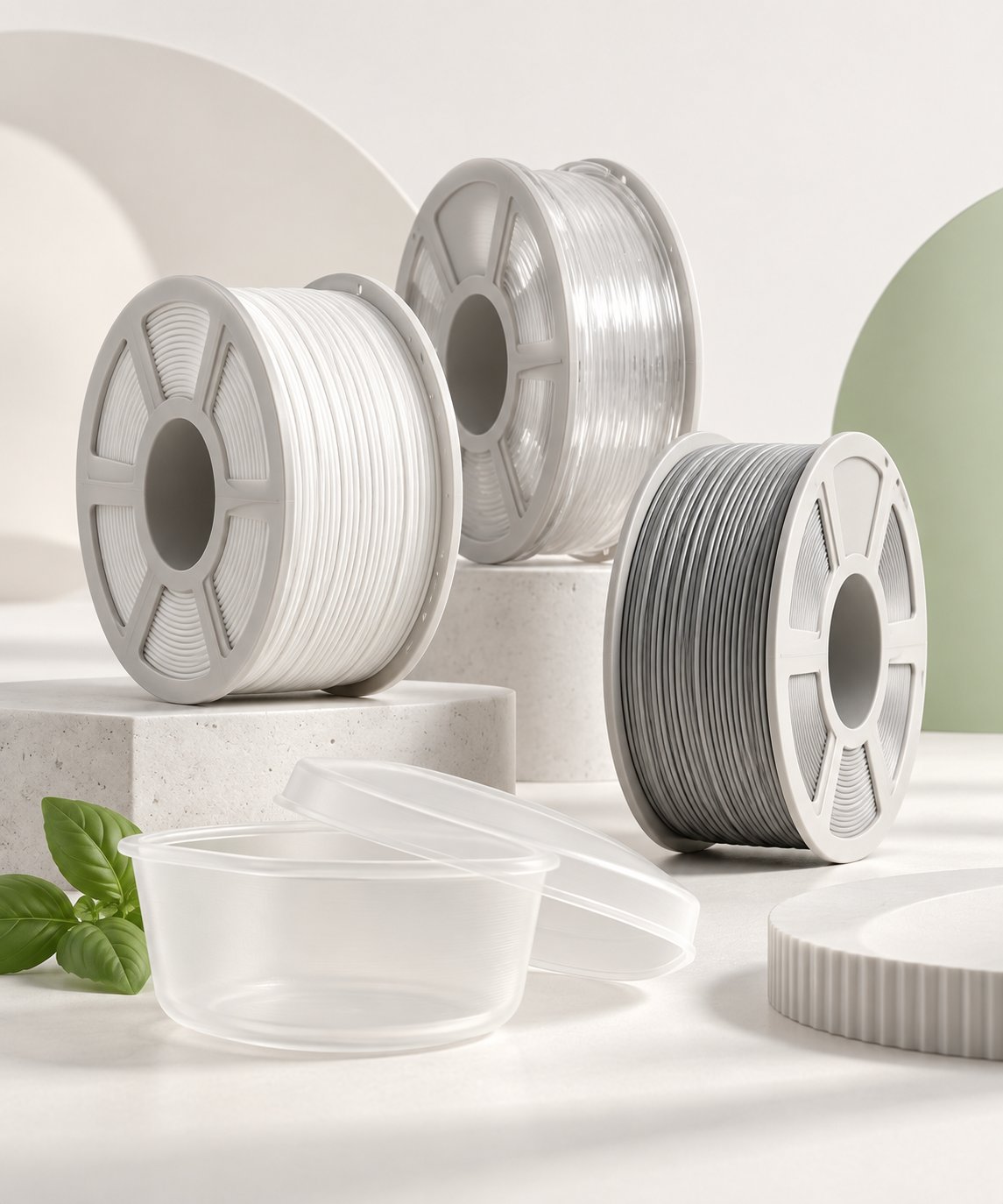
Food-safe 3D printing filament is a material declaration, not a finished-part guarantee. This buyer guide explains what food grade means for PLA, PETG, ABS, and TPU, why colorants and additives are the usual risk point, and how to verify a supplier's documentation before you order.
Buyer Guide
A supplier can call a filament "food grade" and still leave you exposed. What matters for a food-contact part is the material declaration behind the spool, the colorant in it, and the conditions the printed part will actually see.
What this guide covers
Food grade means two different things
Buyers searching for food-safe 3D printer filament usually want one answer: can I print a part that touches food? The honest answer splits the question in two.
The first question is about the raw material. Does the filament compound — polymer, colorant, and any additives — meet the food-contact rules of the market where the finished part will be sold? That is a material-level question, and it can be documented.
The second question is about the printed part. A material that meets a food-contact standard does not automatically make every printed object food-safe. Layer lines create surfaces that trap residue and are hard to clean. Print conditions, nozzle choice, and post-processing all affect the result. A raw-material declaration covers the input; it does not certify your finished part.
Keeping those two apart is the difference between a clean compliance file and a claim you cannot defend.
Material-by-material suitability
Suitability depends on chemistry first, then on what the compounder put into the resin. The table below is a starting point for screening, not a compliance decision.
| Material | Typical food-contact position | What to watch |
|---|---|---|
| PLA | Often used for dry or short-contact applications; not suited to hot or acidic foods | Low heat resistance; colorants vary widely between suppliers |
| PETG | Common choice for functional food-contact parts where a documented grade is available | Confirm the specific grade and color carry the declaration, not just the base resin |
| ABS | Generally a weaker fit for direct food contact | Additives and pigments; surface finish and cleaning |
| TPU | Depends heavily on formulation | Plasticizers and additives vary; request the compound's declaration |
None of these materials is food-safe by name alone. A PLA from one compounder and a PLA from another can sit on opposite sides of a compliance question because of what was mixed into the pellet.
Why colorants and additives are the usual risk point
Base polymers are well characterized. Colorants are not. A pigment that is fine in an outdoor part may be unacceptable in a food-contact one, and the same base resin can be sold in dozens of colors with different regulatory status.
This is where most buyer problems start. A supplier quotes "food-grade PETG," but the declaration on file covers the natural or clear grade only. The black or red version the buyer actually wants uses a different masterbatch, and no one checked whether that colorant is cleared for food contact.
Two practical consequences:
- Ask per grade and per color. A declaration for one color does not transfer to another.
- Treat additives the same way. Processing aids, impact modifiers, and plasticizers all sit inside the compound and all fall under the same scrutiny as the pigment.
For buyers sourcing color masterbatch separately, the same logic applies on the pellet side; our masterbatch compliance guide covers that path in detail.
Raw-material declaration vs. finished-part claim
A raw-material declaration is a document from the material supplier stating that the compound meets a named regulation or standard. It usually names the regulation, the grade, and the color. It is a statement about the input.
A finished-part claim is a statement that the object you print is safe for a specific food-contact use. That claim depends on the material, the print process, the part geometry, and how the part is cleaned and used. It is a much larger statement, and it is yours to make — not your filament supplier's.
When a supplier blurs the two, buyers inherit the risk. The clean approach is to collect the material declaration, then evaluate the printed part against the rules of the destination market and the actual use conditions.
A verification checklist for buyers
Use this before you place a production order, not after.
- Ask for the material declaration. Request the document for the exact grade you are buying, not a general product brochure.
- Confirm the scope covers your grade and color. Check that the declaration names the specific colorant or masterbatch used in the spool you will receive.
- Check the rules of your target market. A declaration written against one region's regulation may not satisfy another. Match the document to where the part will be sold.
- Confirm the printed part's use conditions. Temperature, fat content, acidity, contact time, and cleaning method all affect whether a material is appropriate. A declaration does not answer these.
- Keep batch documentation on file. If your supplier issues per-batch compliance documents, store them with the shipment records.
What Wanzhoutong can document
Wanzhoutong is a Shenzhen-based factory-direct supplier of 3D printing filament and color masterbatch, running 12 extrusion lines and serving B2B buyers in Southeast Asia and Europe. Our PETG Clear Filament 1.75 mm is formulated to meet EU 10/2011 and FDA 21 CFR 177.1630 material requirements for food contact. Buyers should still verify compliance for their specific end-use.
Specifications for that grade: 92% light transmission at 3 mm wall thickness; diameter 1.75 mm held within +/- 0.02 mm; shrinkage below 0.3%; Izod impact strength 7.5 kJ/m2; vacuum-sealed with desiccant; CE compliance documentation included per batch; MOQ 50 kg with mixed pallet options.
We also supply PLA, ABS, and TPU filament, plus universal white color masterbatch for PE and PP. If you are evaluating PETG for a functional part, our article on why PETG is the first choice for functional parts explains where the material earns its place.
FAQ
Is PLA filament food safe?
PLA is often used for dry or short-contact items, but it is not food-safe by name. Suitability depends on the colorant and additives in the specific compound, and PLA's low heat resistance limits it for hot foods. Ask for the declaration for your exact grade and color.
Does a food-contact material declaration cover my printed part?
No. The declaration covers the raw material. Your printed part has its own surface, geometry, and use conditions. You are responsible for evaluating the finished part against the rules of your market.
Why does the color matter so much?
Because the colorant is a separate ingredient with its own regulatory status. A declaration for a clear or natural grade does not automatically apply to a pigmented version of the same polymer.
Can I use any PETG for food-contact parts?
No. PETG is a family, not a single specification. Look for a grade whose supplier can name the regulation it meets and issue documentation for the exact color you are ordering.
Next step
If you are sourcing filament for a food-contact application, start with the documentation. Request the material declaration for the PETG Clear Filament grade and color you intend to use, confirm it matches your target market's rules, and then evaluate the printed part against its actual use conditions. Buyers who want to compare PETG against other options can review our functional-parts article before ordering.