
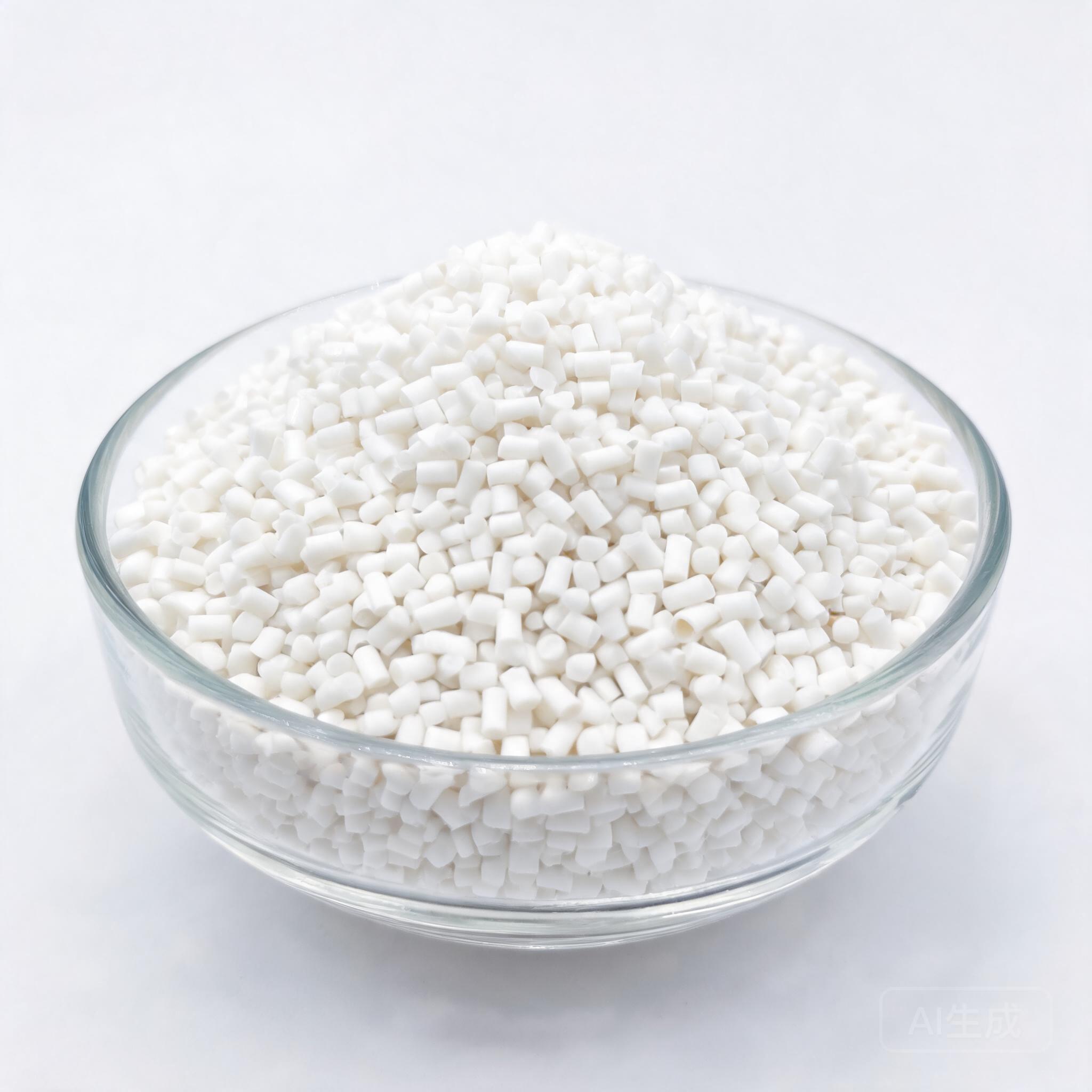
A practical buyer's guide to calcium carbonate vs talc filler masterbatch—loading trade-offs, carrier compatibility, dispersion, and how to compare true cost per part.
Filler masterbatch is a cost lever—but only if you size it correctly
If you're reading this, you're probably not asking whether filler masterbatch exists. You're asking whether it can cut your material cost without turning your finished parts into something your customers reject. That's the right question, and the answer depends less on the word "filler" and more on two specific minerals: calcium carbonate (CaCO3) and talc.
Filler masterbatch is a concentrated blend of mineral powder, a carrier resin, and dispersing agents, pre-mixed in pellet form. Instead of dosing raw powder into your hopper—which creates dust, poor dispersion, and inconsistent parts—you let the masterbatch manufacturer do the compounding, then simply let-down the pellets at your extruder or injection press. The result: lower raw material cost per kilo, because mineral is cheaper than polymer, and predictable processing, because the mineral is already wetted out and dispersed.
But not all fillers behave alike. Choosing between CaCO3 and talc affects stiffness, impact strength, surface finish, and even how your parts warp. This guide walks through the trade-offs so you can spec the right grade—and evaluate supplier quotes on something more meaningful than price per kilo.
Key takeaways
- CaCO3 is the workhorse for cost reduction in non-critical applications; talc adds stiffness and dimensional stability where parts need to hold shape.
- Higher filler loading usually means lower cost but also lower impact strength and a rougher surface—unless the masterbatch is well-dispersed.
- Carrier compatibility matters as much as mineral type; match the carrier to your base resin (PP, PE, etc.).
- Compare quotes on cost per finished part, not per kilo of masterbatch. Ask for let-down ratio, density, and how properties shift at your target loading.
- Verify dispersion with a simple film test or by checking for specks and gels on your own line.
What is filler masterbatch and what does it actually do?
Think of it as a pre-made blend that lets you replace some of your expensive polymer with cheap mineral—without turning your plant into a dusty mess. The masterbatch supplier compounds mineral powder with a carrier resin (often PP, PE, or a specialty wax) and additives that help the mineral wet out and stay suspended. You add this pellet concentrate to your virgin or recycled resin at a let-down ratio, typically between 5% and 30% by weight, depending on the application.
The main benefits are cost and, in some cases, performance. Calcium carbonate can improve stiffness and reduce shrinkage in PP parts. Talc can increase heat deflection temperature and reduce warpage in large flat parts. Both reduce the amount of polymer you need, which directly lowers your material bill.
But there's a catch: fillers change the mechanical behavior of the final part. Impact strength often drops as filler loading rises. Surface finish can become dull or chalky. And if the mineral isn't well dispersed, you'll see specks, gels, or weak spots in your parts. That's why choosing the right filler and the right masterbatch quality is a decision, not a reflex.
If you're new to filler masterbatch, start by understanding that it's not a one-size-fits-all product. The product range at a typical masterbatch manufacturer includes white, black, and color concentrates, but filler masterbatch is a separate category with its own specifications. You wouldn't use a color masterbatch to cut cost, and you wouldn't use a filler masterbatch to achieve a bright white color—though some fillers do help with opacity.
CaCO3 vs. talc: which fits your application?
The mineral choice is the first fork in the road. Here's how the two compare in practice.
| Property | Calcium Carbonate (CaCO3) | Talc |
|---|---|---|
| Primary benefit | Cost reduction, some stiffness improvement | Stiffness, dimensional stability, heat resistance |
| Effect on impact | Drops with loading; fine particles and good dispersion minimize the loss | Platelet structure can reduce impact more; often combined with impact modifiers |
| Surface finish | Can become dull or rough at high loadings | Smoother surface possible; used in automotive interiors |
| Warpage | Less impact on warpage | Reduces warpage in flat parts due to platelet orientation |
| Typical applications | Packaging, films, pipes, non-critical injection molded parts | Automotive parts, appliance housings, furniture, any part needing rigidity |
Calcium carbonate is the default choice for cost reduction in applications where you can tolerate some loss of impact strength and surface quality. It's cheap, widely available, and works well in PE and PP films, sheets, and molded parts that don't see heavy stress. If you're making shopping bags, crates, or pipe, CaCO3 filler masterbatch is often the fastest way to shave material cost.
Talc is the choice when you need stiffness and dimensional stability. Its platelet shape acts like a miniature reinforcement, increasing flexural modulus and reducing shrinkage and warpage. That's why talc-filled PP is common in automotive dashboards, fan housings, and washing machine drums. The trade-off is that talc can be harder on impact strength, so you might need to add an impact modifier—which can eat into your cost savings.
Your application dictates the filler. If you're making a thin-walled part that needs to hold its shape at high temperature, talc is likely the better bet. If you're making a film where cost is king and you can tolerate some haze, CaCO3 wins.
How filler loading affects impact, stiffness, and surface
Loading level is the second lever, and it's where many buyers get burned. More filler means lower cost per kilo, but it also means more mineral in your part, which changes its properties in predictable ways.
Impact strength almost always decreases as loading increases. The mineral particles act as stress concentrators—cracks start at the particles and propagate. Fine particle size and good dispersion help, but there's a limit. If you need a part that survives a drop test, you'll need to keep loading moderate or use an impact modifier.
Stiffness generally increases with loading, up to a point. Both CaCO3 and talc make the part more rigid, which can be a benefit if you're replacing a thicker wall with a thinner one. But the effect is more pronounced with talc due to its platelet geometry.
Surface finish tends to degrade with loading. You'll see a duller, rougher surface, and at high loadings you might get visible agglomerates or "fish eyes." If your part has a cosmetic surface, you'll need a finer particle grade or a lower loading—or you'll need to paint or texture it.
There's no universal number for the "right" loading. It depends on your part geometry, your processing conditions, and your performance requirements. A good masterbatch supplier will ask about your application and recommend a starting let-down ratio. Be wary of anyone who quotes a single number without asking what you're making.
Carrier compatibility: the hidden factor
The mineral is only half the story. The carrier resin in the masterbatch must be compatible with your base resin. If you're running PP, you need a PP carrier—or at least a carrier that's compatible with PP. If you're running PE, you need a PE carrier. Mixing incompatible polymers can cause phase separation, delamination, or poor mechanical properties.
This is where a factory-direct manufacturer with a range of carriers has an advantage. A supplier like Wanzhoutong, which has been compounding masterbatch since 2012 with 12 extrusion lines, can tailor the carrier to your resin and process. They also offer custom color matching and OEM/ODM services, which means you can get a filler masterbatch that's matched to your specific recipe, not just a generic product.
When you talk to a supplier, always specify your base resin, your process (injection, blow molding, film extrusion, etc.), and your target loading. A competent supplier will use that information to choose the carrier and the dispersing agents. If they don't ask, that's a red flag.
Dispersion: the difference between "good" and "cheap"
You can't see dispersion in the pellet. You can only see it in your parts. Poor dispersion shows up as specks, streaks, or weak spots—and it can ruin a production run.
Here's how to check dispersion before you commit to a large order:
- Film test: Extrude a thin film (20-50 microns) with your masterbatch at the target let-down ratio. Hold it up to light. Look for agglomerates, gels, or pinholes. A well-dispersed film should be uniform.
- Part test: Mold a test part and inspect the surface for specks or roughness. Also test mechanical properties—impact, tensile, flexural—against your specs.
- Processing test: Run a small batch on your own line and check for pressure fluctuations, screw torque, or die buildup. These can indicate poor dispersion or lubrication issues.
Ask the supplier for a sample and run these tests yourself. A reputable manufacturer will send samples and wait for your feedback. If they push for a large order before you've tested, be cautious.
How to compare supplier quotes on true cost per part
The price per kilo of masterbatch is the least useful number you can compare. Here's why: two suppliers might quote $1.50/kg and $1.80/kg, but the more expensive one might allow a higher let-down ratio without hurting your parts, making it cheaper per finished part.
To compare quotes fairly, you need to know:
- Let-down ratio: How much masterbatch do you add per 100 kg of resin? A higher ratio means more cost savings—but only if the parts still pass.
- Density of the final compound: If you're selling parts by weight, a higher density can mean more material per part. But if you're selling by piece, density affects how many parts you get per kilo.
- Property retention: At the recommended let-down ratio, what happens to impact strength, stiffness, and surface finish? Ask for data or a sample to test.
- Consistency: Does the masterbatch have consistent quality from batch to batch? Ask about their QC process and whether they test each batch.
Here's a simple way to think about it: calculate the cost per part at the let-down ratio you actually plan to use. If Supplier A costs $1.50/kg but you can only use 5% loading before parts fail, while Supplier B costs $1.80/kg but you can use 10% loading, Supplier B might be cheaper per part—because you're replacing more resin with cheap mineral.
Don't be afraid to ask for a cost-per-part breakdown. A professional supplier will be happy to help you calculate it. If they can't or won't, that's a sign they don't understand their own product.
What to verify before ordering
Before you place a bulk order, run through this checklist:
- Sample testing: Always test a sample on your own line at your target let-down ratio. Don't skip this step.
- Carrier match: Confirm the carrier is compatible with your resin. Ask for the carrier type if it's not on the datasheet.
- MOQ and lead time: Some suppliers have high minimum order quantities. Wanzhoutong, for example, offers MOQ starting from 50 kg, which is low for the industry and lets you test without committing to a container.
- Packaging: For export, standard 25 kg bags are common. Confirm the packaging is suitable for your handling and storage.
- Certification and documentation: Ask for material safety data sheets (MSDS) and any relevant food-contact or REACH compliance documents if you need them. Don't assume—ask.
- Customization: If you need a specific let-down ratio or a blend of fillers, ask if the supplier can do custom compounding. Many can, especially if they offer OEM/ODM services like Wanzhoutong does.
Frequently asked questions
What is the difference between filler masterbatch and white masterbatch?
White masterbatch uses titanium dioxide (TiO2) to achieve opacity and whiteness. Filler masterbatch uses minerals like CaCO3 or talc primarily to reduce cost and modify mechanical properties. Some filler masterbatches also contain TiO2 for opacity, but they're not interchangeable.
Can I use filler masterbatch in food packaging?
Only if the specific masterbatch is certified for food contact. Calcium carbonate is generally considered safe, but the carrier and additives must also comply with food-contact regulations. Ask the supplier for documentation, and verify it covers your application and region.
Will filler masterbatch affect the color of my part?
Fillers can make parts look duller or more opaque. If you need a bright color, you may need to adjust your color masterbatch loading or use a different filler grade. Some fillers have a blue tint (CaCO3) or a grey tint (talc) that can affect the final shade.
What is the maximum loading I can use?
It depends on your application and the quality of the masterbatch. Some applications run at 30% or higher, but you need to test. Start with a conservative loading and increase until you see property losses you can't tolerate. Ask your supplier for guidance based on your specific part.
Making the final call
Filler masterbatch is a proven way to reduce material cost, but it's not a commodity you can buy on price alone. The right choice depends on your application, your process, and your quality requirements.
Start by defining your part's performance envelope: what impact, stiffness, and surface finish do you really need? Then choose the filler type—CaCO3 for general cost reduction, talc for stiffness and dimensional stability. Match the carrier to your resin, test samples on your own line, and compare quotes on cost per part, not per kilo.
If you're working with a manufacturer that understands compounding—like Wanzhoutong, which has been making masterbatch since 2012 and offers custom formulations with low MOQs—you can get a product that's tailored to your exact needs. That's worth more than a penny saved on the wrong masterbatch.
Ready to test a filler masterbatch for your application? Ask for samples and the technical data you need. A good supplier will be happy to provide both.